
What is the QTc Calculator?
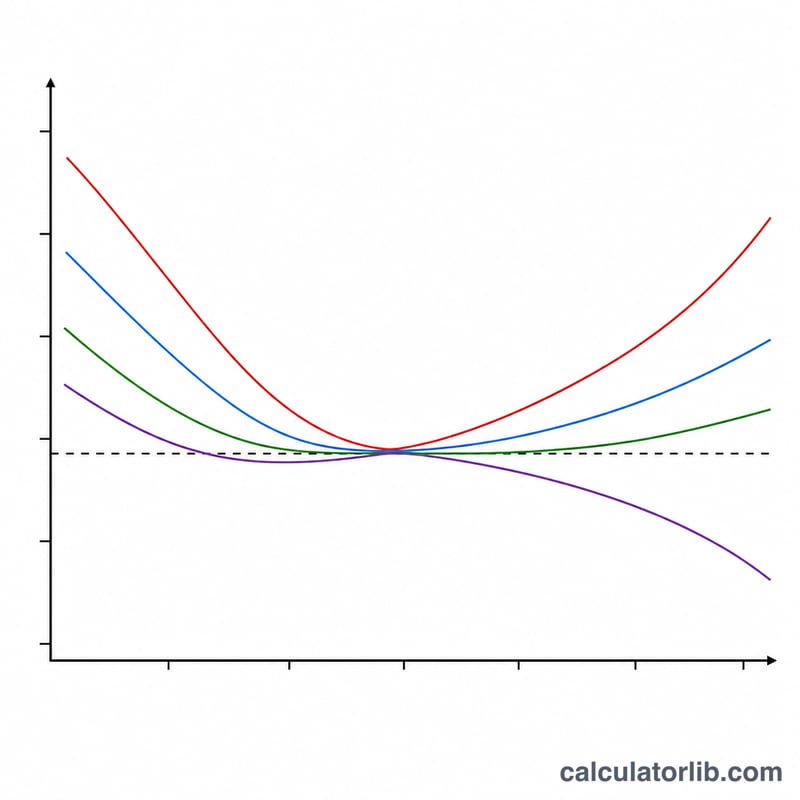
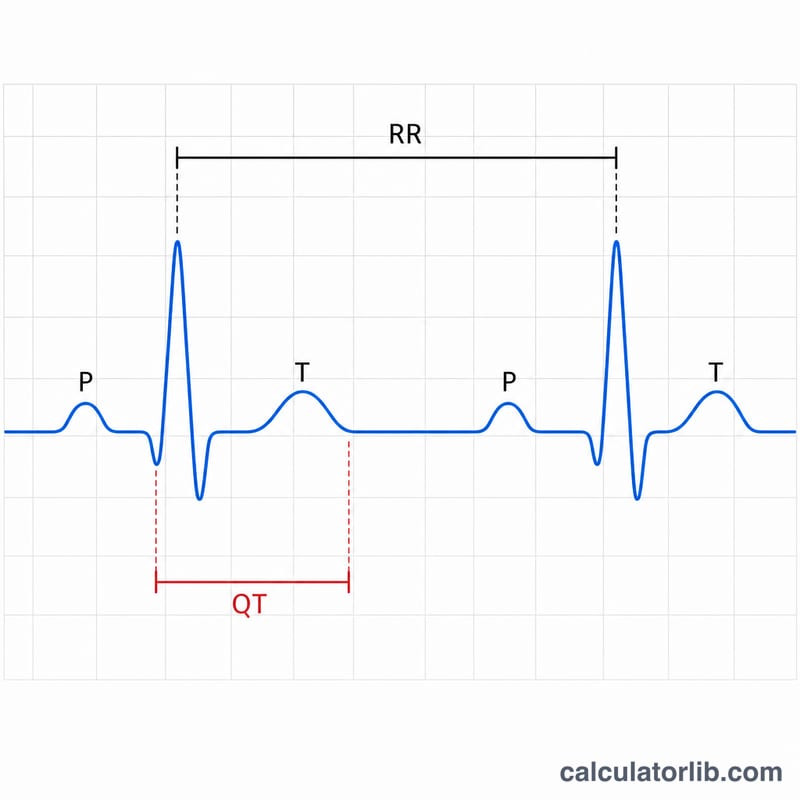
The QTc calculator estimates the heart-rate-corrected QT interval from a measured QT interval and heart rate on an ECG. Because the QT interval naturally shortens as heart rate increases, raw QT values cannot be compared between patients with different rates. Correction formulas normalize QT to a standard heart rate of 60 bpm so that abnormal prolongation (a risk factor for arrhythmias such as Torsades de Pointes) can be detected reliably.
How to use it
Enter the measured QT interval in milliseconds, the heart rate in beats per minute, and choose a correction formula. The calculator first derives the RR interval as \(RR = 60 / \text{HR}\) (in seconds), then applies the selected correction. Bazett is the most widely used; Fridericia is preferred at faster heart rates.
The formula explained
RR (s) = 60 / HR. With QT in seconds:
$$\text{Bazett: } \text{QTc} = \frac{\text{QT}}{\sqrt{RR}}$$$$\text{Fridericia: } \text{QTc} = \frac{\text{QT}}{\sqrt[3]{RR}}$$$$\text{Framingham: } \text{QTc} = \text{QT} + 0.154 \times (1 - RR)$$$$\text{Hodges: } \text{QTc} = \text{QT} + 0.00175 \times (\text{HR} - 60)$$Results are converted back to milliseconds.
Worked example
For QT = 400 ms and HR = 75 bpm:
$$RR = \frac{60}{75} = 0.8 \text{ s}$$Using Fridericia,
$$\text{QTc} = \frac{0.4}{\sqrt[3]{0.8}} = \frac{0.4}{0.92832} = 0.43087 \text{ s} \approx 430.87 \text{ ms}$$Using Bazett,
$$\text{QTc} = \frac{0.4}{\sqrt{0.8}} = \frac{0.4}{0.89443} = 0.44721 \text{ s} \approx 447.21 \text{ ms}$$FAQ
What is a normal QTc? Generally below 450 ms in men and below 460 ms in women; values above 500 ms carry a high arrhythmia risk.
Which formula should I use? Bazett is the clinical standard but overcorrects at high rates and undercorrects at low rates; Fridericia is more accurate outside 60–100 bpm.
Is this a medical device? No. This tool is for educational purposes and does not replace clinical judgment.