
What Is the Corrected Calcium Calculator?
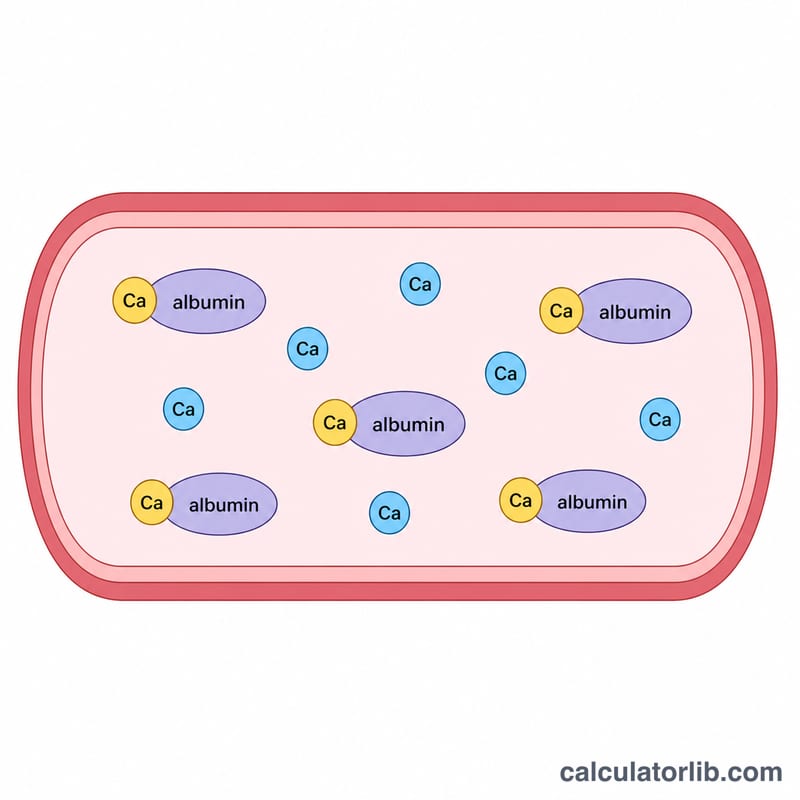
This tool uses US conventional units (calcium in mg/dL, albumin in g/dL). About 40% of serum calcium is bound to albumin, so when albumin is low, the measured total calcium underestimates the clinically relevant calcium. The corrected calcium formula adjusts the measured value back toward what it would be at a normal albumin of 4.0 g/dL, giving a more accurate picture of calcium status.
How to Use It
Enter the patient's measured total serum calcium (mg/dL) and serum albumin (g/dL) from the lab report. The calculator returns the albumin-corrected calcium in mg/dL. This estimate is a screening aid only — an ionized calcium measurement is the definitive test when accuracy matters.
The Formula Explained
The standard correction is:
$$\text{Corrected Ca} = \text{Measured Ca} + 0.8 \times \left(4.0 - \text{Albumin}\right)$$
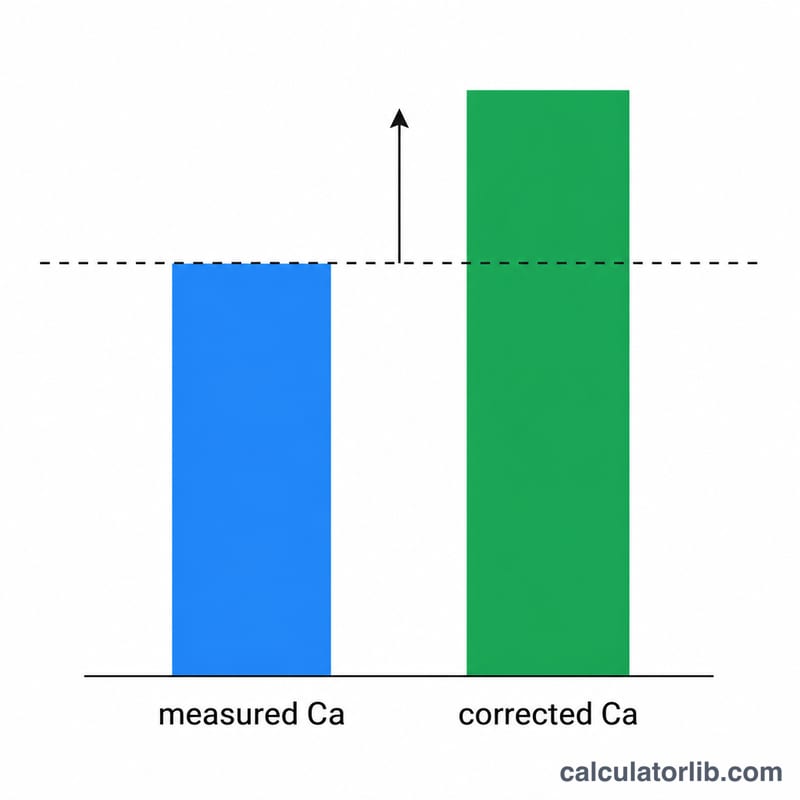
For every 1.0 g/dL that albumin falls below the reference 4.0 g/dL, the formula adds 0.8 mg/dL to the measured calcium. If albumin is at or above 4.0, the correction is zero or slightly negative.
Worked Example
A patient has a measured calcium of 8.0 mg/dL and albumin of 2.0 g/dL. $$\text{Corrected Ca} = 8.0 + 0.8 \times \left(4.0 - 2.0\right) = 8.0 + 0.8 \times 2.0 = 8.0 + 1.6 = \mathbf{9.6 \text{ mg/dL}}$$ Although the measured value looked low, the corrected value is within the normal range — the apparent hypocalcemia was due to low albumin.
FAQ
Why 4.0 g/dL? It represents a typical normal serum albumin level used as the reference point.
Is this accurate? The formula is a rough estimate. In critically ill patients or severe albumin disturbances it can be unreliable; ionized calcium is preferred.
What units does this use? Calcium in mg/dL and albumin in g/dL (US conventional units). For SI units (mmol/L and g/L) a different equation applies.