What Is the Parkland Formula?
The Parkland (Baxter) formula is a widely used clinical guideline for estimating the volume of intravenous fluid a burn patient needs during the first 24 hours after injury. Adequate fluid resuscitation prevents hypovolemic shock and organ damage caused by the large fluid shifts that follow major burns. This tool is for educational purposes and clinical estimation only — it does not replace professional medical judgment, monitoring, or local protocols.
How to Use This Calculator
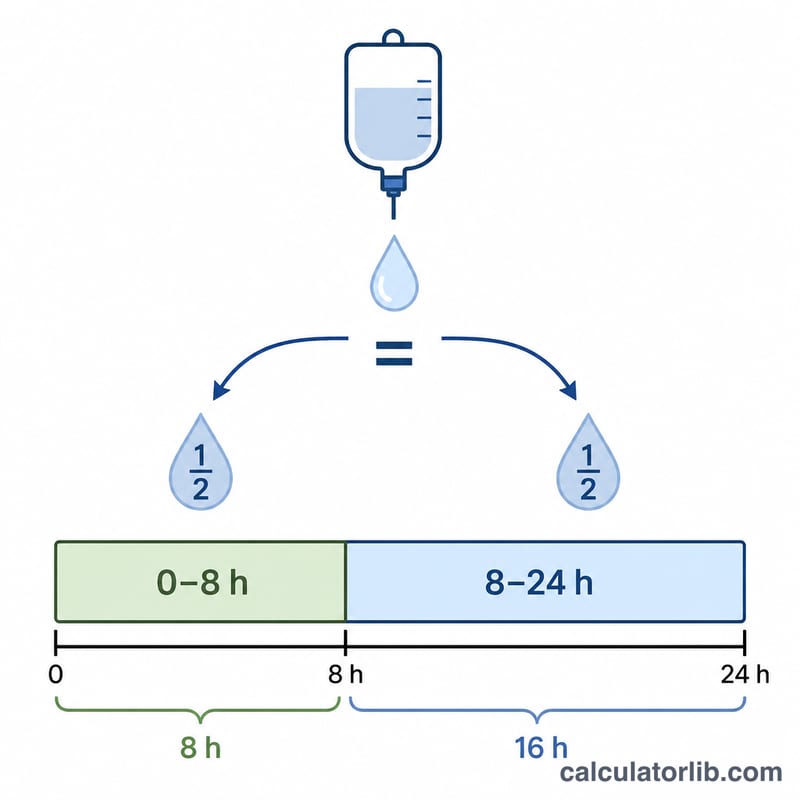
Enter the patient's body weight in kilograms and the estimated percentage of total body surface area (%TBSA) affected by partial- and full-thickness burns. The calculator returns the total 24-hour fluid volume along with how to split it: the first half over the first 8 hours and the second half over the following 16 hours, with hourly infusion rates for each phase.
The Formula Explained
The core equation is $$V = 4 \times \text{Weight (kg)} \times \text{TBSA (\%)}$$, using lactated Ringer's solution. The timing matters as much as the volume: the first 50% is infused over hours 0–8 measured from the moment of the burn (not from arrival), and the remaining 50% over hours 8–24. Time already elapsed since injury should be subtracted when planning the first-phase rate.
Worked Example
For an 80 kg patient with 40% TBSA burns: $$4 \times 80 \times 40 = 12{,}800 \text{ mL total.}$$ The first half (6,400 mL) is given over 8 hours at 800 mL/hr, and the second half (6,400 mL) over 16 hours at 400 mL/hr.
Key Terms and Definitions
- %TBSA (total body surface area)
- The percentage of the body surface affected by burns. Only partial-thickness (second-degree) and full-thickness (third-degree) burns are counted; superficial (first-degree) burns, which involve only redness without blistering, are excluded. A common quick estimate in adults is the rule of nines, which assigns approximately 9% to each arm, 9% to the head and neck, 18% to each leg, 18% to the front of the trunk and 18% to the back of the trunk, and 1% to the perineum. More detailed charts (such as Lund-Browder) are used for children and more precise assessment.
- Lactated Ringer's solution
- A balanced isotonic crystalloid containing sodium, potassium, calcium, chloride and lactate. It is the standard fluid used in initial burn resuscitation.
- Crystalloid
- An intravenous fluid made of water and small dissolved solutes (electrolytes) that can cross cell membranes and capillary walls freely. Examples include lactated Ringer's and normal saline.
- Resuscitation
- Treatment aimed at restoring and maintaining adequate circulating volume and tissue perfusion. In burns, this means replacing fluid lost into damaged tissue through leaky capillaries.
- Hypovolemic shock
- A life-threatening state in which low circulating volume causes inadequate organ perfusion. Burn shock is a major cause in the first 24-48 hours.
- Urine output target
- The hourly urine volume used as a bedside marker of adequate perfusion. For adults it is generally about 0.5 mL/kg/hr (roughly 30-50 mL/hr); fluid rates are adjusted to meet it.
- Baxter formula
- Another name for the Parkland formula, after Charles Baxter, who developed it with colleagues at Parkland Memorial Hospital in Dallas, Texas.
FAQ
Which fluid is used? Lactated Ringer's solution is the standard crystalloid for Parkland resuscitation.
Does the 8-hour clock start at admission? No — it starts at the time of the burn injury. Subtract elapsed time to set the correct initial rate.
How is fluid then adjusted? The calculated volume is only a starting estimate. Rates are titrated to urine output (typically \(0.5\text{–}1\ \text{mL/kg/hr}\) in adults) and other clinical signs.