
What Is Total Body Water?
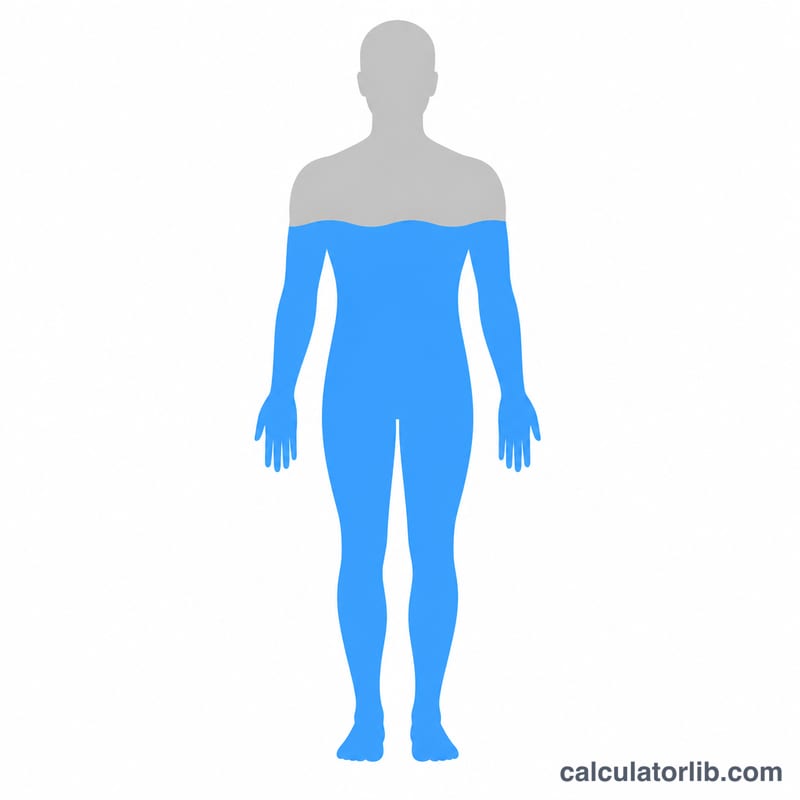
Total body water (TBW) is the total amount of fluid contained in your body, including water inside cells (intracellular fluid) and outside cells (interstitial fluid and blood plasma). Water is the largest single component of the human body and is essential for circulation, temperature regulation, digestion, and nearly every cellular process. This calculator gives a quick estimate of TBW in liters based on body weight and gender.
How to Use This Calculator
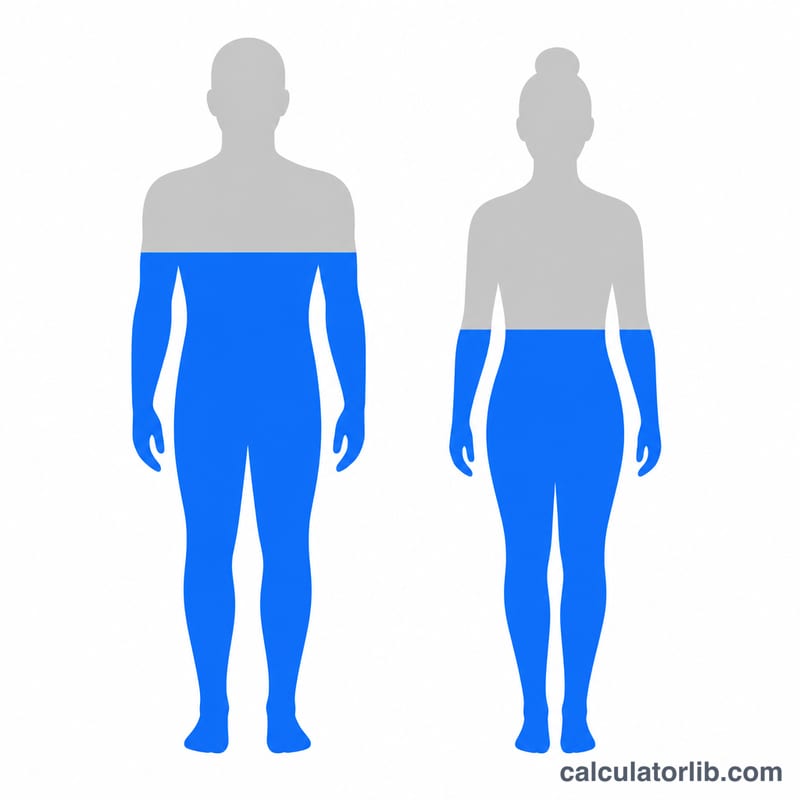
Select your gender, then enter your body weight in kilograms. The calculator multiplies your weight by a standard fraction — 60% for males and 50% for females — to estimate your total body water. It also shows the body water percentage used.
The Formula Explained
The simplest clinical estimate of body water assumes that water makes up a roughly fixed proportion of body mass:
$$\text{TBW} = \text{weight (kg)} \times 0.6 \text{ (male) or } 0.5 \text{ (female)}$$
Men typically carry less body fat and more muscle, which holds more water, so the male factor is higher. These percentages are population averages — actual TBW varies with age, body composition, and hydration status.
Worked Example
Suppose a man weighs 80 kg. His estimated total body water is $$80 \times 0.6 = \textbf{48 liters},$$ or 60% of his body weight. A woman weighing 60 kg would have $$60 \times 0.5 = \textbf{30 liters},$$ or 50%.
FAQ
Is this an exact medical measurement? No. It is a rough estimate. Precise TBW is measured with techniques like isotope dilution or bioelectrical impedance.
Why do men and women use different factors? On average women have a higher percentage of body fat, which contains less water than lean tissue, so a lower fraction is used.
Does age affect body water? Yes. Body water percentage tends to decline with age, so this simple method may overestimate TBW in older adults.