
What Is the Urine Anion Gap?
The urine anion gap (UAG) is a calculated value used to assess the kidney's ability to excrete acid as ammonium (NH₄⁺) in patients with a normal (non-anion-gap, hyperchloremic) metabolic acidosis. Because ammonium is excreted with chloride, a measured rise in urinary chloride relative to the measured cations (sodium and potassium) produces a negative gap, indirectly signaling robust ammonium excretion.
How to Use This Calculator
Enter the urinary concentrations of sodium (Na⁺), potassium (K⁺) and chloride (Cl⁻) in mEq/L from a random ("spot") urine sample. The calculator instantly returns the urine anion gap in mEq/L. This tool is intended for educational and clinical-support purposes only and does not replace professional medical judgment.
The Formula Explained
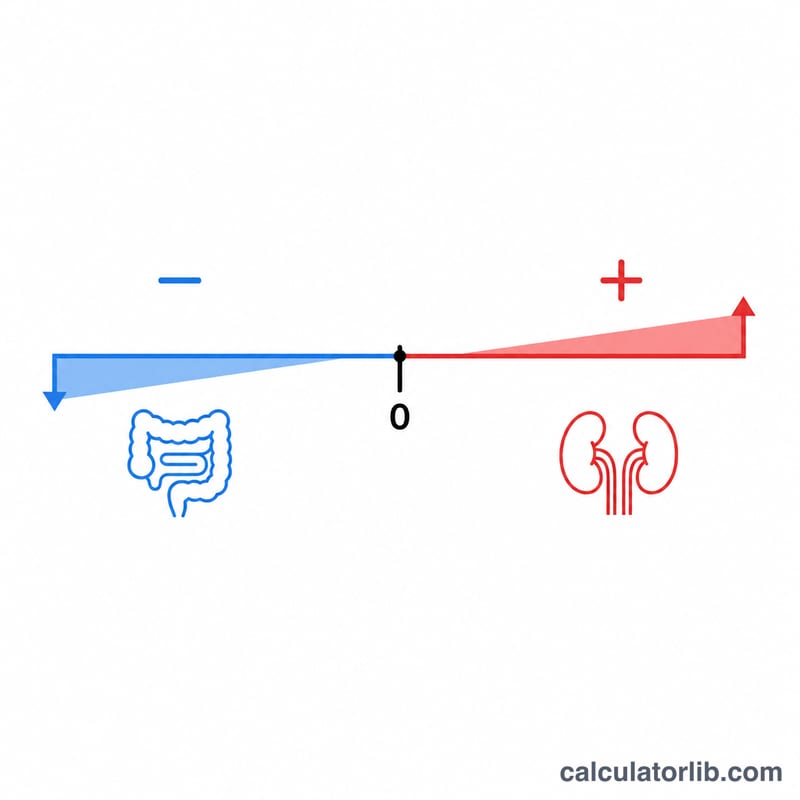
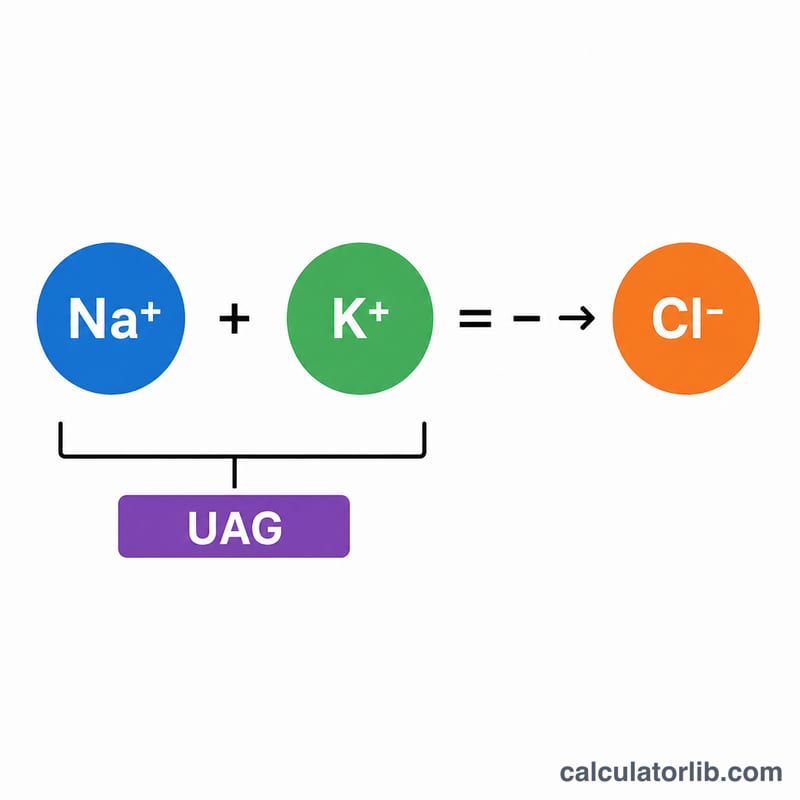
The equation is simply $$\text{UAG} = \text{Na}^{+} + \text{K}^{+} - \text{Cl}^{-}$$ The measured cations (sodium and potassium) are summed and the measured anion (chloride) is subtracted. The unmeasured anion that "fills the gap" is largely ammonium. A negative UAG suggests appropriately high ammonium excretion (e.g., gastrointestinal bicarbonate loss such as diarrhea). A positive UAG suggests impaired renal ammonium excretion (e.g., renal tubular acidosis).
Worked Example
Suppose a spot urine shows Na⁺ = 40 mEq/L, K⁺ = 30 mEq/L and Cl⁻ = 60 mEq/L. Then $$\text{UAG} = 40 + 30 - 60 = 10 \text{ mEq/L}$$ A positive value here would prompt evaluation for distal renal tubular acidosis.
FAQ
What does a negative urine anion gap mean? A negative UAG indicates high urinary ammonium (and therefore chloride) excretion, typically appropriate in non-renal causes of acidosis like diarrhea.
What does a positive urine anion gap mean? A positive UAG suggests the kidneys are not excreting enough ammonium, pointing toward renal tubular acidosis.
Is the UAG reliable in all settings? No. The UAG is unreliable when urinary unmeasured anions (e.g., ketones, hippurate, certain drugs) are present, when urine sodium is very low, or when there is volume depletion. In such cases the urine osmolal gap is preferred.