
What is Lorentz length contraction?
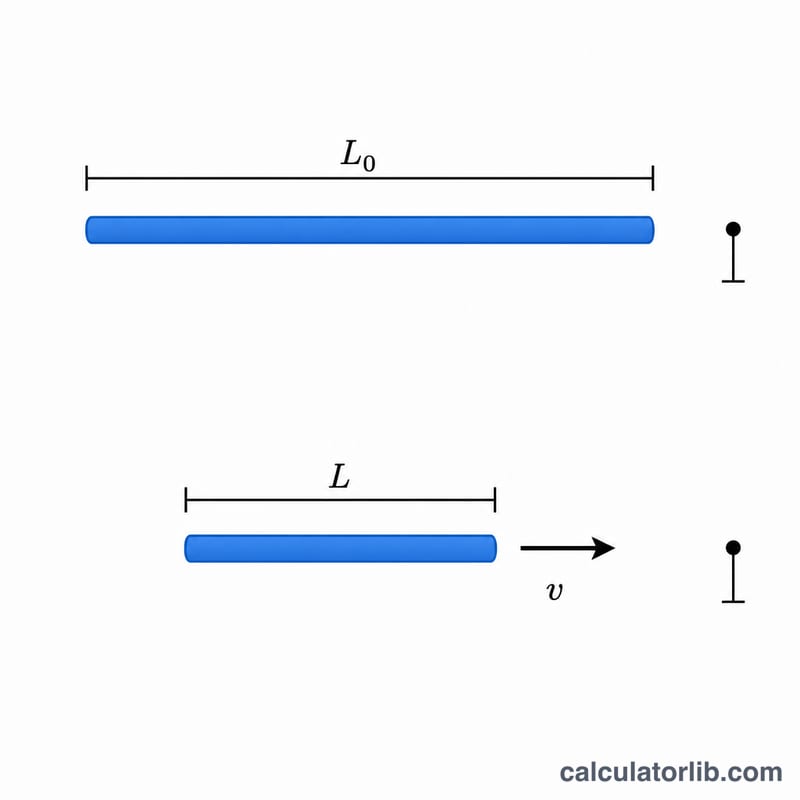
In Albert Einstein's special theory of relativity, an object moving at a high speed relative to an observer appears shortened along its direction of motion. This effect, called Lorentz (or Lorentz-FitzGerald) contraction, is a universal law of physics that applies everywhere and is not specific to any country or region. The faster the object moves, the shorter it looks; at the speed of light it would shrink to zero length.
How to use this calculator
Enter the rest length L0 (the proper length measured when the object is at rest) in meters, and the relative velocity v in kilometers per second. The speed of light c is fixed at 299792.458 km/s. The calculator returns the observed length L and the velocity expressed as a percentage of light speed (\(v/c\)). If you enter a velocity greater than c, the calculator rejects it because faster-than-light motion is physically forbidden.
The formula explained
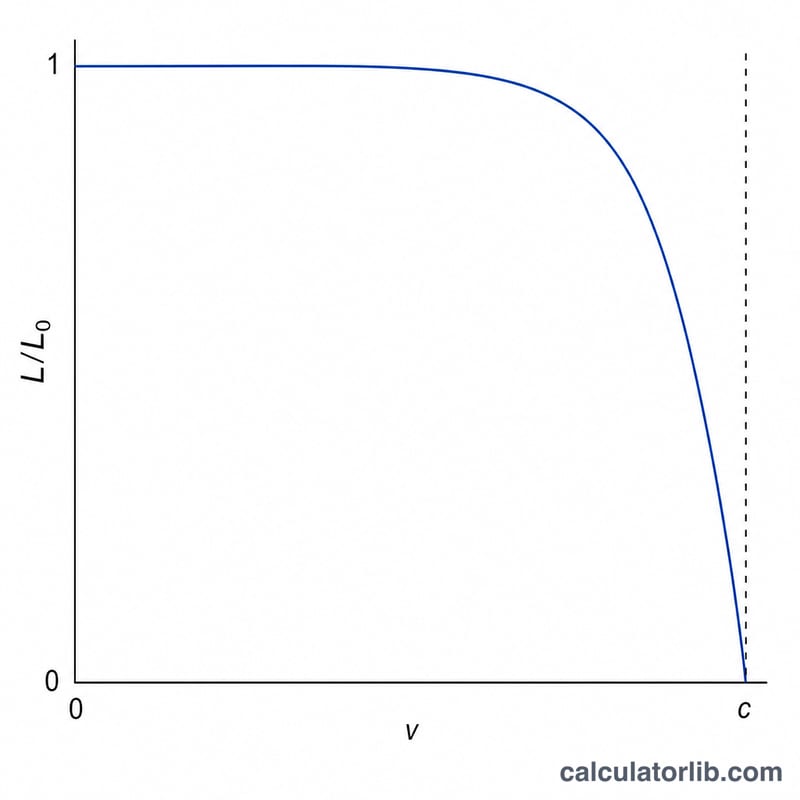
The contracted length is $$L = \text{L}_0 \sqrt{1 - \left(\dfrac{\text{v}}{c}\right)^2}.$$ The dimensionless ratio \(\beta = v/c\) determines the contraction factor. When v is small compared with c, \(\beta^2\) is tiny and L is almost identical to L0 - which is why we never notice contraction at everyday speeds. As v approaches c, the term under the square root shrinks toward zero and L collapses dramatically.
Worked example
Suppose a rod has a rest length \(\text{L}_0 = 6 \text{ m}\) and travels at 99% of light speed, so \(\beta = 0.99\). Then \(\beta^2 = 0.9801\), and \(1 - 0.9801 = 0.0199\). The square root of 0.0199 is about 0.14107, so $$L = 6 \times 0.14107 = 0.8464 \text{ m}$$ - the rod appears only about 85 cm long. The velocity ratio is 99%.
FAQ
Does the object physically get shorter? The object's own rest length is unchanged; the shortening is what an external observer measures because of the relativity of simultaneity.
Does width also shrink? No. Contraction occurs only along the direction of motion. Dimensions perpendicular to the velocity are unaffected.
Why can't v exceed c? If \(v > c\) the quantity \(1 - v^2/c^2\) becomes negative and its square root is imaginary, which has no physical meaning. Massive objects cannot reach or surpass the speed of light.