
What is the round-trip average speed?
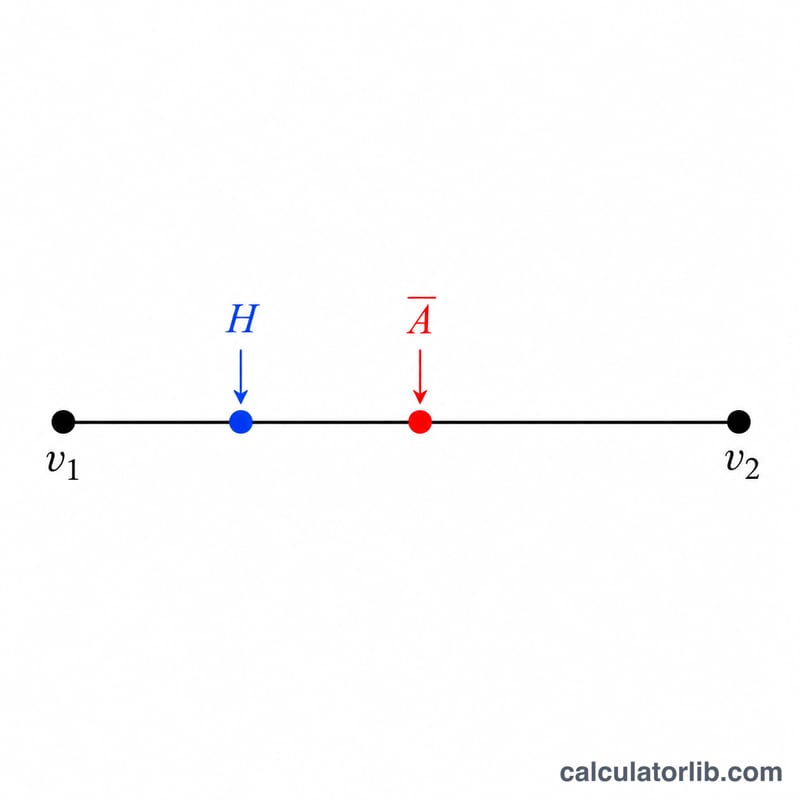
When you travel out and back over the same distance but at two different constant speeds, your overall average speed for the whole journey is not the simple average of the two speeds. Because you spend more time on the slower leg, the slower speed dominates. The correct value is the harmonic mean of the two speeds. This is pure constant-velocity physics and works the same anywhere in the world.
How to use it
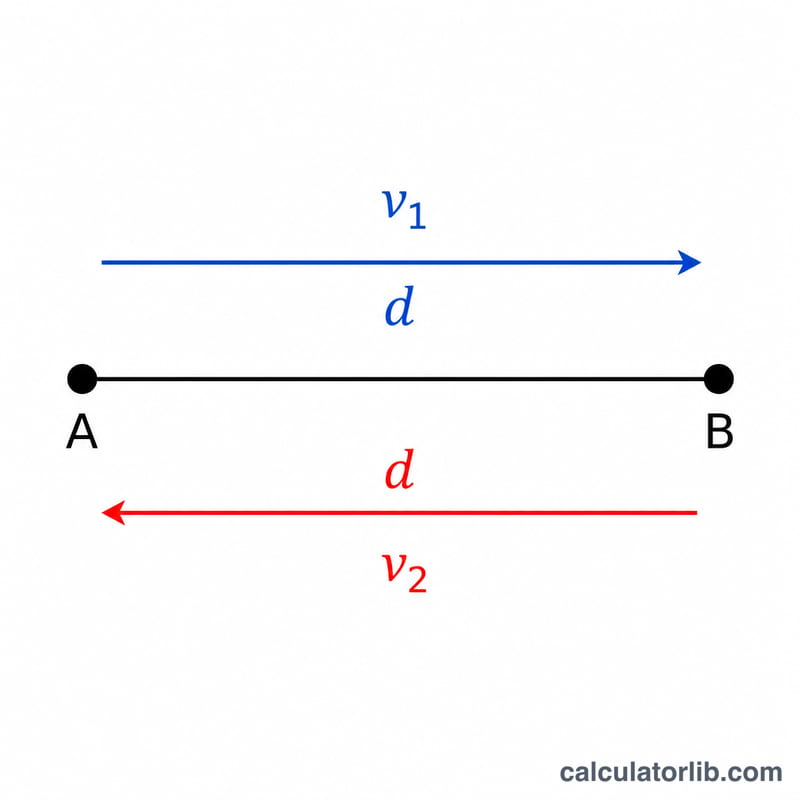
Enter the outbound speed (v1) and the return speed (v2) in the same unit — the default is kilometres per hour. The calculator returns the round-trip average speed in that same unit. It also shows the arithmetic mean so you can see how much it differs from the correct answer.
The formula explained
Let the one-way distance be \(d\). The total distance is \(2d\). The outbound time is \(d/v_1\) and the return time is \(d/v_2\), so the total time is \(d(v_1+v_2)/(v_1 \cdot v_2)\). Average speed is total distance divided by total time:
$$v = 2d \div \left[ \frac{d(v_1+v_2)}{v_1 \cdot v_2} \right] = \frac{2 \cdot v_1 \cdot v_2}{v_1+v_2}$$
The distance \(d\) cancels out, so the answer depends only on the two speeds.
Worked example
With \(v_1 = 12\) km/h and \(v_2 = 20\) km/h: $$v = \frac{2 \times 12 \times 20}{12 + 20} = \frac{480}{32} = 15 \text{ km/h}$$ The arithmetic mean would have wrongly given \((12 + 20) \div 2 = 16\) km/h.
FAQ
Why isn't it just \((v_1+v_2)/2\)? Because equal distances mean unequal times — you spend longer at the slower speed, so it carries more weight. The arithmetic mean would only be correct if you spent equal time at each speed.
What if one speed is huge? As one leg's speed grows toward infinity, the average approaches twice the slower speed and never exceeds it. For example, with \(v_2 = 20\), no matter how fast \(v_1\) is, the round-trip average stays below 40 km/h.
What if a speed is zero? Then that leg never completes, so the formula returns 0 — you cannot finish the round trip. The formula also requires the outbound and return distances to be equal; for unequal legs, use total distance divided by total time instead.