
What is time dilation?
Time dilation is a prediction of Albert Einstein's special theory of relativity: a clock moving relative to an observer ticks more slowly than the observer's own clock. The faster the relative velocity, the larger the effect. This calculator is pure physics and applies universally — there is no country or jurisdiction dependence.

How to use this calculator
Enter the object's proper time T0 (the time elapsed in the moving object's own rest frame, in seconds) and the relative velocity v. Choose the velocity unit (km/s, m/s, km/h, mph, or as a fraction of the speed of light). The tool converts \(v\) to km/s, compares it with the fixed speed of light \(c = 299{,}792.458\ \text{km/s}\), and returns the dilated time \(T\) seen by a stationary observer along with \(v\) as a percentage of \(c\) and the Lorentz factor gamma.
The formula explained
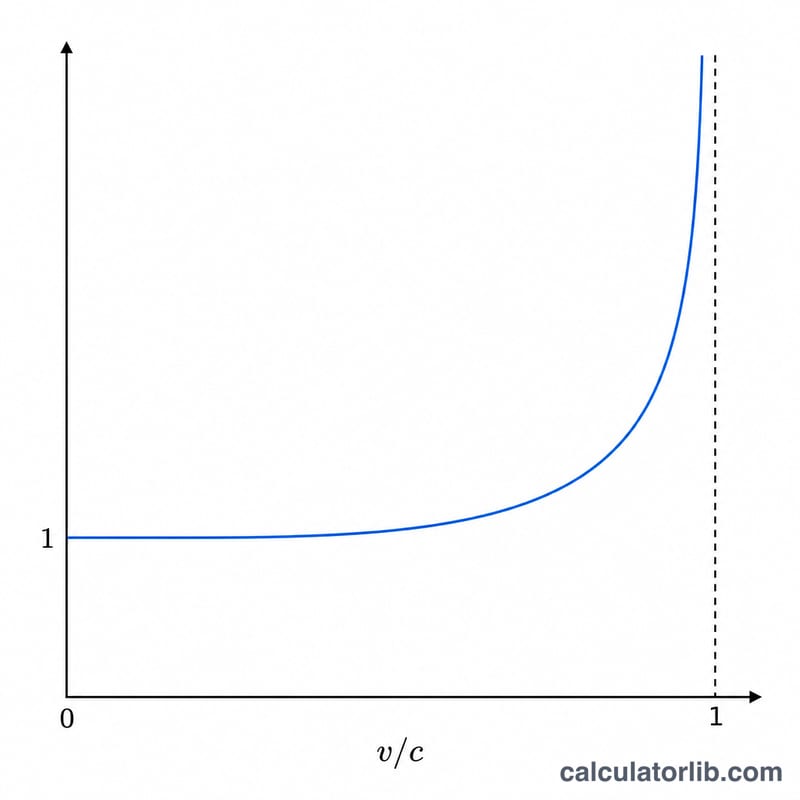
The governing equation is $$T = \dfrac{T_0}{\sqrt{1 - \dfrac{v^2}{c^2}}}$$ The denominator \(\sqrt{1 - \frac{v^2}{c^2}}\) is the inverse of the Lorentz factor \(\gamma = \frac{1}{\sqrt{1 - (v/c)^2}}\). When \(v\) is small compared to \(c\), gamma is almost exactly 1 and \(T\) equals \(T_0\) — no measurable dilation. As \(v\) approaches \(c\), the term \(\frac{v^2}{c^2}\) approaches 1, the denominator approaches 0, and \(T\) grows without bound.
Worked example
Take \(T_0 = 1\ \text{s}\) and \(v = 200{,}000\ \text{km/s}\). Then $$\frac{v}{c} = \frac{200000}{299792.458} = 0.667133,$$ so \(v/c = 66.7133\%\). Squaring gives \(\left(\frac{v}{c}\right)^2 = 0.445066\), so \(1 - 0.445066 = 0.554934\) and \(\sqrt{0.554934} = 0.744939\). Therefore $$T = \frac{1}{0.744939} = 1.342393\ \text{s}.$$ To the stationary observer, the moving object's one-second tick lasts about 1.34 seconds.
FAQ
What happens at v = c? The denominator becomes zero, so \(T\) is infinite — the moving clock appears frozen. Nothing with mass can actually reach \(c\).
Can v be larger than c? No. A velocity above the speed of light makes \(1 - \frac{v^2}{c^2}\) negative and the square root imaginary; the calculator rejects it as physically invalid.
What if v = 0? Then \(\gamma = 1\) and \(T = T_0\), meaning no time dilation occurs.