
What are the Airy functions?
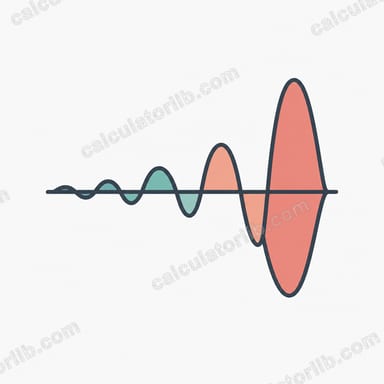
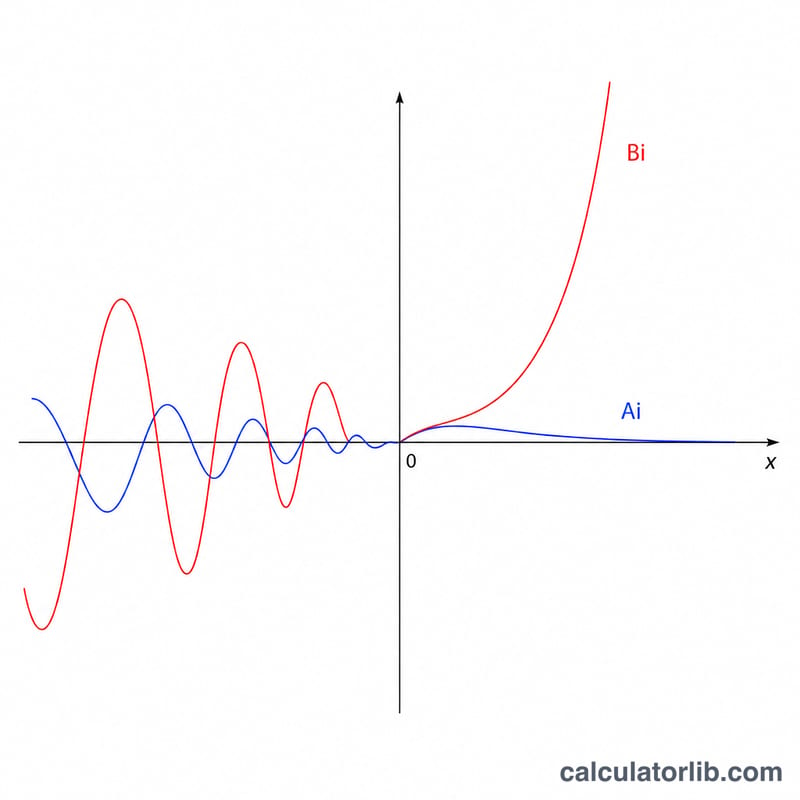
The Airy functions Ai(x) and Bi(x) are the two linearly independent solutions of the Airy differential equation \(y'' = x\,y\) (equivalently \(y'' - x\,y = 0\)). They appear throughout physics and applied mathematics: near classical turning points in quantum mechanics (the WKB connection problem), in the description of caustics and rainbows in optics, and in asymptotic analysis. Ai(x) is the solution that decays as x grows large and positive, while Bi(x) grows exponentially in the same limit. For negative x both oscillate and slowly decay like \(|x|^{-1/4}\).
How to use this calculator
Enter any finite real value of x (positive, negative, or zero) and read off Ai(x) and Bi(x). The default x = 1.0 is provided as a starting point. There are no units — x is a pure dimensionless real number.
The formula explained
For moderate |x| the calculator uses the everywhere-convergent power series. Two series f(x) and g(x) are summed by a stable recurrence: for f, \(\text{term}_k = \text{term}_{k-1} \times x^3 / ((3k-1)(3k))\) starting from 1; for g, \(\text{term}_k = \text{term}_{k-1} \times x^3 / ((3k)(3k+1))\) starting from x. Then $$\text{Ai}(x) = c_1 f(x) - c_2 g(x), \quad \text{Bi}(x) = \sqrt{3}\,\bigl(c_1 f(x) + c_2 g(x)\bigr)$$ with \(c_1 = \text{Ai}(0) = 0.3550280539\) and \(c_2 = -\text{Ai}'(0) = 0.2588194038\). For |x| beyond about 8 the code switches to the asymptotic expansions to avoid cancellation error.
Worked example (x = 1)
\(f(1) \approx 1.1722994\) and \(g(1) \approx 1.0853395\). So $$\text{Ai}(1) = 0.3550280539 \times 1.1722994 - 0.2588194038 \times 1.0853395 \approx 0.1352924,$$ and $$\text{Bi}(1) = \sqrt{3} \times (0.4161680 + 0.2808727) \approx 1.2074236.$$ These match the standard reference values.
FAQ
What is Ai(0) and Bi(0)? \(\text{Ai}(0) = 0.3550280539\) and \(\text{Bi}(0) = \sqrt{3} \times \text{Ai}(0) = 0.6149266274\), exact closed forms.
Why does Bi(x) blow up? Bi(x) grows like \(\exp\!\left(\tfrac{2}{3}x^{3/2}\right)\) for large positive x and will overflow a double precision number near \(x \approx 100\); this is expected behaviour, not an error.
Can I use negative x? Yes. For large negative x the functions oscillate, and the calculator uses the oscillatory asymptotic forms for accuracy.