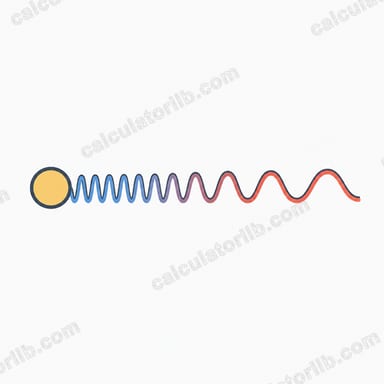

What is the relativistic Doppler effect?
When a source of light moves relative to an observer, its measured wavelength and frequency change. Unlike the classical Doppler effect for sound, the relativistic version also includes time dilation through the Lorentz factor, so even motion perpendicular to the line of sight produces a shift. This calculator returns the observed wavelength, the corresponding frequency, and the speed ratio for any source speed and direction. It is universal physics (special relativity) and applies everywhere.
How to use it
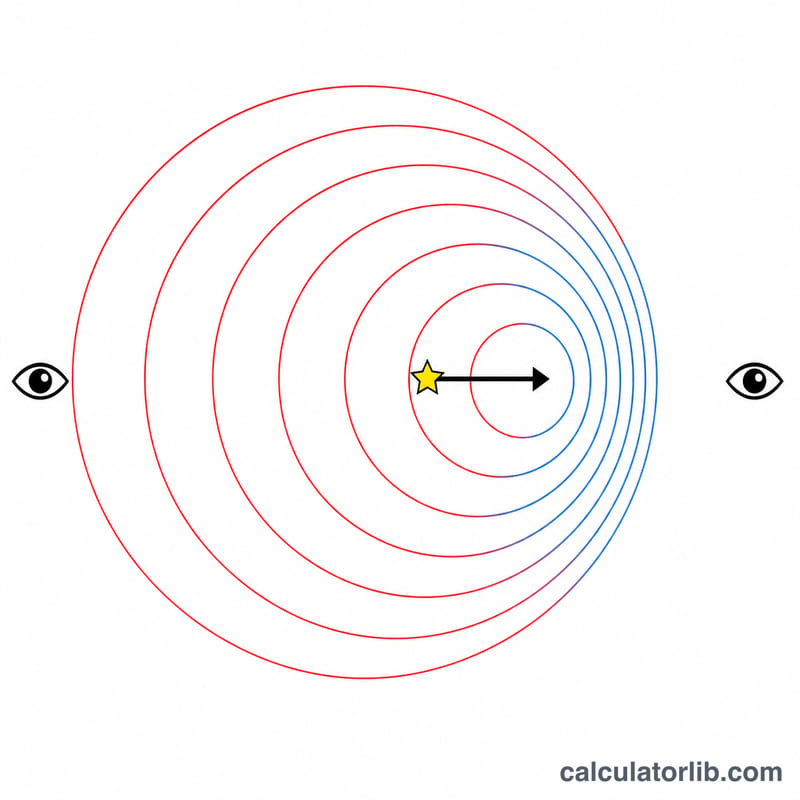
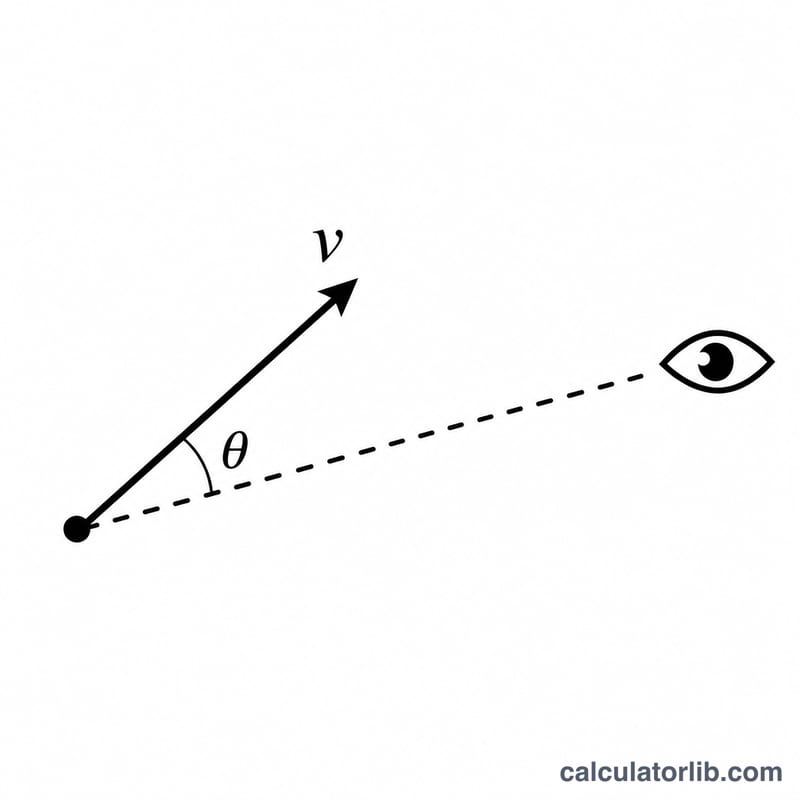
Enter the source rest wavelength in nanometers, the relative speed in kilometers per second, and the direction angle in degrees. The angle convention is: 0° means the source is approaching directly (toward you, producing blueshift), 180° means it is receding directly (moving away, producing redshift), and 90° is transverse motion (a pure time-dilation redshift). The relative speed must be less than the speed of light, 299,792.458 km/s.
The formula explained
Let \(\beta = v_0/c\) and \(\gamma = 1/\sqrt{1-\beta^2}\). The observed wavelength is $$\lambda = \lambda_0 \times \gamma \times (1 - \beta\cos\theta).$$ At \(\theta = 180^\circ\), \(\cos\theta = -1\), so the factor becomes \(\gamma(1+\beta) > 1\), giving redshift. At \(\theta = 0^\circ\), the factor \(\gamma(1-\beta) < 1\) gives blueshift. The frequency follows from \(\nu = c/\lambda\) with \(\lambda\) in meters.
Worked example
For \(\lambda_0 = 570\) nm, \(v_0 = 30{,}000\) km/s, \(\theta = 180^\circ\): $$\beta = \frac{30000}{299792.458} = 0.10007,$$ $$\gamma = 1.00505,$$ and the factor \(= 1.00505 \times 1.10007 = 1.10560\). So $$\lambda = 570 \times 1.10560 = 630.19\ \text{nm}\ \text{(redshifted).}$$ The frequency is \(c/\lambda \approx 475{,}724\) GHz, and the speed ratio is 10.01%.
FAQ
Why does a sideways-moving source still shift? At \(\theta = 90^\circ\) the classical Doppler term vanishes, but the Lorentz factor \(\gamma \ge 1\) remains, producing the transverse (time-dilation) redshift unique to relativity.
Can I enter a speed equal to the speed of light? No. As \(v_0\) approaches \(c\), \(\gamma\) diverges; the calculator requires \(v_0 < 299{,}792.458\) km/s.
What does the speed ratio mean? It is \(\beta\) expressed as a percentage, i.e. the fraction of the speed of light at which the source moves.