
What is the Photoelectric Effect Calculator?
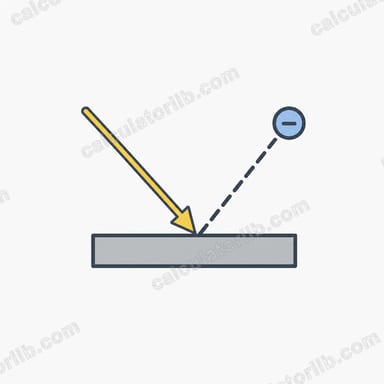
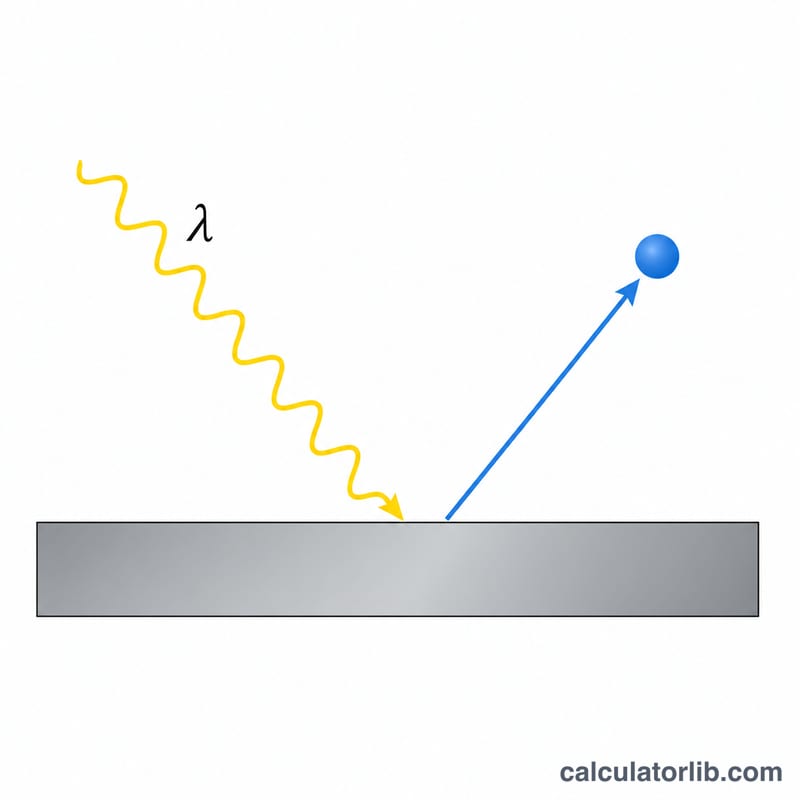
This tool applies Einstein's photoelectric equation to find the maximum kinetic energy of electrons ejected from a metal surface when light of a given frequency strikes it. It is a universal physics calculator based on fundamental constants, so it applies anywhere.
How to use it
Enter the frequency of the incoming light in units of \(\times 10^{14}\) Hz (visible light is roughly 4–7.5 \(\times 10^{14}\) Hz) and the work function \(\Phi\) of the metal in electron-volts (eV). The calculator returns the photon energy, the maximum electron kinetic energy, the threshold frequency, and whether emission occurs.
The formula explained
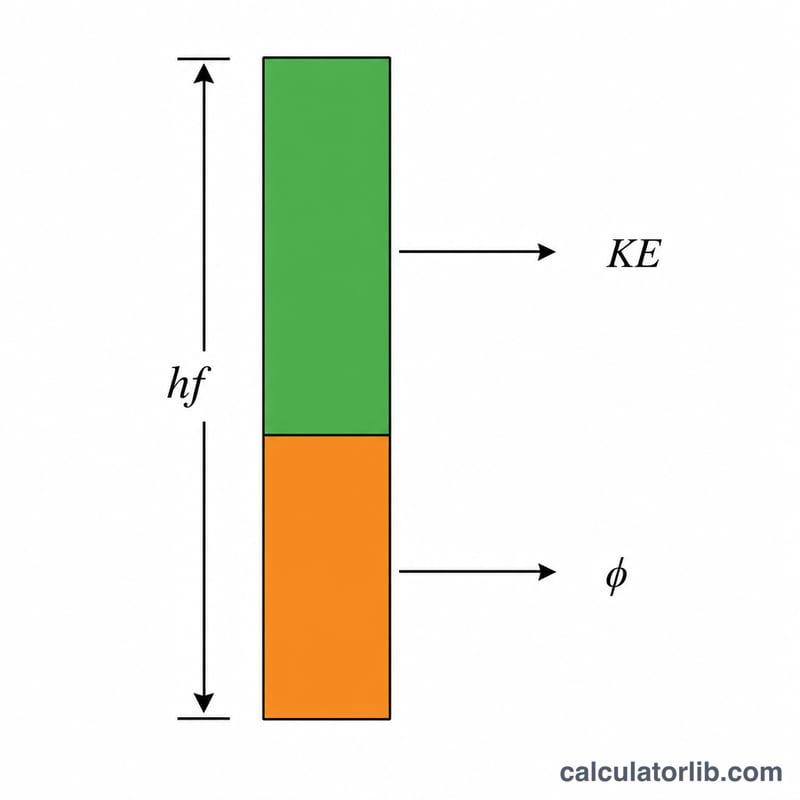
The governing equation is $$KE_{max} = h \cdot f - \Phi$$ where \(h\) is Planck's constant (\(6.626 \times 10^{-34}\ \text{J}\cdot\text{s}\)), \(f\) is the light frequency, and \(\Phi\) is the work function. A photon carries energy \(E = h \cdot f\). If that energy exceeds \(\Phi\), the surplus becomes the electron's kinetic energy; if not, no electron is emitted. The threshold frequency is \(f_0 = \Phi / h\).
Worked example
For \(f = 10 \times 10^{14}\) Hz (\(1.0 \times 10^{15}\) Hz) and \(\Phi = 2.3\) eV: photon energy $$= \frac{h \cdot f}{e} = \frac{6.626 \times 10^{-34} \times 1.0 \times 10^{15}}{1.602 \times 10^{-19}} \approx 4.136\ \text{eV}$$ $$KE_{max} = 4.136 - 2.3 \approx 1.836\ \text{eV}$$ Threshold $$f_0 = \frac{2.3 \times 1.602 \times 10^{-19}}{6.626 \times 10^{-34}} \approx 5.56 \times 10^{14}\ \text{Hz}$$ Since the photon exceeds the work function, electrons are emitted.
FAQ
What if the photon energy is below the work function? No electrons are ejected; \(KE_{max}\) is reported as 0 and "Electron emitted?" shows No.
Why are frequencies in \(\times 10^{14}\) Hz? Visible and near-visible light frequencies are around \(10^{14}\) Hz, so this scale keeps the input numbers convenient.
Does intensity matter? Intensity affects the number of electrons, not their maximum kinetic energy — only frequency and work function set \(KE_{max}\).