
What this calculator does
This tool estimates the approximate number of calories (kilocalories) a dog or cat needs each day to maintain a healthy body condition. It uses the internationally standard veterinary energy equations: the Resting Energy Requirement (RER) scaled by a species-specific Maintenance Energy Requirement (MER) factor. While the original reference is a Japanese Ministry of the Environment pet-food guide, the underlying metabolic formula is universal and not country-specific.
How to use it
Choose whether your pet is a dog or a cat, enter the body weight, and pick the unit (kg, g, or lb). The body weight is normalized to kilograms internally, then the calculator returns the estimated daily calorie requirement along with the intermediate RER value.
The formula explained
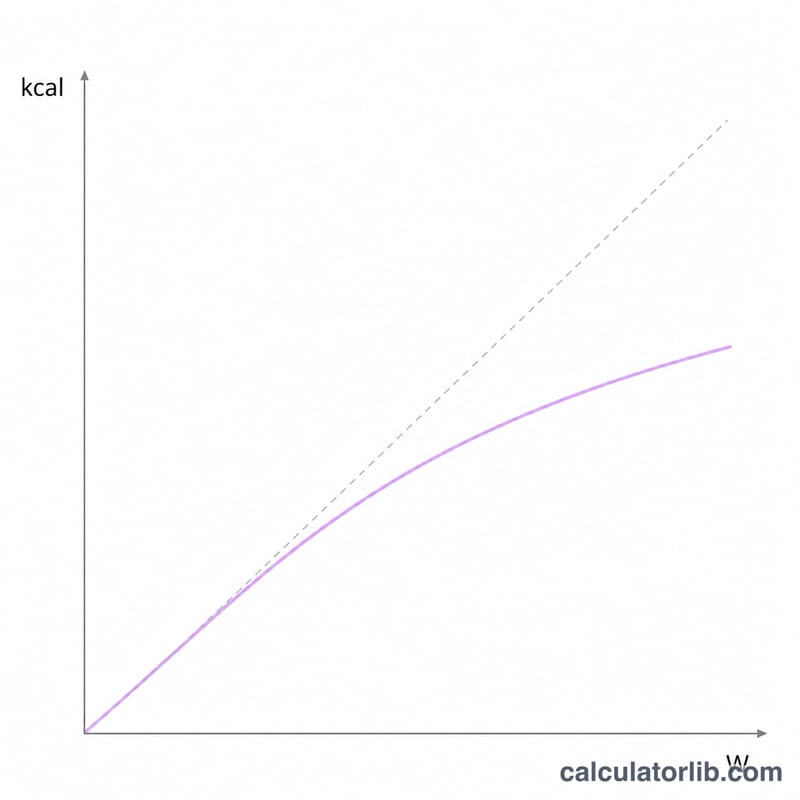
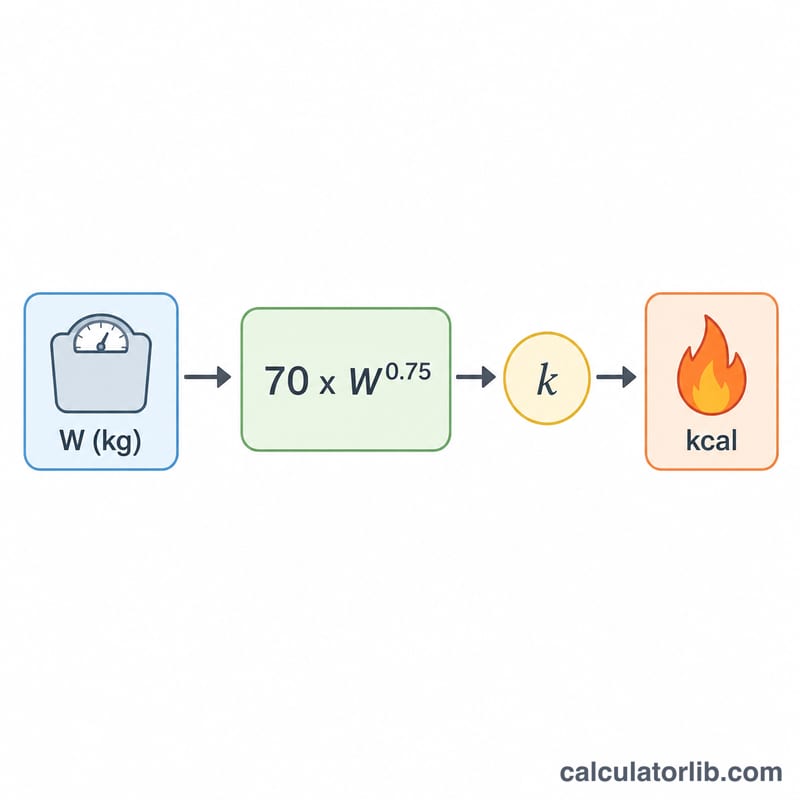
The resting energy requirement is calculated with the allometric (metabolic body weight) form: $$\text{RER} = 70 \times W_{kg}^{0.75}$$ This power form stays valid across the full weight range, unlike the linear approximation \(30W + 70\) which only holds for 2–45 kg. The daily requirement is then $$\text{MER} = k \times \text{RER}$$ where \(k\) is the adult maintenance multiplier: 1.6 for a typical neutered dog and 1.2 for a typical neutered cat.
Worked example
A 5 kg dog: \(W^{0.75} = 3.3437\), so $$\text{RER} = 70 \times 3.3437 = 234.06 \text{ kcal/day}$$ Daily requirement = \(1.6 \times 234.06 = \) about 375 kcal/day. A 4 kg cat: \(W^{0.75} = 2.8284\), \(\text{RER} = 197.99\), daily = \(1.2 \times 197.99 = \) about 238 kcal/day.
FAQ
Is this exact? No. It is a reference estimate. Actual needs vary with age, neuter status, activity level, pregnancy or lactation, and health. Adjust the food amount based on observing your pet's condition.
Why \(W^{0.75}\)? Energy metabolism scales with metabolic body weight rather than linearly, so the power form is accurate for both very small and very large animals.
What if my pet is a puppy or kitten? Growing animals need more energy (factors up to ~3.0). This tool uses a single adult maintenance factor per species, so consult your veterinarian for life-stage adjustments.