
What this calculator does
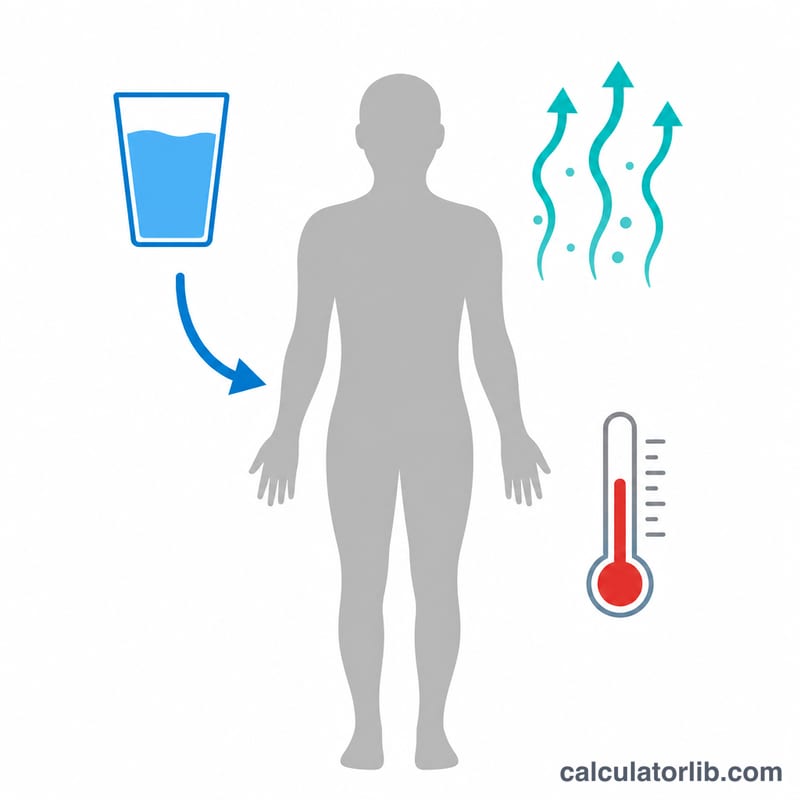
This tool gives two quick, body-weight-based estimates: your daily water requirement (how much water your body needs each day) and your daily water evaporation (roughly how much water you lose each day through the skin and breath). It is a simple arithmetic estimation popularized in the Japanese book "Water Health Science" by Koichiro Fujita. The formulas are universal arithmetic, so they are not tied to any country. They are intended for adults; children need proportionally more water relative to body weight.
How to use it
Enter your body weight in kilograms and your body temperature in degrees Celsius (a normal range is about 35 to 37.5 C). The calculator instantly returns your estimated daily water requirement and daily water evaporation, both rounded to whole milliliters per day. Body weight must be greater than zero.
The formulas explained
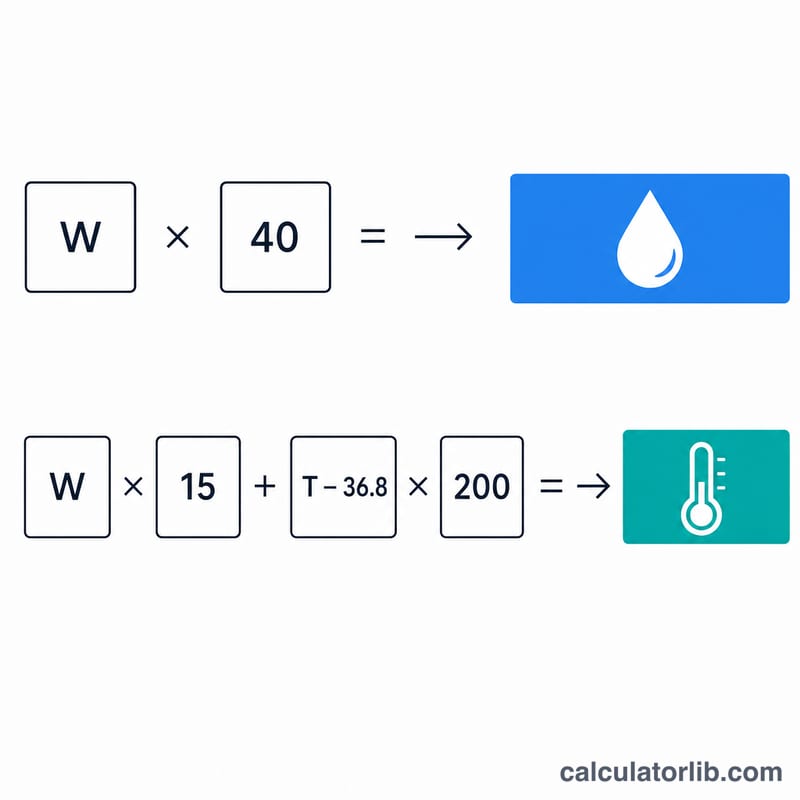
Daily water requirement is simply body weight (kg) x 40. Daily water evaporation is body weight (kg) x 15 + 200 x (body temperature - 36.8), where 36.8 C is treated as the baseline normal body temperature. The temperature term raises water loss when you run a fever and lowers it slightly when temperature is below baseline. If the computed evaporation falls below zero, it is clamped to zero.
$$W_{req} = \text{Body Weight (kg)} \times 40$$
$$W_{evap} = \text{Body Weight (kg)} \times 15 + 200 \times \left(\text{Body Temp (}^{\circ}\text{C)} - 36.8\right)$$
Worked example
For a 60 kg adult at 37 C: requirement = \(60 \times 40 = 2400\) mL/day. Evaporation:
$$60 \times 15 + 200 \times (37 - 36.8) = 900 + 200 \times 0.2 = 900 + 40 = 940 \text{ mL/day}$$
FAQ
Does "water requirement" mean I must drink all of it? No. An adult's total daily water comes from several sources: roughly 1 L from food, about 0.3 L produced metabolically inside the body, and about 1.2 L from beverages, totaling around 2.5 L/day. This number is an informational reference, not part of the calculation.
Why is 36.8 C used? It is the assumed normal baseline body temperature in the evaporation formula. Temperatures above it increase estimated loss; below it decrease loss.
Is this suitable for children? No. The model is for adults. Children generally need more water per kilogram of body weight.