What is the Daily Protein Requirement Calculator?
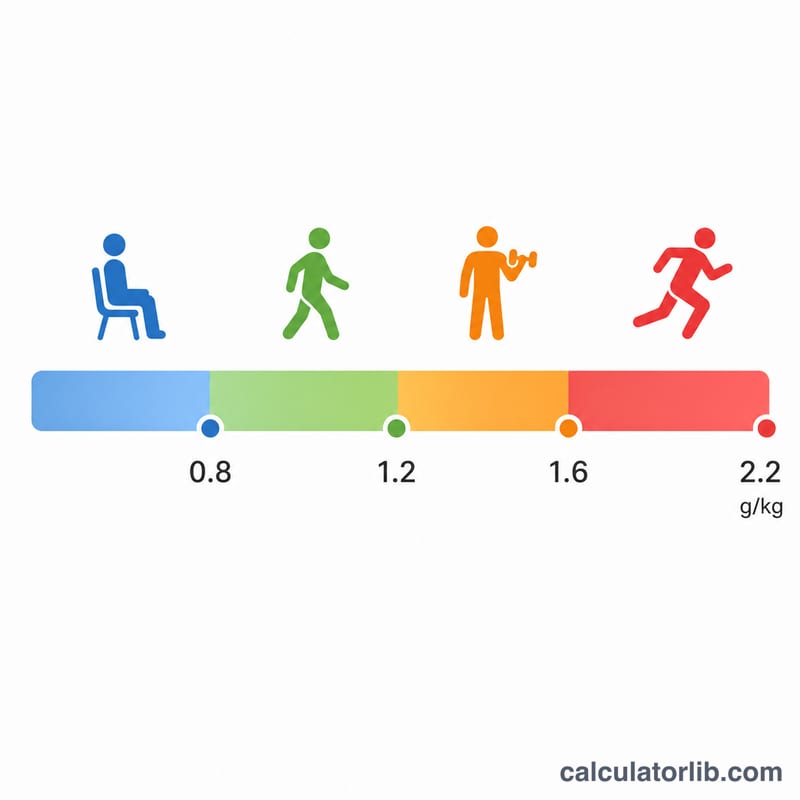
This tool estimates how many grams of protein you should eat each day based on your body weight and how active you are. Protein needs are commonly expressed per kilogram of body weight: the official RDA is 0.8 g/kg for sedentary adults, while active people, lifters and athletes typically benefit from 1.2 to 2.2 g/kg.
How to use it
Enter your body weight, choose kilograms or pounds, then pick the activity/goal level that best matches you. The calculator converts pounds to kilograms automatically, multiplies by the chosen factor, and shows your total daily protein, a rough per-meal target across three meals, and the calories that protein provides (4 kcal per gram).
The formula explained
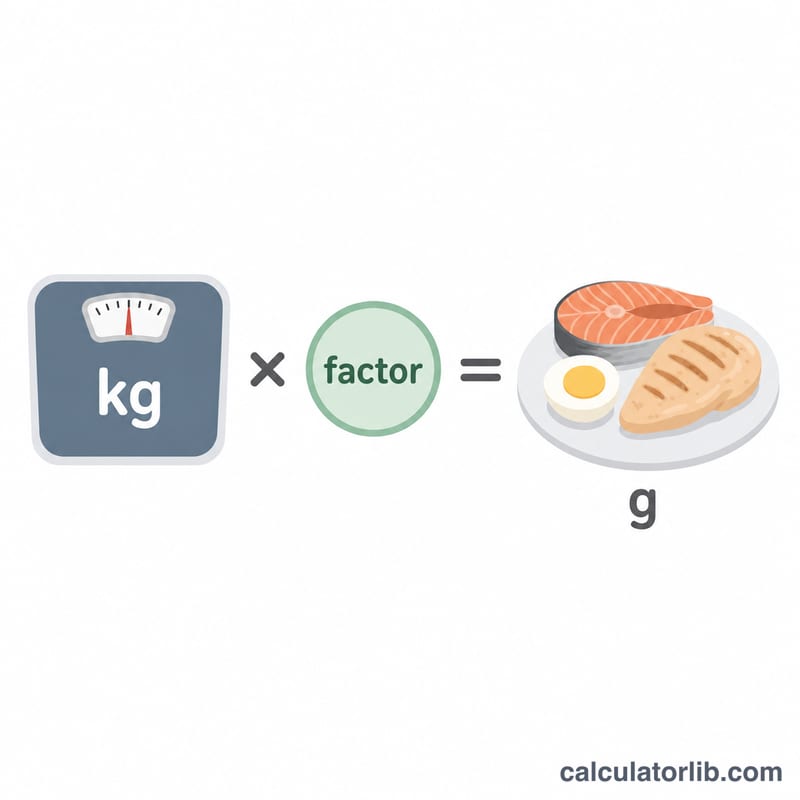
The core equation is $$\text{Protein (g)} = \text{Weight (kg)} \times \text{Factor}$$ The factor is the science-backed amount of protein per kilogram for your goal. Higher factors support muscle building, recovery from training, and preserving lean mass while cutting calories.
Worked example
A 70 kg active adult choosing the 1.2 g/kg factor needs $$70 \times 1.2 = 84 \text{ g}$$ of protein per day. Split across three meals that is about 28 g each, supplying roughly 336 kcal from protein.
Protein Factors by Activity Level and Goal (g/kg)
The calculator multiplies body weight in kilograms by a goal factor: \(\text{Protein (g)} = \text{Weight (kg)} \times \text{Goal Factor}\). The table shows commonly cited ranges. The g/lb column is the g/kg value divided by 2.2046 and rounded.
| Activity level / goal | g per kg per day | g per lb per day | Where the range comes from |
|---|---|---|---|
| Sedentary healthy adult | 0.8 | 0.36 | RDA from the Dietary Reference Intakes (US/Canada, National Academies) |
| Light / recreational activity | about 1.0–1.2 | about 0.45–0.54 | Practical range between the RDA and the lower end of sports-nutrition recommendations (ACSM/Academy of Nutrition and Dietetics/Dietitians of Canada position stand); not a formal standard |
| Endurance training | about 1.2–1.6 | about 0.54–0.73 | Within the 1.2–2.0 g/kg range in the ACSM/AND/DC joint position stand; ISSN position stand cites 1.4–2.0 g/kg for exercising people |
| Strength training / muscle gain | about 1.6–2.2 | about 0.73–1.0 | ISSN position stand (1.4–2.0 g/kg) and meta-analyses of resistance training; the upper end is used in some research and by practitioners |
| Fat loss with lean-mass preservation | about 1.8–2.2 | about 0.82–1.0 | Commonly cited in sports-nutrition reviews; higher intakes are favored during calorie deficits, consistent with ISSN guidance on body composition |
The calculator's goal options (0.8, 1.2, 1.6, 2.0 and 2.2 g/kg) are representative points within these ranges. These are general guideline ranges, not individual prescriptions, and the RDA applies to the US and Canada. Other countries publish their own reference values that are often similar.
Interpreting Your Protein Result
What 0.8 g/kg means. The RDA of 0.8 g/kg is the intake that meets the needs of nearly all (about 97–98%) healthy sedentary adults. It is a minimum adequacy target, not an optimal or maximum intake. The 1.2–2.2 g/kg range is the one studied and recommended for physically active people, including endurance and strength athletes.
Worked example. A 70 kg person choosing a 1.6 g/kg goal: \(70\ \text{kg} \times 1.6\ \text{g/kg} = \) 112 g of protein per day.
Per-meal split (illustrative). Dividing 112 g across 4 meals gives \(112 \div 4 = 28\) g per meal. Many sports-nutrition sources suggest spreading protein over the day, but the exact split is flexible. Treat it as an example, not a requirement.
Protein as a share of calories. Protein provides about 4 kcal per gram, so 112 g is \(112 \times 4 = 448\) kcal. On a 2,500 kcal diet that is \(448 \div 2500 \approx 17.9\%\) of energy. The Acceptable Macronutrient Distribution Range (AMDR) in the US/Canada DRIs for adults is 10–35% of calories from protein. Very high g/kg targets on low-calorie diets can exceed this range, so check both numbers.
Limits of the estimate. The result is an estimate based on body weight and a chosen factor. Actual needs vary with age, training load, energy intake, body composition and protein quality. For people with a high body fat percentage, some practitioners base the calculation on a goal or lean body weight instead.
Medical conditions. People with kidney disease, pregnant or breastfeeding women, older adults with sarcopenia or illness, and anyone with a metabolic or other medical condition may have different protein needs, higher or lower. This tool gives general information only and is not medical or dietary advice. Consult a physician or registered dietitian before changing your protein intake.
FAQ
Should I use the RDA or a higher factor? The 0.8 g/kg RDA prevents deficiency in sedentary people. If you exercise, train with weights, or want to build or retain muscle, 1.6–2.2 g/kg is generally more appropriate.
Should I use total or lean body weight? For most people total body weight works well. Individuals with very high body fat may prefer to base intake on lean or goal weight to avoid overestimating.
Can I eat too much protein? For healthy people, intakes up to about 2.2 g/kg are well tolerated. Those with kidney disease should consult a doctor before increasing protein.