
What is Basal Metabolic Rate?
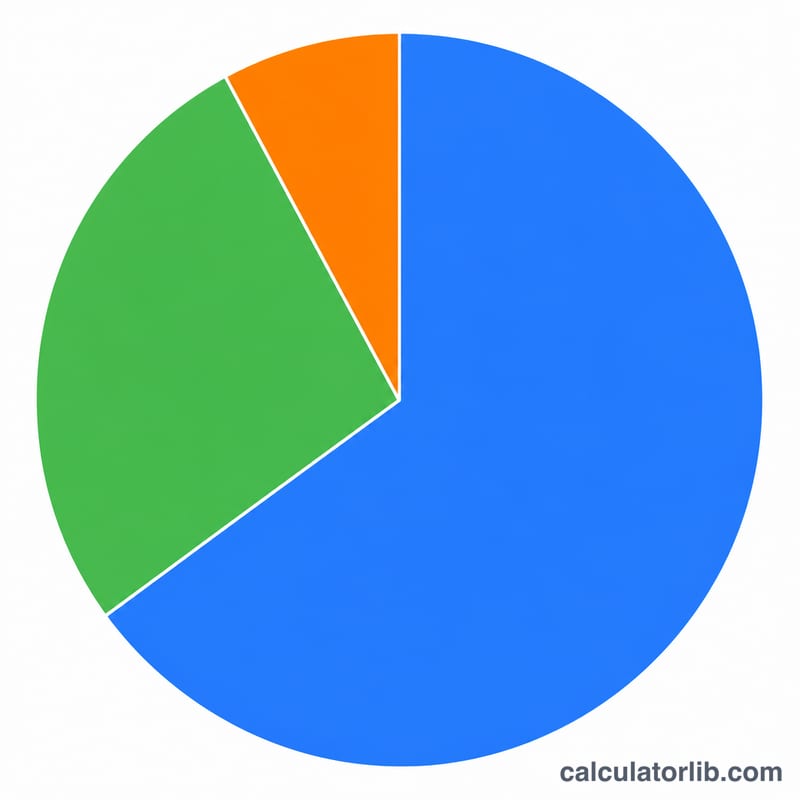
Basal Metabolic Rate (BMR) is the number of calories (kilocalories per day) your body burns at complete rest just to keep its vital functions running — breathing, circulation, cell production, and maintaining body temperature. It represents the largest portion of your total daily energy expenditure. This calculator uses the revised Harris-Benedict equation (Roza & Shizgal, 1984), an updated version of the classic 1919 formula. The equation is universal and used worldwide; no country-specific rules apply.
How to use this calculator
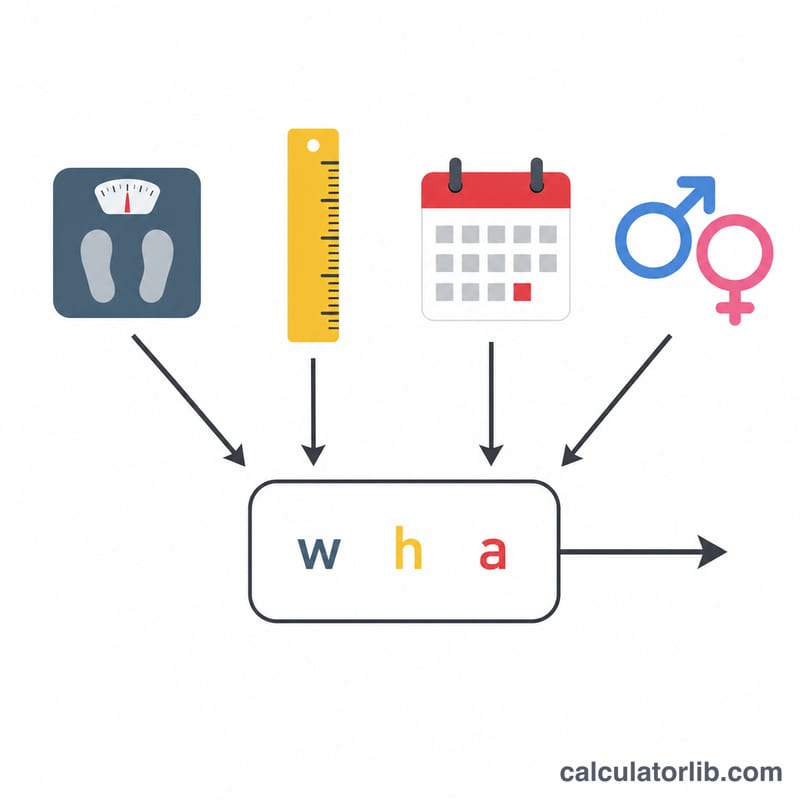
Enter your age in years, select your sex, and provide your height in centimetres and weight in kilograms. The result is your estimated BMR in kcal/day. If your measurements are in imperial units, convert first: \(1\text{ inch} = 2.54\text{ cm}\), \(1\text{ ft} = 30.48\text{ cm}\), and \(1\text{ lb} = 0.45359237\text{ kg}\).
The formula explained
The revised Harris-Benedict equation is a simple linear formula with sex-specific coefficients. For men: $$\text{BMR} = 13.397 \times \text{weight(kg)} + 4.799 \times \text{height(cm)} - 5.677 \times \text{age(years)} + 88.362$$ For women: $$\text{BMR} = 9.247 \times \text{weight} + 3.098 \times \text{height} - 4.330 \times \text{age} + 447.593$$ Weight increases BMR most strongly, height adds a smaller amount, and age reduces it as metabolism slows.
Worked example
A 30-year-old man who is 170 cm tall and weighs 60 kg: $$\text{BMR} = 13.397 \times 60 + 4.799 \times 170 - 5.677 \times 30 + 88.362 = 803.82 + 815.83 - 170.31 + 88.362 = 1537.7$$ which rounds to about 1538 kcal/day.
Frequently asked questions
How do I get my total daily calorie needs? Multiply your BMR by a physical activity factor — roughly 1.2 if sedentary up to about 1.9 if very active — to estimate Total Daily Energy Expenditure (TDEE). That step is not part of this calculator.
Is the Harris-Benedict equation accurate for everyone? It is a population-level estimate for healthy adults. It is less reliable for children, the very elderly, very lean or very obese individuals, and pregnant or lactating women.
Why "revised"? The 1984 revision by Roza and Shizgal updated the original 1919 coefficients to better fit modern data. This tool uses those revised coefficients exactly.