
What is Basal Metabolic Rate?
Your Basal Metabolic Rate (BMR) is the number of calories your body burns at complete rest to keep essential functions running — breathing, circulation, cell production, and temperature regulation. It typically accounts for 60–70% of the total calories you burn each day. Knowing your BMR is the foundation for any weight-loss, maintenance, or muscle-gain plan because it tells you the minimum energy your body requires.
How to use this calculator
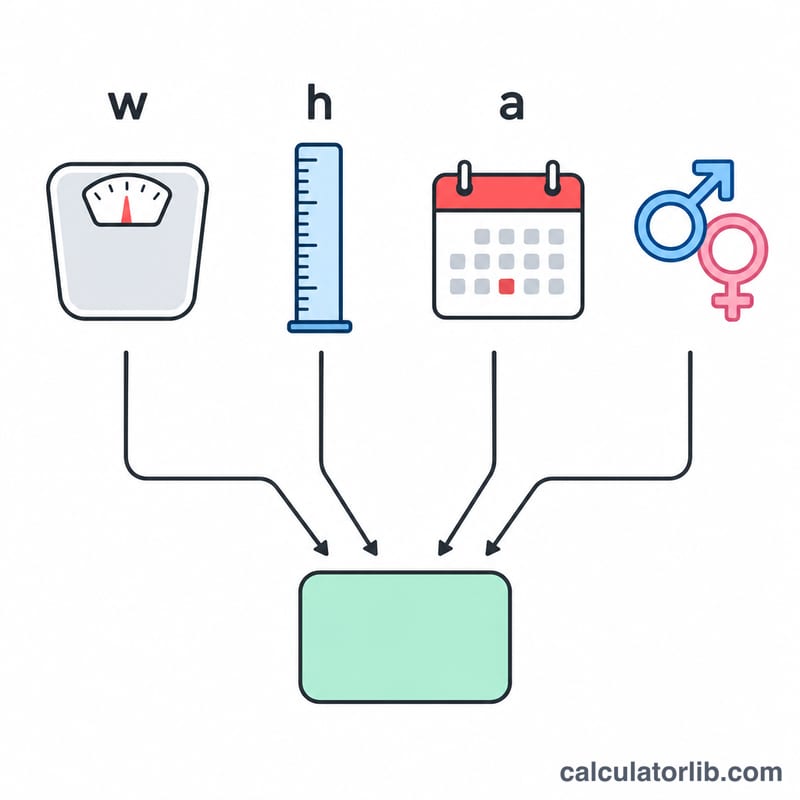
Select your gender, then enter your weight in kilograms, height in centimetres, and age in years. The calculator instantly returns your BMR in calories per day. It also shows your estimated Total Daily Energy Expenditure (TDEE) across five activity levels — multiply your BMR by an activity factor to estimate how many calories you actually burn in a typical day.
The formula explained
This tool uses the Mifflin-St Jeor equation, widely regarded as the most accurate predictive BMR formula for the general population. For men: $$\text{BMR} = (10 \times \text{kg}) + (6.25 \times \text{cm}) - (5 \times \text{age}) + 5$$ For women the only difference is the final constant: $$\text{BMR} = (10 \times \text{kg}) + (6.25 \times \text{cm}) - (5 \times \text{age}) - 161$$ The activity multipliers range from \(1.2\) (sedentary) to \(1.9\) (extra active).
Worked example
Consider a 30-year-old man weighing 70 kg at 175 cm tall: $$\text{BMR} = (10 \times 70) + (6.25 \times 175) - (5 \times 30) + 5 = 700 + 1093.75 - 150 + 5 = 1648.75 \text{ calories/day}$$ At a moderately active level (\(\times 1.55\)) his TDEE is about 2,556 calories per day.
Activity Level Multipliers
Your Basal Metabolic Rate (BMR) covers only the calories your body burns at complete rest. To estimate your Total Daily Energy Expenditure (TDEE) — the calories you actually burn in a day — you multiply BMR by an activity factor that reflects how much you move and exercise.
| Activity Level | Multiplier | Typical Weekly Activity |
|---|---|---|
| Sedentary | 1.2 | Little or no exercise; desk job, mostly sitting |
| Lightly active | 1.375 | Light exercise or sport 1–3 days per week |
| Moderately active | 1.55 | Moderate exercise or sport 3–5 days per week |
| Very active | 1.725 | Hard exercise or sport 6–7 days per week |
| Extra active | 1.9 | Very hard daily exercise, physical job, or twice-daily training |
For example, a person with a BMR of 1,600 kcal who is moderately active has an estimated TDEE of \(1{,}600 \times 1.55 = 2{,}480\) kcal per day.
Interpreting Your BMR and TDEE
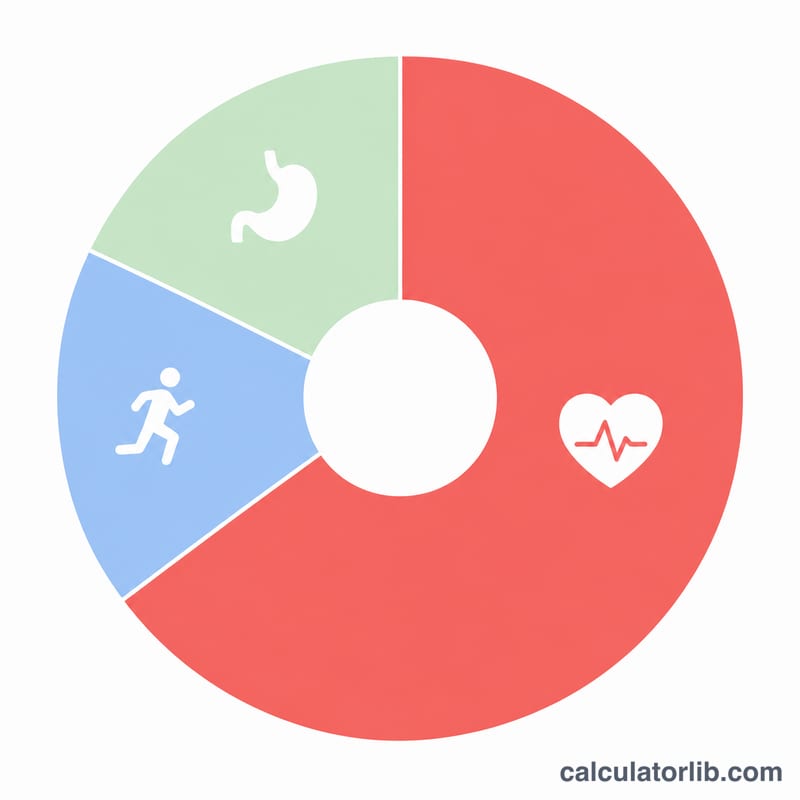
BMR (Basal Metabolic Rate) is the number of calories your body uses to keep its essential functions running — breathing, circulation, cell production and maintaining body temperature — while completely at rest. It typically accounts for the largest share (roughly 60–70%) of the calories most people burn each day.
TDEE (Total Daily Energy Expenditure) is your BMR plus all the energy used through daily movement, exercise and the digestion of food (the thermic effect of food). It is your BMR multiplied by an activity factor and represents the calories you need to maintain your current weight.
To change weight, you adjust intake relative to TDEE. Body fat stores about 3,500 kcal per pound (roughly 7,700 kcal per kilogram). A consistent deficit below TDEE drives fat loss, while a surplus drives weight gain. For instance, a daily deficit of 500 kcal corresponds to about \(\tfrac{500 \times 7}{3{,}500} = 1\) pound of fat loss per week, in theory. Real-world results vary because metabolism adapts as you lose weight.
Keep in mind that the Mifflin-St Jeor equation is an estimate. Even though it is one of the most accurate prediction equations for the general population, individual results can differ from the prediction by roughly ±10%. The formula does not directly account for body composition: people with more muscle mass burn more at rest than the equation predicts, while those with more fat mass may burn less. Factors like genetics, hormones, medications and prior dieting also shift true values.
This information is general in nature and is not medical or nutritional advice. For personalized guidance on calorie targets, weight management or any health condition, consult a qualified healthcare professional or registered dietitian.
FAQ
Is BMR the same as TDEE? No. BMR is calories burned at complete rest; TDEE includes activity and is BMR multiplied by an activity factor.
How accurate is the Mifflin-St Jeor equation? It estimates BMR within roughly 10% for most people, though body composition can shift the true value.
Should I eat at my BMR to lose weight? Generally no — eating below BMR long-term is not recommended. Create a moderate deficit from your TDEE instead.