
What this calculator does
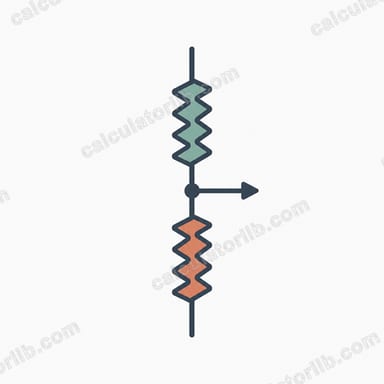
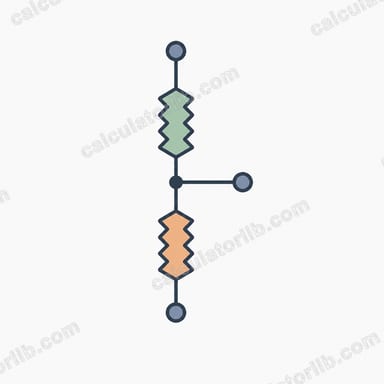
This calculator finds the output voltage of a capacitive voltage divider - two capacitors, C1 and C2, connected in series across an AC supply, with the output measured across C2 (the lower capacitor). Because a capacitor's opposition to alternating current, its reactance, is inversely proportional to its capacitance, a capacitive divider splits voltage in the opposite direction to a resistive one: the output across C2 grows with C1, not with C2.
How to use it
Enter the input (supply) voltage Vin in volts, then the two capacitance values C1 and C2 in nanofarads. C1 is the capacitor connected to the input and C2 is the capacitor connected to ground, with the output taken at the node between them. The calculator returns the output voltage across C2, the voltage across C1, the divider ratio, and the equivalent series capacitance. Any consistent capacitance unit works for the voltage results because the units cancel in the ratio.
The formula explained
For a sinusoidal signal the reactance of each capacitor is
$$X_{C1} = \frac{1}{2 \pi f C_1}, \quad X_{C2} = \frac{1}{2 \pi f C_2}$$The two capacitors carry the same current, so the voltage divides in proportion to reactance, exactly like a resistive divider:
$$V_{out} = V_{in} \cdot \frac{ X_{C2} }{ X_{C1} + X_{C2} } = V_{in} \cdot \frac{ C_1 }{ C_1 + C_2 }$$The frequency term f cancels, so the divider ratio depends only on the capacitance values. The equivalent series capacitance of the two capacitors is
$$C_{series} = \frac{ C_1 C_2 }{ C_1 + C_2 }$$Worked example
Suppose Vin is 12 V, C1 is 100 nF and C2 is 200 nF. The divider ratio is C1 / (C1 + C2) = 100 / 300 = 0.3333, so the output across C2 is 12 × 0.3333 = 4 V. The remaining 8 V appears across C1, and the series capacitance is (100 × 200) / 300 = 66.67 nF. Notice that the larger capacitor, C2, carries the smaller share of the voltage.
Frequently asked questions
Why is the output proportional to C1 and not C2? A capacitor's reactance is inversely proportional to its capacitance, so the larger capacitor has the smaller reactance and drops less voltage. The voltage across C2 therefore scales with C1, the value of the other capacitor.
Does frequency change the output voltage? No. The frequency term cancels in the ratio, so an ideal, unloaded capacitive divider produces the same ratio C1 / (C1 + C2) at every frequency.
What happens when I connect a load? A real load draws current and pulls the output below the ideal value. This calculator assumes a high-impedance, open-circuit output; for a loaded divider you must include the load impedance in parallel with C2.