
What this calculator does
This tool computes the pH of a weak monoprotic acid solution from its acid dissociation constant (Ka) and its initial molar concentration (C). Unlike the common shortcut \([\text{H}^{+}] = \sqrt{\text{K}_a \cdot \text{C}}\), this calculator solves the full quadratic that comes from the equilibrium expression, so it stays accurate even when the acid is fairly strong or dilute and dissociation is no longer negligible.
How to use it
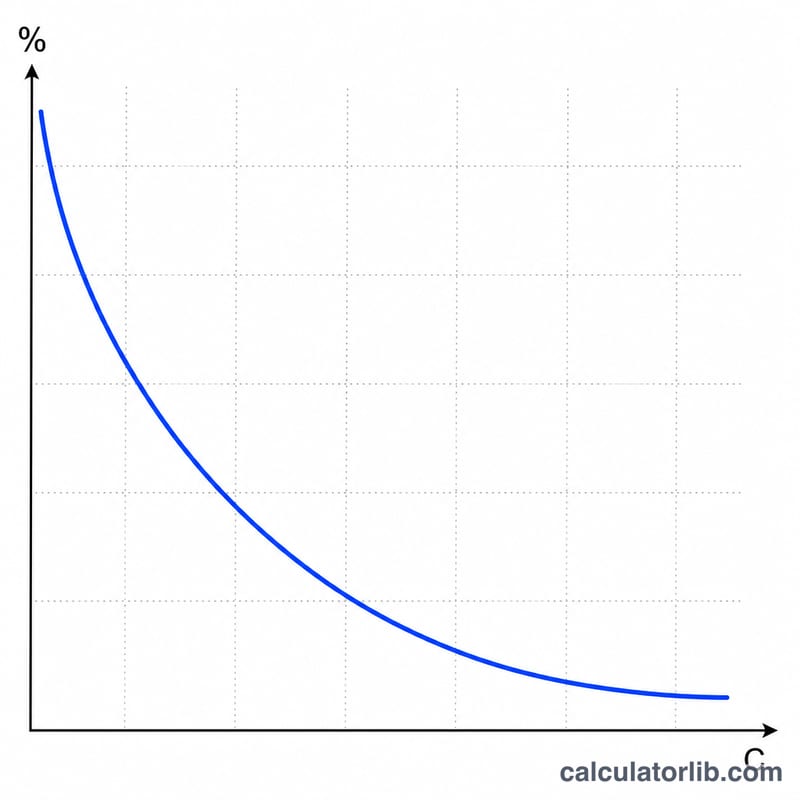
Enter the Ka value (for example \(1.8\times10^{-5}\) for acetic acid — type it as 1.8e-5) and the starting concentration of the acid in moles per litre. The calculator returns the pH plus the hydrogen-ion concentration, the pOH (14 − pH at 25 °C), and the percent dissociation, which tells you what fraction of the acid molecules have ionised.
The formula explained
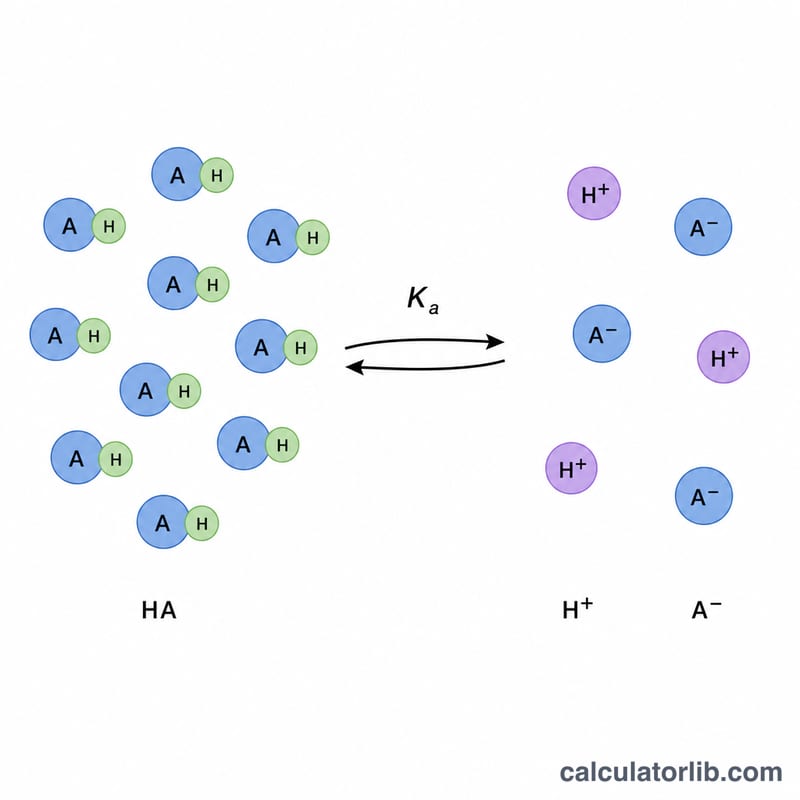
For the equilibrium HA ⇌ H⁺ + A⁻, \(\text{K}_a = \frac{x^{2}}{\text{C} - x}\), where \(x = [\text{H}^{+}]\). Rearranging gives \(x^{2} + \text{K}_a\,x - \text{K}_a\,\text{C} = 0\). Solving with the quadratic formula and keeping the positive root yields $$[\text{H}^{+}] = \frac{-\text{K}_a + \sqrt{\text{K}_a^{2} + 4\,\text{K}_a\,\text{C}}}{2}$$ Then $$\text{pH} = -\log_{10}\left( [\text{H}^{+}] \right)$$
Worked example
Acetic acid with \(\text{K}_a = 1.8\times10^{-5}\) at \(\text{C} = 0.1\ \text{mol/L}\): $$\text{K}_a^{2} + 4\,\text{K}_a\,\text{C} = 3.24\times10^{-10} + 7.2\times10^{-6} \approx 7.2003\times10^{-6}$$ Its square root is \(2.6833\times10^{-3}\), so $$[\text{H}^{+}] = \frac{-1.8\times10^{-5} + 2.6833\times10^{-3}}{2} \approx 1.3328\times10^{-3}\ \text{mol/L}$$ $$\text{pH} = -\log_{10}\left( 1.3328\times10^{-3} \right) \approx 2.88$$
FAQ
Why use the quadratic instead of \(\sqrt{\text{K}_a \cdot \text{C}}\)? The simple approximation assumes x is tiny compared with C. For dilute or stronger weak acids that assumption fails, so the quadratic gives a more reliable answer.
Does this work for polyprotic acids? It only treats the first ionisation. For diprotic or triprotic acids you would need to handle subsequent equilibria separately.
What temperature does pOH assume? The pOH uses \(\text{K}_w = 10^{-14}\), valid at 25 °C. At other temperatures Kw changes.