
What is a Barometric Pressure Unit Converter?
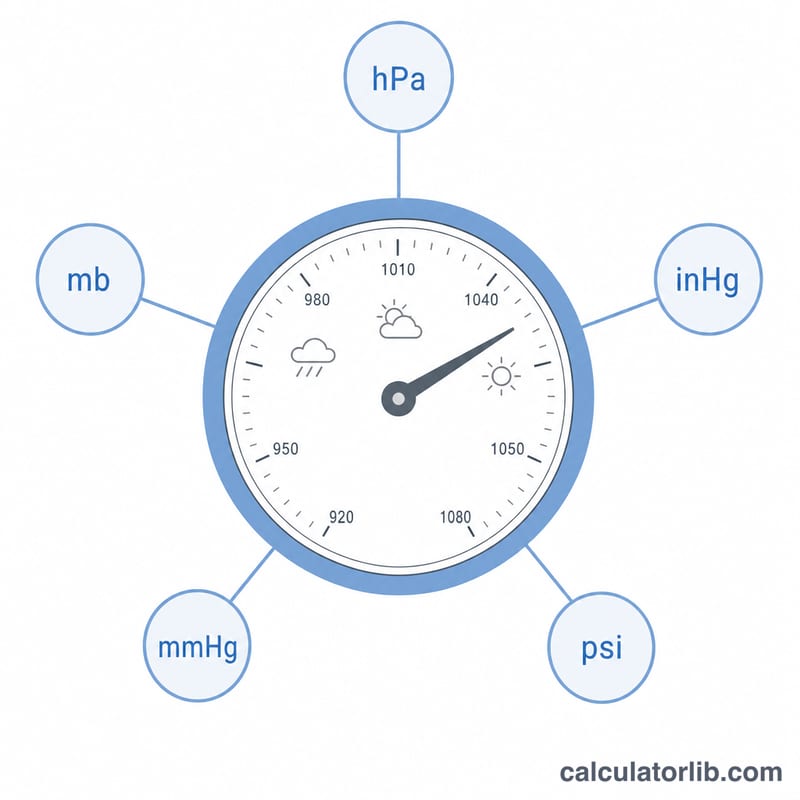
Atmospheric (barometric) pressure is reported in different units around the world. Meteorologists and aviators in many countries use hectopascals (hPa) or the numerically identical millibar (mb), while the United States traditionally uses inches of mercury (inHg). Medical and laboratory settings often use millimeters of mercury (mmHg), and engineers may need pounds per square inch (psi). This converter lets you enter a pressure in any one of these units and instantly see all the equivalents.
How to use it
Enter your pressure value, choose the unit it is currently expressed in, and submit. The tool first converts your value to hectopascals as a common base, then derives every other unit. Standard sea-level pressure is 1013.25 hPa, equal to 1013.25 mb, about 29.92 inHg, 760 mmHg and 14.696 psi.
The formula explained
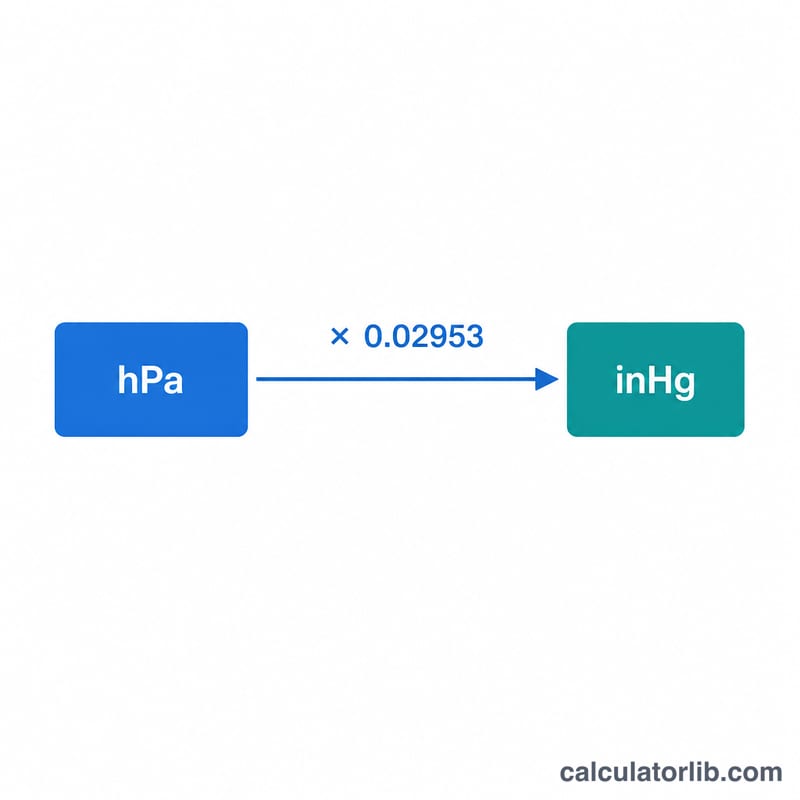
All conversions are anchored to the hectopascal. From hPa the factors are: \(\text{inHg} = \text{hPa} \times 0.02953\), \(\text{mmHg} = \text{hPa} \times 0.750062\), \(\text{psi} = \text{hPa} \times 0.0145038\), and \(\text{mb} = \text{hPa}\) (they are defined as equal). When you enter a value in another unit, the converter divides by the matching factor to get hPa first.
Worked example
Suppose your barometer reads 1013.25 hPa. Then $$\text{inHg} = 1013.25 \times 0.02953 \approx 29.92,$$ $$\text{mmHg} = 1013.25 \times 0.750062 \approx 760.0,$$ and $$\text{psi} = 1013.25 \times 0.0145038 \approx 14.696.$$ The millibar value is simply 1013.25 mb.
Interpreting Your Pressure Reading
Once you convert your measurement into a common weather unit, the number tells you something about the state of the atmosphere overhead. Meteorologists most often report pressure in hectopascals (hPa), which are numerically identical to millibars (mb): \(1\ \text{hPa} = 1\ \text{mb}\). Aviation and U.S. weather reports frequently use inches of mercury (inHg) instead.
The standard reference
The internationally defined standard sea-level atmospheric pressure is 1013.25 hPa. This single value is the agreed reference point used to define one standard atmosphere, and it equals approximately 29.92 inHg, 760 mmHg, and 14.696 psi. When a barometer reads close to this figure, the atmosphere is near its average sea-level state.
Typical sea-level range
At sea level, barometric pressure normally fluctuates within roughly 980–1030 hPa as weather systems move through. Readings outside this band do occur—deep storms and powerful anticyclones can push beyond it—but the great majority of day-to-day values fall inside it.
What the value suggests about the weather
- Low pressure (below about 1000 hPa): generally associated with rising air, clouds, wind, and unsettled or stormy weather. The lower and more rapidly falling the reading, the more vigorous the system tends to be; tropical cyclones can drop well below 950 hPa.
- Near standard (about 1000–1020 hPa): typical, often changeable conditions—the trend (rising or falling) matters more than the exact value.
- High pressure (above about 1020 hPa): generally associated with sinking air that suppresses cloud formation, bringing settled, fair, and often calm weather.
It is worth noting that the direction and speed of change are usually more informative than any single reading. A steadily falling barometer signals deteriorating conditions, while a rising barometer suggests improving weather, regardless of whether the absolute value is slightly above or below 1013.25 hPa.
Two cautions when interpreting raw values: surface stations report pressure adjusted ("reduced") to sea level so that locations at different elevations can be compared—an un-reduced reading taken at altitude will be considerably lower. This is general weather-interpretation information, not a substitute for an official forecast.
FAQ
Is hPa the same as millibar? Yes — \(1\ \text{hPa} = 1\ \text{mb}\) exactly, so the numbers are always identical.
What is standard sea-level pressure? 1013.25 hPa, which is 29.92 inHg or 760 mmHg.
Why does the US use inHg? It is a historical convention from mercury barometers; aviation altimeters in the US are set in inches of mercury.