
What this calculator does
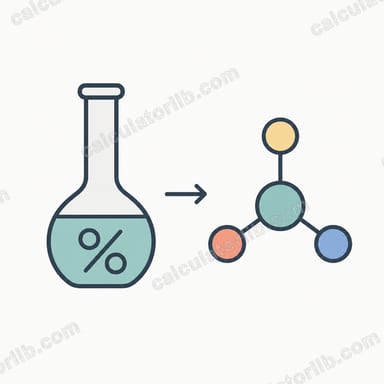
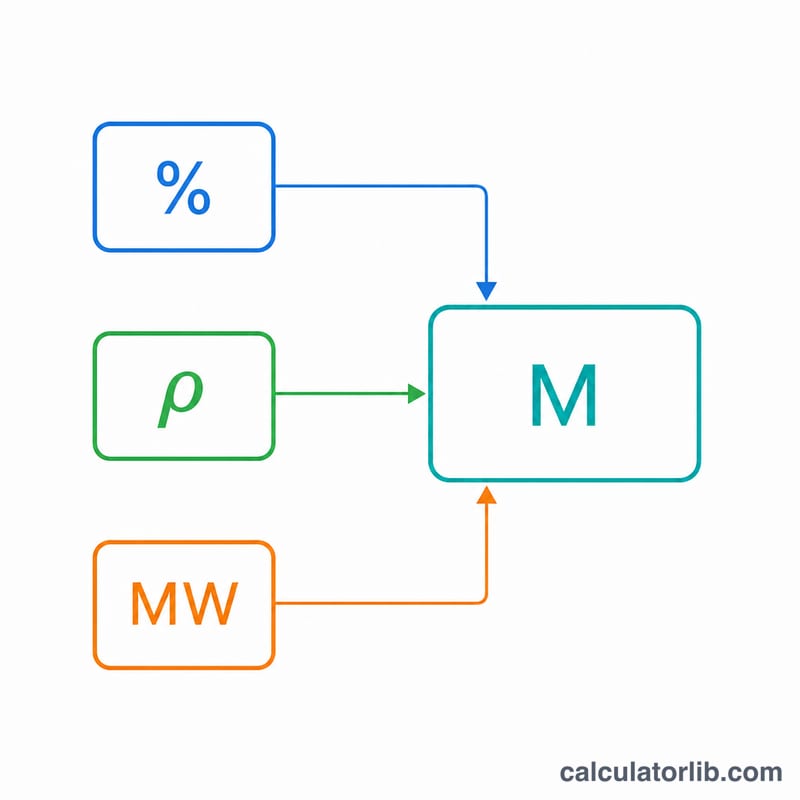
The Concentrated Acid Molarity Calculator converts the label information of a concentrated acid or stock chemical—its mass percent (%w/w), density, and molar mass—into molarity expressed in moles per liter (M). This is a universal chemistry calculation and applies anywhere. It is especially handy for preparing dilutions of common reagents such as hydrochloric acid, sulfuric acid, nitric acid, and ammonia.
The formula explained
The working equation is:
$$M = \frac{10 \cdot \%w/w \cdot \rho}{MW}$$
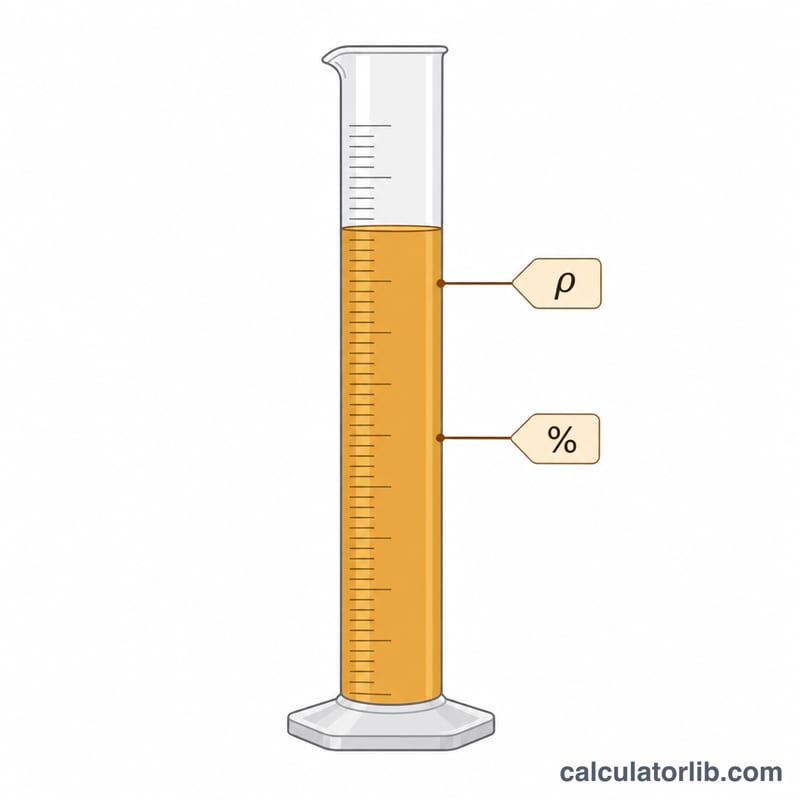
Here %w/w is the mass percentage of the solute, \(\rho\) is the solution density in g/mL, and MW is the molar mass of the solute in g/mol. One liter of solution weighs \(1000 \cdot \rho\) grams; multiplying by %w/w/100 gives the grams of solute, and dividing by MW gives moles. Combining the constants (1000/100 = 10) yields the compact factor of 10.
How to use it
Enter the mass percent printed on the bottle (e.g. 37 for concentrated HCl), the density in g/mL (e.g. 1.19), and the molar mass of the solute (e.g. 36.46 g/mol for HCl). The calculator returns the molarity in mol/L.
Worked example
For concentrated hydrochloric acid: %w/w = 37, \(\rho\) = 1.19 g/mL, MW = 36.46 g/mol.
$$M = \frac{10 \times 37 \times 1.19}{36.46} = \frac{440.3}{36.46} \approx 12.08 \text{ mol/L}$$ This matches the familiar ~12 M value for reagent-grade HCl.
FAQ
Why the factor of 10? It comes from 1000 mL/L divided by 100 (to turn a percentage into a fraction): 1000/100 = 10.
What density should I use? Use the density of the concentrated solution at the stated temperature, usually printed on the manufacturer's certificate of analysis.
Can I use it for bases? Yes—it works for any solution where you know mass percent, density, and the solute's molar mass, including ammonia and sodium hydroxide solutions.