
What Is Capacitive Reactance?
Capacitive reactance (Xc) is the opposition that a capacitor presents to alternating current (AC). Unlike a resistor, a capacitor's opposition depends on the signal frequency: the higher the frequency, the lower the reactance. Reactance is measured in ohms (Ω), just like resistance, but it does not dissipate energy as heat — it stores and releases it.
How to Use This Calculator
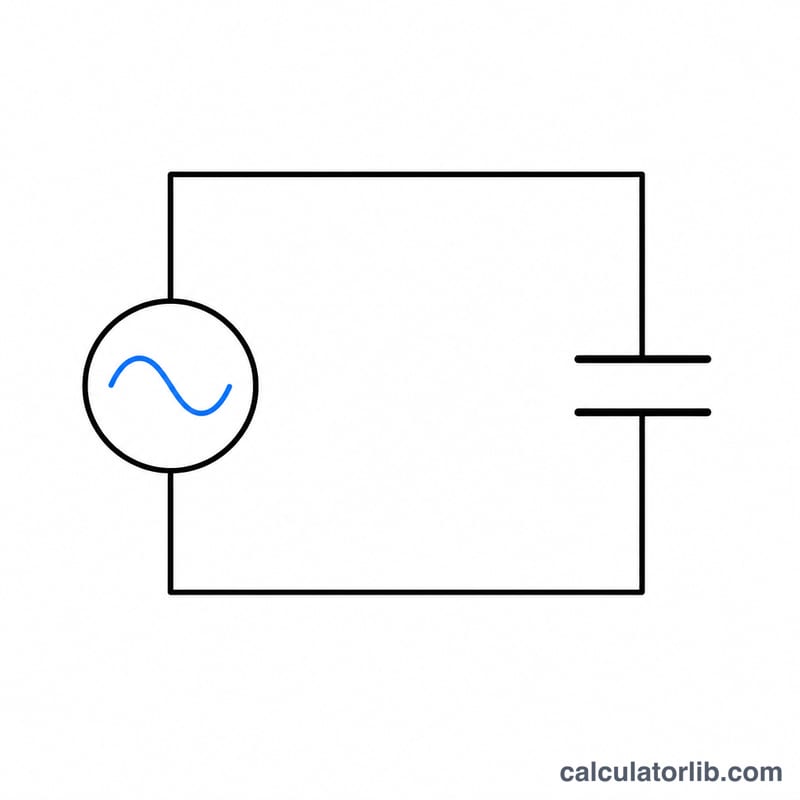
Enter the AC frequency in hertz (Hz) and the capacitance value in microfarads (µF). The calculator converts microfarads to farads automatically and returns the capacitive reactance in ohms. Use it for filter design, coupling/decoupling networks, and AC circuit analysis.
The Formula Explained
The reactance is given by \(X_C = \dfrac{1}{2\pi f C}\), where f is frequency in hertz and C is capacitance in farads. The constant \(2\pi\) converts frequency to angular frequency (\(\omega = 2\pi f\)). As f or C increases, the product in the denominator grows and Xc falls — which is why capacitors pass high frequencies and block DC (0 Hz gives infinite reactance).
$$X_C = \frac{1}{2\pi \cdot \text{Frequency (Hz)} \cdot \text{Capacitance (µF)} \times 10^{-6}}$$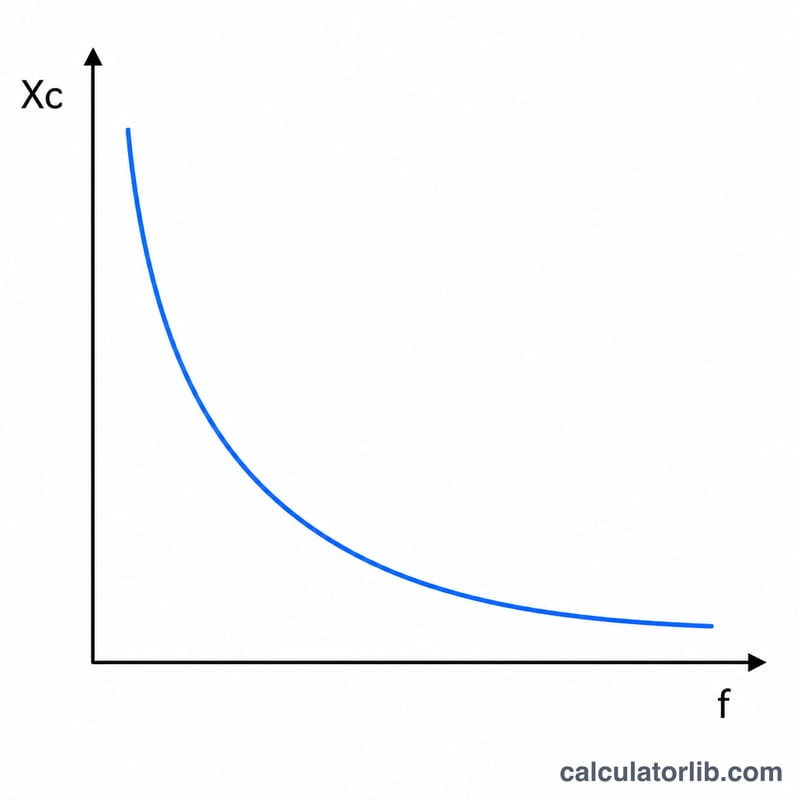
Worked Example
For a 10 µF capacitor at 60 Hz: \(C = 10 \times 10^{-6} = 0.00001 \ \text{F}\). Then $$X_C = \frac{1}{2 \times \pi \times 60 \times 0.00001} = \frac{1}{0.0037699} \approx 265.26 \ \Omega.$$ At 1000 Hz the same capacitor would have only \(\approx 15.9 \ \Omega\) of reactance.
FAQ
Why does reactance decrease with frequency? A capacitor charges and discharges more readily as the signal alternates faster, so it impedes the current less.
What is the reactance at DC? At 0 Hz the denominator is zero, giving infinite reactance — a capacitor blocks DC.
What units should I use? Enter frequency in Hz and capacitance in µF; the result is in ohms. For nanofarads divide by 1000 to convert to µF, or for picofarads divide by 1,000,000.