
What Is a Capacitive Transformerless Power Supply?
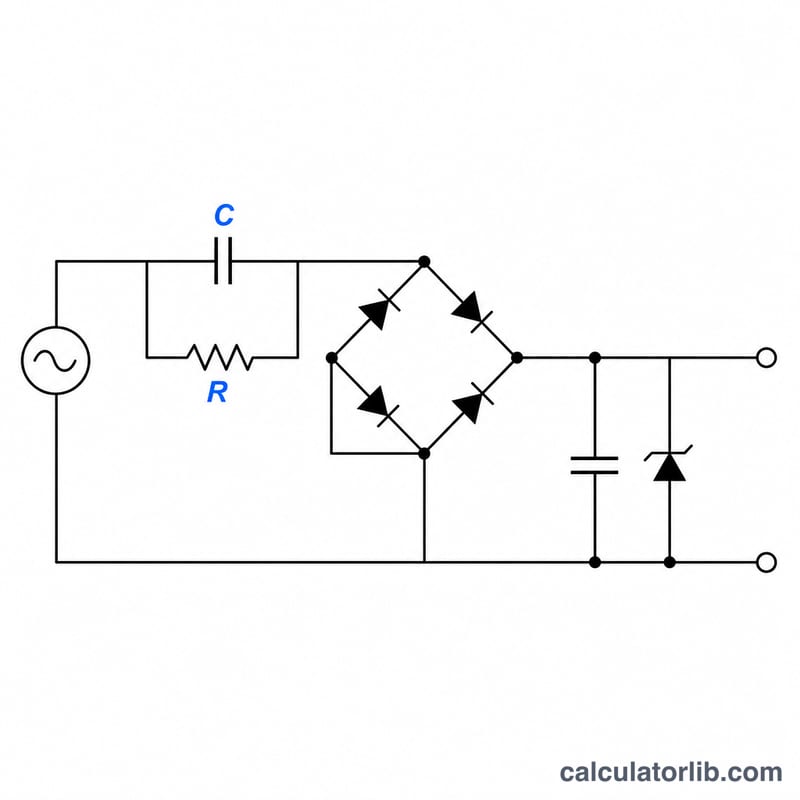
A capacitive (or "capacitor dropper") transformerless power supply uses the reactance of an X-rated capacitor in series with the AC mains to limit current to a small low-voltage load — typically a few milliamps for an LED indicator, a microcontroller, or a relay coil. Because the capacitor stores and releases energy rather than dissipating it like a resistor, this approach is compact and runs cool, which is why it is widely used in mains-connected appliances. Warning: these circuits are not isolated from the mains and are dangerous to touch — treat the entire circuit as live.
How to Use This Calculator
Enter your mains voltage (e.g. 230 V in Europe, 120 V in North America), the mains frequency (50 or 60 Hz), the dropper capacitor value in microfarads, and the output voltage of your load. The calculator returns the capacitive reactance, the available RMS output current in milliamps, and the approximate power delivered to the load.
The Formula Explained
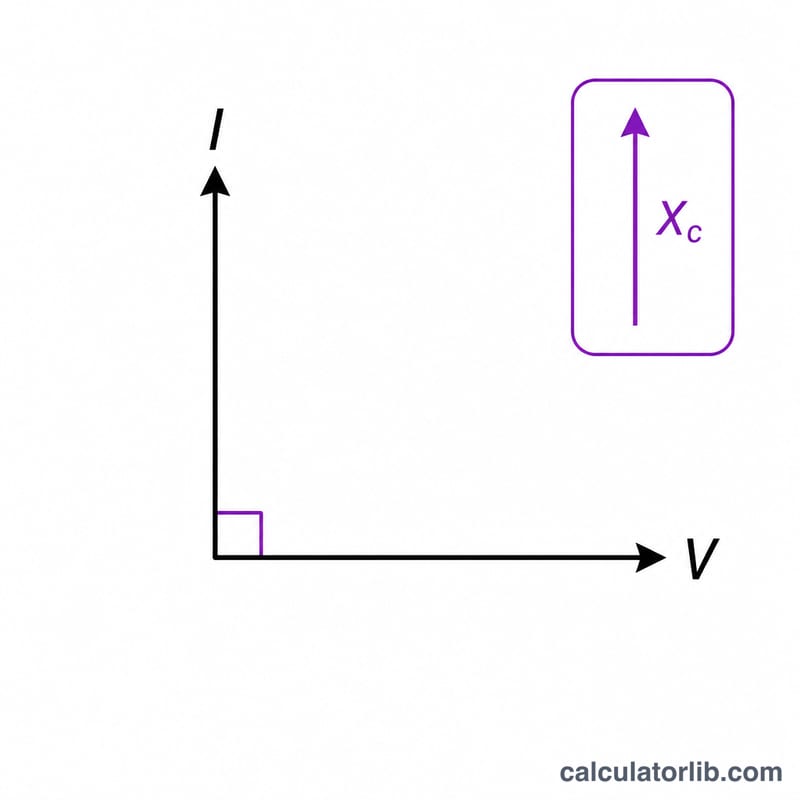
The capacitor presents a reactance \(X_c = \dfrac{1}{2\pi f C}\), measured in ohms. The current it allows to pass is set by Ohm's law for reactance: \(I = \dfrac{V_{mains}}{X_c}\), which simplifies to:
$$I = V_{mains} \times 2\pi f C$$This is the maximum RMS current available; the actual current is dominated by the capacitor because its reactance is far larger than the low-voltage load.
Worked Example
For a 0.47 µF capacitor on 230 V / 50 Hz mains:
$$2\pi f C = 6.2832 \times 50 \times 0.47 \times 10^{-6} = 1.4765 \times 10^{-4}\ \text{S}$$Reactance:
$$X_c = \frac{1}{1.4765 \times 10^{-4}} \approx 6773\ \Omega$$Current:
$$I = 230 \times 1.4765 \times 10^{-4} \approx 0.03396\ \text{A} \approx 33.96\ \text{mA RMS}$$FAQ
What capacitor type should I use? Always use an X1 or X2 rated safety capacitor designed for direct mains connection.
Why add a bleeder resistor? A high-value resistor across the capacitor discharges it safely after power-off so the capacitor does not hold a dangerous charge.
Is the output regulated? No — a zener diode or regulator clamps the output voltage, and the current calculated here is the maximum the dropper can supply.