
What Is a Forward Converter Calculator?
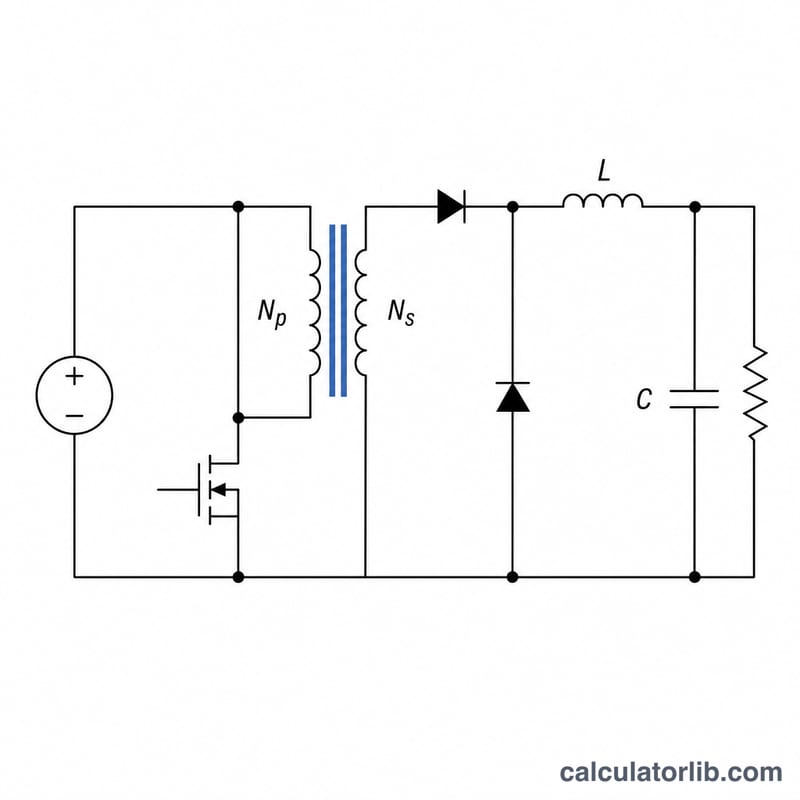
A forward converter is an isolated DC-DC switching topology that transfers energy through a transformer while the switch is on. This calculator finds the ideal continuous-conduction-mode output voltage from three quantities: the input (supply) voltage, the transformer turns ratio between secondary and primary windings, and the switching duty cycle. It is a universal electronics engineering tool useful for power supply design, education, and quick verification.
How to Use It
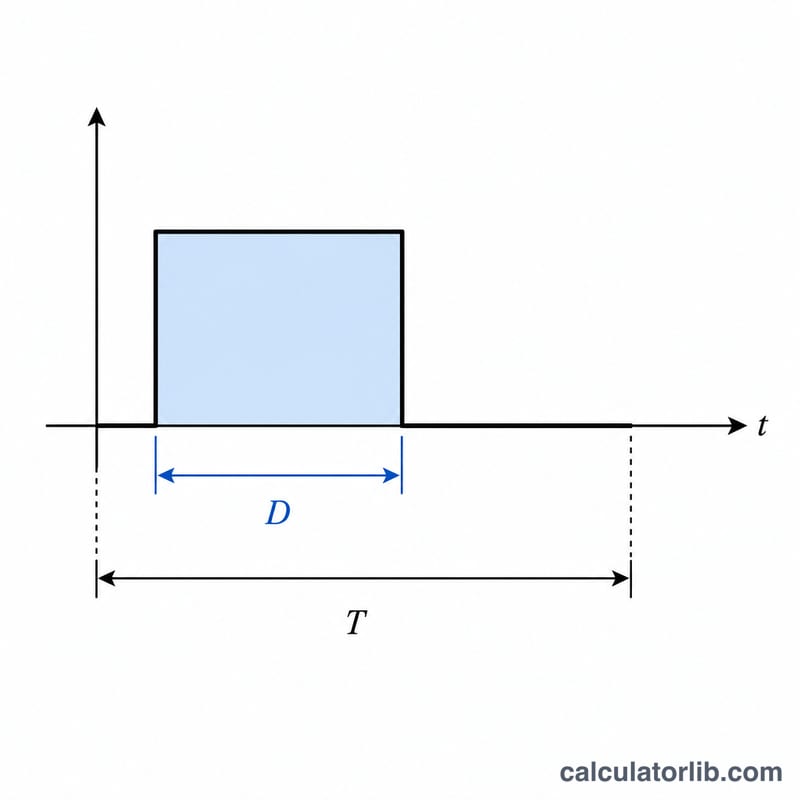
Enter the input voltage Vin in volts, the primary winding turns Np, the secondary winding turns Ns, and the duty cycle D as a fraction between 0 and 1 (for example, 40% = 0.4). The calculator returns the steady-state output voltage along with the computed turns ratio.
The Formula Explained
The ideal forward converter output is:
$$V_{out} = \text{V}_{in} \cdot \frac{\text{N}_s}{\text{N}_p} \cdot \text{D}$$
The transformer scales the input by the turns ratio \(N_s/N_p\), and because energy is delivered only during the on-time, the output is further multiplied by the duty cycle \(D\). This neglects diode drops, winding resistance, and leakage inductance, giving the ideal design target.
Worked Example
Suppose Vin = 48 V, Np = 10 turns, Ns = 5 turns, and D = 0.4. The turns ratio is \(5/10 = 0.5\). Then $$V_{out} = 48 \times 0.5 \times 0.4 = 9.6 \text{ V}.$$ To raise the output, you can increase the duty cycle or the secondary turns.
FAQ
What duty cycle range is valid? A forward converter normally operates below about 0.5 to allow the transformer core to reset; values are entered between 0 and 1.
Does this include diode losses? No. This is the ideal equation; expect the real output to be slightly lower due to rectifier and resistive losses.
Can I solve for duty cycle instead? Rearrange: \(D = V_{out} / (V_{in} \cdot N_s/N_p)\). This tool solves for \(V_{out}\), but the relationship is easily inverted.