
What Is the Hydraulic Pressure Calculator?
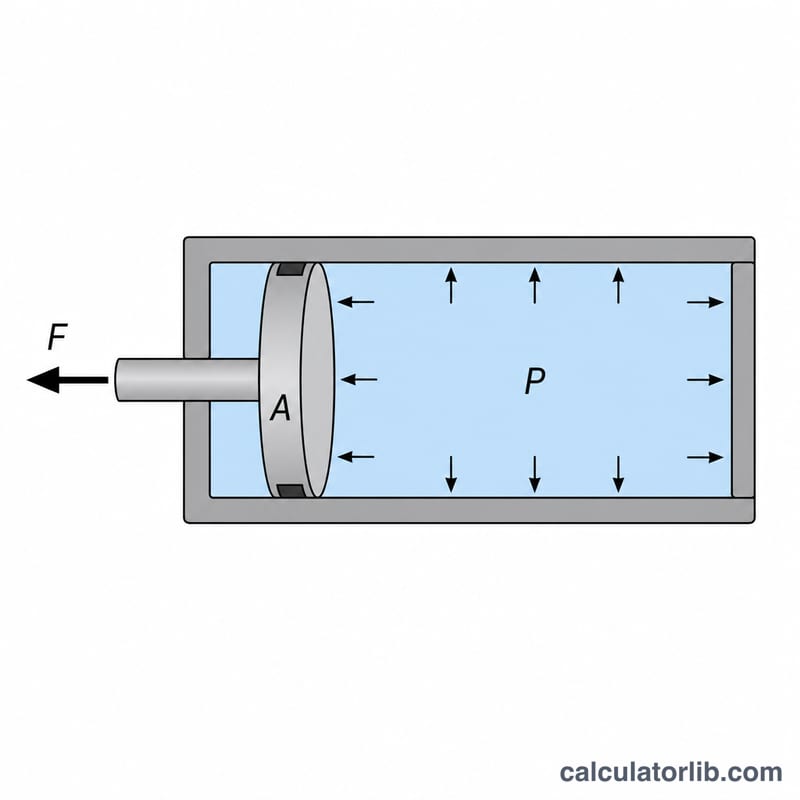
This calculator finds the pressure produced inside a hydraulic system when a force is applied to a piston of a known area. It uses the fundamental relationship \(P = F / A\), where pressure is force divided by the area it acts on. This principle is the basis of Pascal's law and underpins hydraulic jacks, presses, brakes, and lifts. The tool is universal — it works with any consistent SI inputs (newtons and square metres) and also reports the result in kilopascals, bar, and psi for convenience.
How to Use It
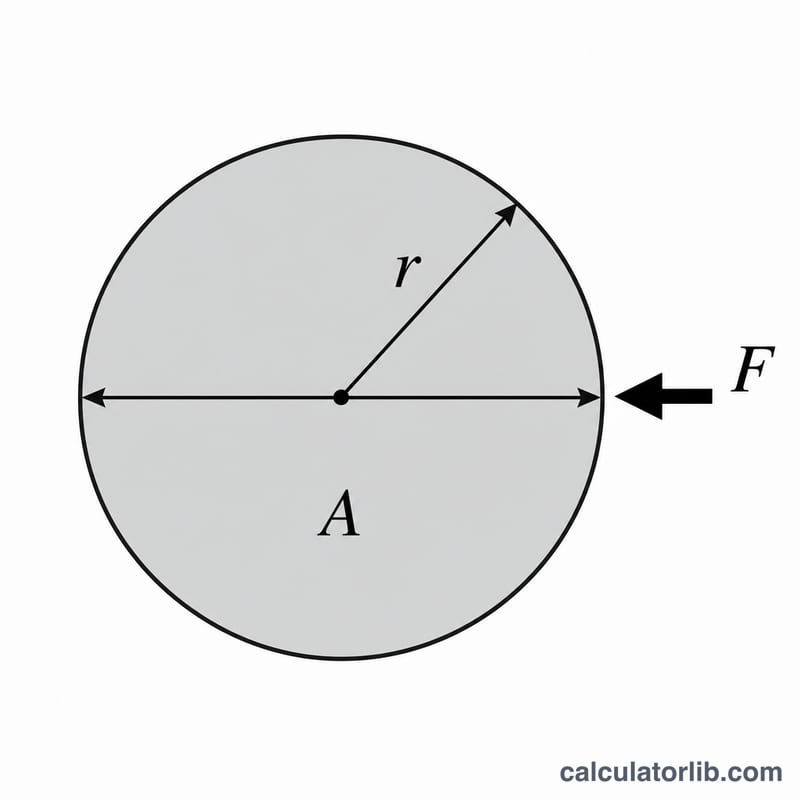
Enter the applied force in newtons (N) and the piston (or contact) area in square metres (m²). The calculator divides force by area to give pressure in pascals (Pa), then converts that value into kPa, bar, and psi. To convert from other units first: 1 kgf ≈ 9.80665 N, and a circular piston area is \(A = \pi \cdot r^2\) where \(r\) is the radius in metres.
The Formula Explained
Pressure is defined as force per unit area:
$$P = \frac{F}{A}$$One pascal equals one newton per square metre (\(1\ \text{Pa} = 1\ \text{N/m}^2\)). Because area is in the denominator, a smaller piston concentrates the same force into a higher pressure — which is why hydraulic systems can multiply force by using pistons of different sizes.
Worked Example
Suppose a press applies a force of 5,000 N to a piston with an area of 0.01 m². Then
$$P = \frac{5000}{0.01} = 500{,}000\ \text{Pa} = 500\ \text{kPa} = 5\ \text{bar} \approx 72.5\ \text{psi}$$Halving the area to 0.005 m² would double the pressure to 1,000,000 Pa.
FAQ
What units should I use? Use newtons for force and square metres for area to get pascals directly. The tool then converts to kPa, bar, and psi automatically.
How do I find the piston area from its diameter? Use \(A = \pi \times (d/2)^2\), with the diameter \(d\) expressed in metres.
Why does a smaller piston give higher pressure? Since \(P = F / A\), dividing the same force by a smaller area yields a larger pressure value.