
What is the Knudsen Number?
The Knudsen number (Kn) is a dimensionless quantity that compares the molecular mean free path of a gas to a representative physical length scale of the system. It tells you whether a gas can be treated as a continuous fluid or whether individual molecular collisions dominate the behavior. It is named after Danish physicist Martin Knudsen and is widely used in microfluidics, vacuum technology, aerospace re-entry aerodynamics, and porous-media flow.
How to Use This Calculator
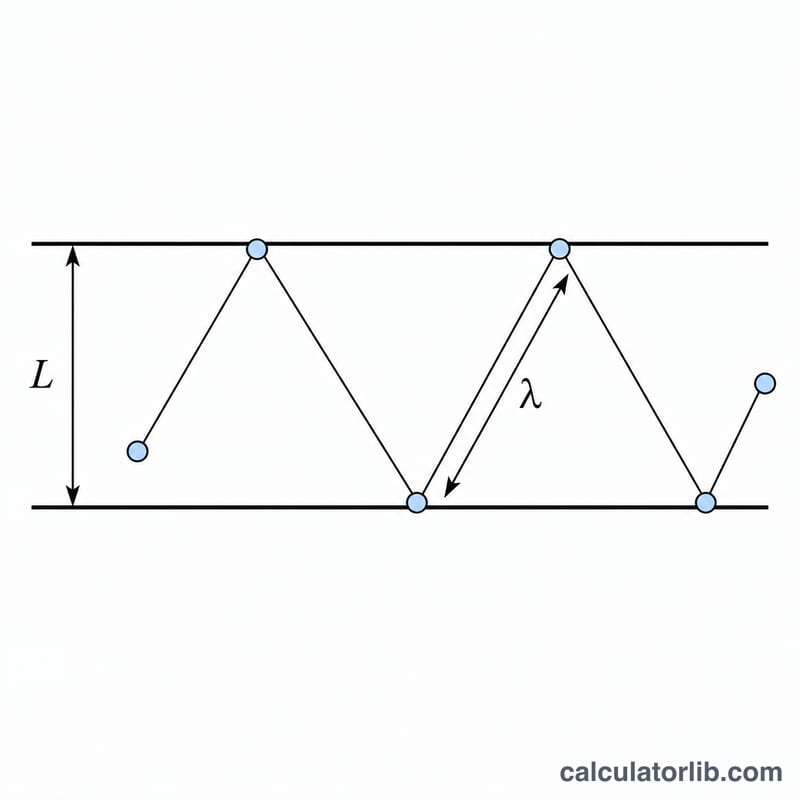
Enter the mean free path \(\lambda\) (the average distance a molecule travels between collisions, in meters) and the characteristic length \(L\) (such as a channel diameter or particle size, in meters). The calculator divides the two values to give Kn and classifies the resulting flow regime.
The Formula Explained
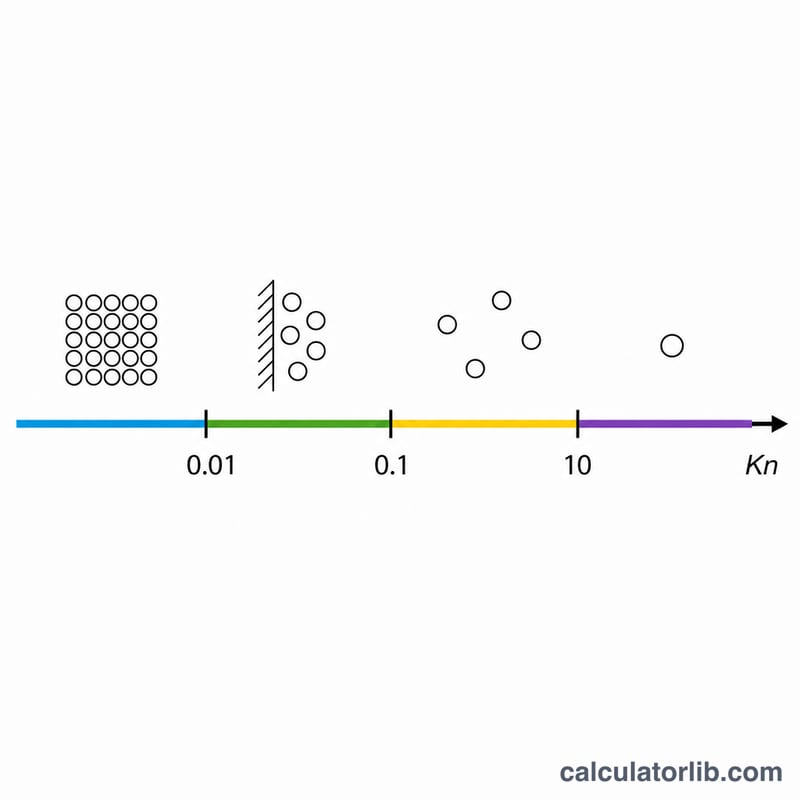
The defining equation is $$\text{Kn} = \frac{\lambda}{L}$$ Because both quantities share the same units, the result is dimensionless. Common regime boundaries are: \(\text{Kn} < 0.01\) continuum flow (Navier–Stokes equations valid), \(0.01 \le \text{Kn} < 0.1\) slip flow, \(0.1 \le \text{Kn} < 10\) transitional flow, and \(\text{Kn} \ge 10\) free molecular flow where intermolecular collisions are rare.
Worked Example
Air at standard conditions has a mean free path of about \(\lambda = 6.81 \times 10^{-8}\ \text{m}\). For a microchannel of \(L = 0.001\ \text{m}\) (1 mm), $$\text{Kn} = \frac{6.81 \times 10^{-8}}{0.001} = 6.81 \times 10^{-5}$$ Since this is far below 0.01, the flow is in the continuum regime and standard fluid dynamics applies.
FAQ
What units should I use? Any units work as long as \(\lambda\) and \(L\) use the SAME unit (e.g. both in meters), because Kn is a ratio.
Why does the regime matter? It determines which physics model is valid — using continuum equations in the free-molecular regime gives wrong results.
What is the mean free path of air? Roughly 68 nm (\(6.8 \times 10^{-8}\ \text{m}\)) at sea-level standard temperature and pressure.