
What is the Magnus force?
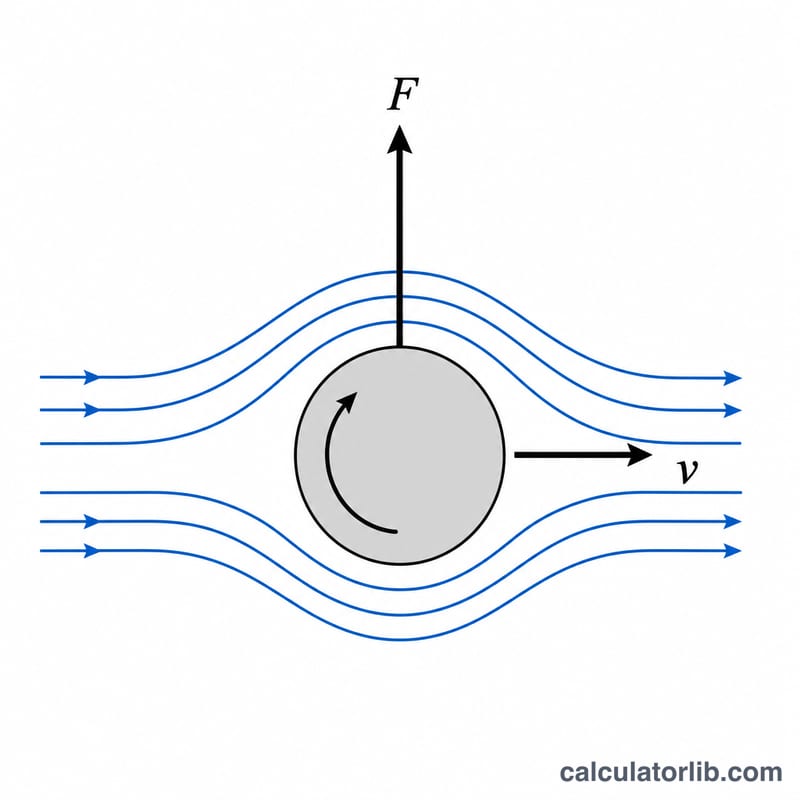
The Magnus force is the sideways (lift) force experienced by a spinning object as it moves through a fluid such as air. The spin drags air around the object, creating a pressure difference between the two sides and deflecting the ball's path. It explains the curve of a soccer free-kick, the dip of a topspin tennis shot and the break of a curveball.
How to use this calculator
Enter the air density (about 1.225 kg/m³ at sea level), the ball's velocity in metres per second, the ball radius in metres, and a dimensionless lift coefficient CL that represents the spin. Higher spin rates produce larger CL values (typically 0.1–0.4 for sports balls). The calculator returns the Magnus force in newtons along with the computed cross-sectional area.
The formula explained
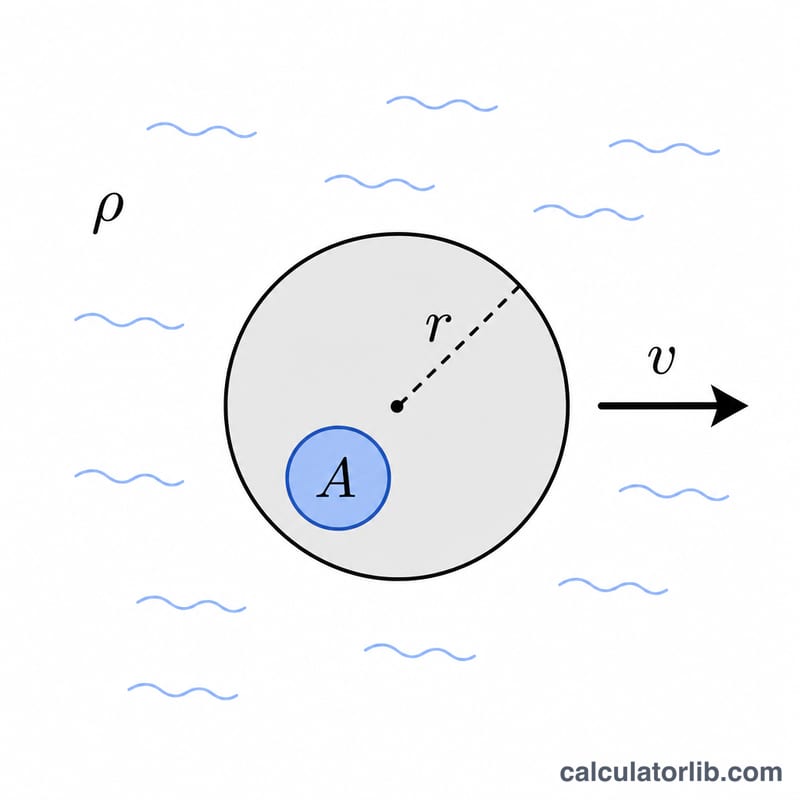
The force is given by $$F = \tfrac{1}{2}\,\rho\,v^{2}\,A\,C_L$$ where \(\rho\) is air density, \(v\) is speed, \(A = \pi r^{2}\) is the frontal area and \(C_L\) is the lift coefficient. The \(v^{2}\) dependence means the force grows rapidly with speed — doubling the velocity quadruples the force.
Worked example
A soccer ball with radius 0.11 m travels at 25 m/s through air of density 1.225 kg/m³ with \(C_L = 0.25\). The area is $$A = \pi \cdot 0.11^{2} \approx 0.038013 \ \text{m}^2.$$ The force is $$F = 0.5 \cdot 1.225 \cdot 25^{2} \cdot 0.038013 \cdot 0.25 \approx 3.638 \ \text{N}$$ — enough to bend the ball noticeably over its flight.
FAQ
What value should I use for CL? It depends on the spin parameter \(S = r\omega/v\). For sports balls \(C_L\) commonly ranges from 0.1 to 0.4; use measured data when available.
What air density should I use? About 1.225 kg/m³ at sea level and 15 °C. It drops at altitude or higher temperatures.
Why does the force curve the ball? The Magnus force acts perpendicular to both the velocity and the spin axis, pushing the ball sideways or upward/downward as it flies.