What this calculator does
This tool tells you how much sales revenue (turnover) your business needs to generate in order to earn a specific target profit. It is based on cost-volume-profit (CVP) analysis, the same framework used for break-even calculations, but extended so the result covers not just your costs but also a profit you choose. It works with any currency — just enter your figures in the same units.
How to use it
Enter three values: the Target Profit you want to earn, the Variable Cost Ratio (variable costs expressed as a percentage of sales), and your total Fixed Cost. The calculator returns the Required Sales, rounded to the nearest whole currency unit.
The formula explained
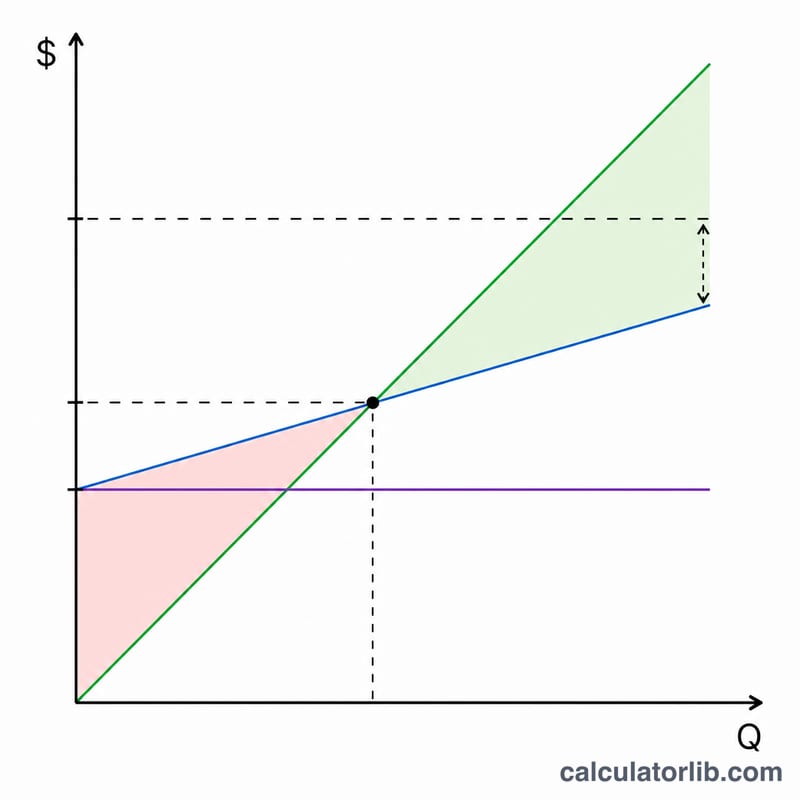
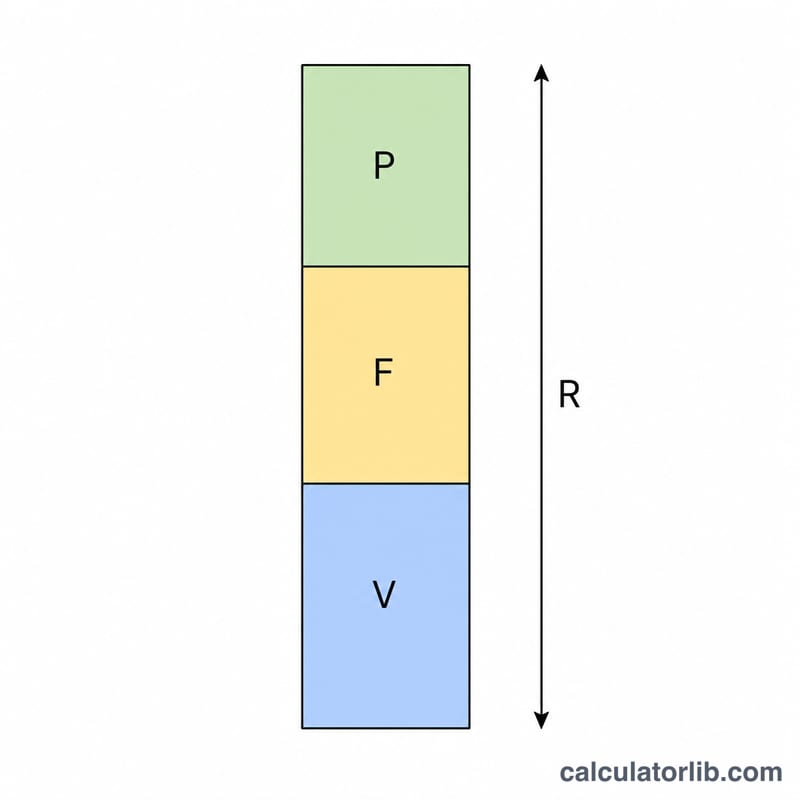
Profit equals Sales minus variable costs minus fixed costs. Variable costs scale with sales, so they equal Sales × v, where v is the variable cost ratio as a fraction. Setting profit equal to your target gives:
$$\text{Target Profit} = \text{Sales} \times (1 - v) - \text{Fixed Cost}$$
Solving for Sales: $$\text{Required Sales} = \dfrac{\text{Target Profit} + \text{Fixed Cost}}{1 - v}$$ The term \(1 - v\) is the contribution margin ratio — the share of every sales dollar available to cover fixed costs and profit.
Worked example
Suppose you want a profit of 1,000,000, your variable cost ratio is 50% (so \(v = 0.50\) and the contribution margin ratio is 0.50), and fixed costs are 200,000. Then $$\text{Required Sales} = \frac{1{,}000{,}000 + 200{,}000}{0.50} = \frac{1{,}200{,}000}{0.50} = 2{,}400{,}000$$ Check: at 2,400,000 sales, variable costs are 1,200,000, fixed costs 200,000, leaving exactly 1,000,000 profit.
Required Sales Under Different Cost Ratios and Profit Targets
The table holds fixed costs constant at 200,000 (any currency) and applies \(\text{Required Sales} = \dfrac{\text{Target Profit} + \text{Fixed Cost}}{1 - v}\), where \(v\) is the variable cost ratio as a decimal.
| Variable cost ratio | Contribution margin ratio | Target profit 0 (break-even) | Target profit 500,000 | Target profit 1,000,000 |
|---|---|---|---|---|
| 40% | 60% | 333,333 | 1,166,667 | 2,000,000 |
| 50% | 50% | 400,000 | 1,400,000 | 2,400,000 |
| 60% | 40% | 500,000 | 1,750,000 | 3,000,000 |
| 70% | 30% | 666,667 | 2,333,333 | 4,000,000 |
| 80% | 20% | 1,000,000 | 3,500,000 | 6,000,000 |
Required sales rise nonlinearly as the variable cost ratio approaches 100%, because the denominator \(1 - v\) shrinks toward zero. With a 500,000 target, moving from 40% to 50% adds about 233,333 in required sales, while moving from 70% to 80% adds about 1,166,667. At a ratio of 100% the contribution margin is zero, so no sales level can cover fixed costs or reach a profit.
Key Terms in CVP Analysis
- Target profit: the operating profit you want to earn over a period, in currency units. It is usually treated as pre-tax.
- Variable cost ratio: variable costs as a percentage of sales revenue (variable costs ÷ sales × 100).
- Contribution margin ratio: the share of each unit of sales left after variable costs to cover fixed costs and profit. Contribution margin ratio = 1 − variable cost ratio.
- Fixed costs: costs that stay the same in total over the relevant range of activity, such as rent or salaried staff.
- Variable costs: costs that change roughly in proportion to sales or volume, such as materials or sales commissions.
- Break-even sales: the sales level at which profit is zero, equal to fixed costs ÷ contribution margin ratio.
- Required sales: the sales revenue needed to reach a stated target profit, equal to (target profit + fixed costs) ÷ contribution margin ratio. It equals break-even sales when the target profit is zero.
Interpreting Your Required Sales Figure
The result is the revenue level at which total contribution margin equals fixed costs plus target profit. In symbols, \((1 - v) \times \text{Sales} = \text{Fixed Cost} + \text{Target Profit}\). At that sales level, the business has covered its variable costs and fixed costs and has exactly the target profit left over.
- Constant variable cost ratio: the model assumes variable costs stay the same percentage of sales at every sales level. Volume discounts or price changes would alter the ratio.
- Fixed costs unchanged: fixed costs are assumed to stay constant across the relevant range. A large increase in sales may require added capacity and so raise fixed costs.
- Single product or constant mix: the model assumes one product, or a sales mix that stays the same, so that one ratio describes all sales.
- Pre-tax result: the figure reflects pre-tax profit unless the target profit entered has already been grossed up for taxes.
- Effect of the cost ratio: a lower variable cost ratio means a larger contribution margin per unit of sales and therefore a lower required sales figure for the same fixed costs and target profit. A higher ratio has the opposite effect.
FAQ
What is the variable cost ratio? It is your variable costs divided by sales, expressed as a percentage. If variable costs are typically 60 cents per dollar of sales, the ratio is 60%.
Why does a 100% ratio give an error? If variable costs equal sales, the contribution margin is zero, so no amount of sales can ever cover fixed costs or generate profit — the target is mathematically unachievable.
Can I plan for break-even instead? Yes — set Target Profit to 0 and the result is your break-even sales.