

What Is the EV/Sales Ratio?
The EV/Sales ratio (also called the Enterprise Value-to-Revenue multiple) measures how much investors are paying for each dollar of a company's annual revenue. Unlike the P/E ratio, EV/Sales works even for unprofitable companies, making it especially popular for valuing high-growth tech and SaaS businesses. Because it uses enterprise value — which includes debt and subtracts cash — it gives a capital-structure-neutral view of valuation.
How to Use This Calculator
Enter the company's Enterprise Value (market cap + total debt − cash and equivalents) and its Annual Revenue (trailing twelve months or forecast). The calculator divides one by the other and returns the multiple, expressed as a number followed by "x".
The Formula Explained
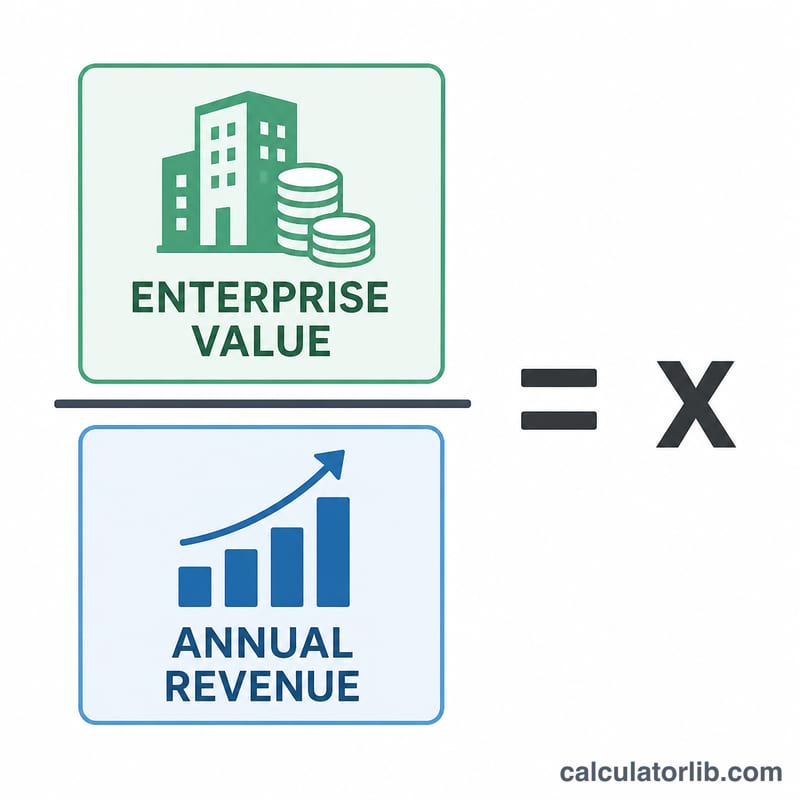
$$\text{EV/Sales} = \frac{\text{Enterprise Value (\$)}}{\text{Annual Revenue (\$)}}$$ A lower multiple may signal an undervalued company or slow growth, while a high multiple often reflects strong growth expectations or premium margins. Always compare against industry peers — a 10x multiple is normal for fast-growing SaaS but expensive for a mature retailer.
Worked Example
Suppose a company has an enterprise value of $5,000,000 and annual revenue of $2,000,000. The EV/Sales multiple is $$\$5{,}000{,}000 \div \$2{,}000{,}000 = 2.5\text{x}$$ 2.5x. This means investors are valuing the business at 2.5 times its yearly sales.
FAQ
What is a good EV/Sales ratio? It varies by industry. Many mature companies trade at 1x–3x, while high-growth software firms can exceed 10x. Compare with peers, not a fixed benchmark.
Why use enterprise value instead of market cap? Enterprise value accounts for debt and cash, so it reflects the true cost of acquiring the whole business and allows fair comparison across differently financed companies.
Should I use trailing or forward revenue? Both are common. Trailing (TTM) reflects actual results; forward revenue reflects analyst expectations. Be consistent when comparing companies.