
What Is ROIC?
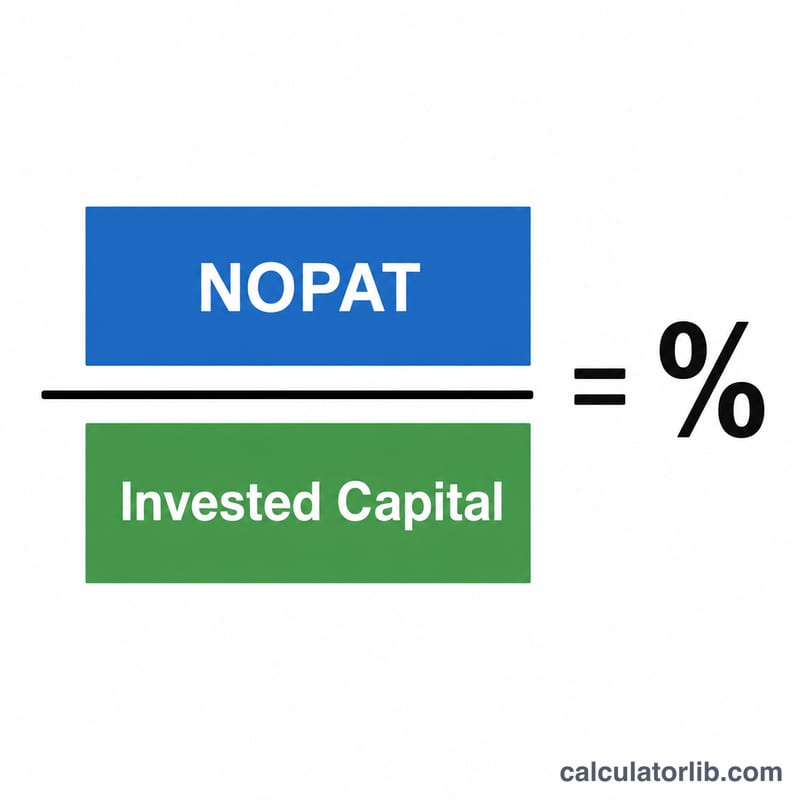
Return on Invested Capital (ROIC) measures how efficiently a company uses the money invested in its operations to generate profit. It compares net operating profit after tax (NOPAT) against the total capital invested by both shareholders and debt holders. A higher ROIC indicates a business that creates more value per dollar of capital deployed.
How to Use This Calculator
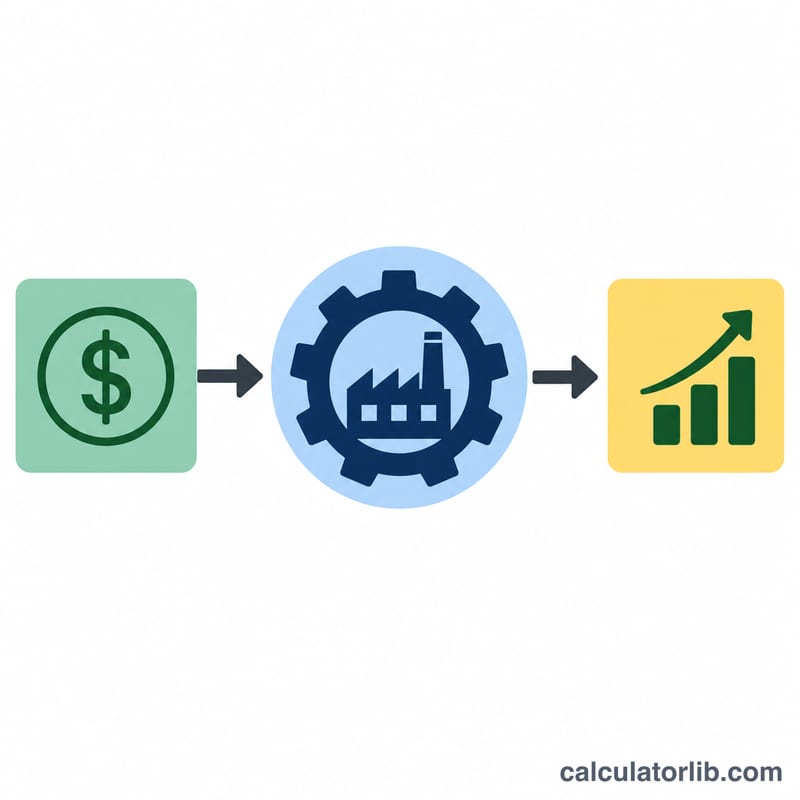
Enter the company's NOPAT (operating profit after subtracting taxes) and its invested capital (typically debt plus equity, minus excess cash). The calculator divides NOPAT by invested capital and expresses the result as a percentage. Investors often compare ROIC to the company's weighted average cost of capital (WACC) — when ROIC exceeds WACC, the company is creating value.
The Formula Explained
The equation is $$\text{ROIC} = \frac{\text{NOPAT}}{\text{Invested Capital}} \times 100\%$$ NOPAT strips out the effects of financing decisions by using operating profit taxed at the marginal rate, so ROIC reflects core operating efficiency rather than capital structure. Invested capital represents the funds tied up in the business that must earn a return.
Worked Example
Suppose a company reports NOPAT of $150,000 and has invested capital of $1,000,000. $$\text{ROIC} = \frac{150{,}000}{1{,}000{,}000} = 0.15 = 15\%$$ This means the firm earns 15 cents of after-tax operating profit for every dollar of capital invested. If its WACC is 9%, the company is generating a healthy 6-point spread of economic value.
FAQ
What is a good ROIC? Many analysts consider an ROIC above 10% solid, and consistently exceeding the cost of capital is the key benchmark.
How is NOPAT calculated? \(\text{NOPAT} = \text{Operating Income} \times (1 - \text{Tax Rate})\). It removes the effect of interest expense and one-off items.
How does ROIC differ from ROE? ROE measures return to equity holders only, while ROIC includes all invested capital (debt and equity), making it less sensitive to leverage.