

What Is ARR?
Annual Recurring Revenue (ARR) is the value of the recurring revenue components of your subscription business normalized to a single calendar year. It is one of the most important metrics for SaaS and subscription companies because it smooths out monthly fluctuations and gives investors and operators a clear, predictable view of yearly revenue. ARR counts only recurring revenue — subscriptions and contracted recurring fees — and excludes one-time charges like setup fees, professional services, or one-off purchases.
How to Use This Calculator
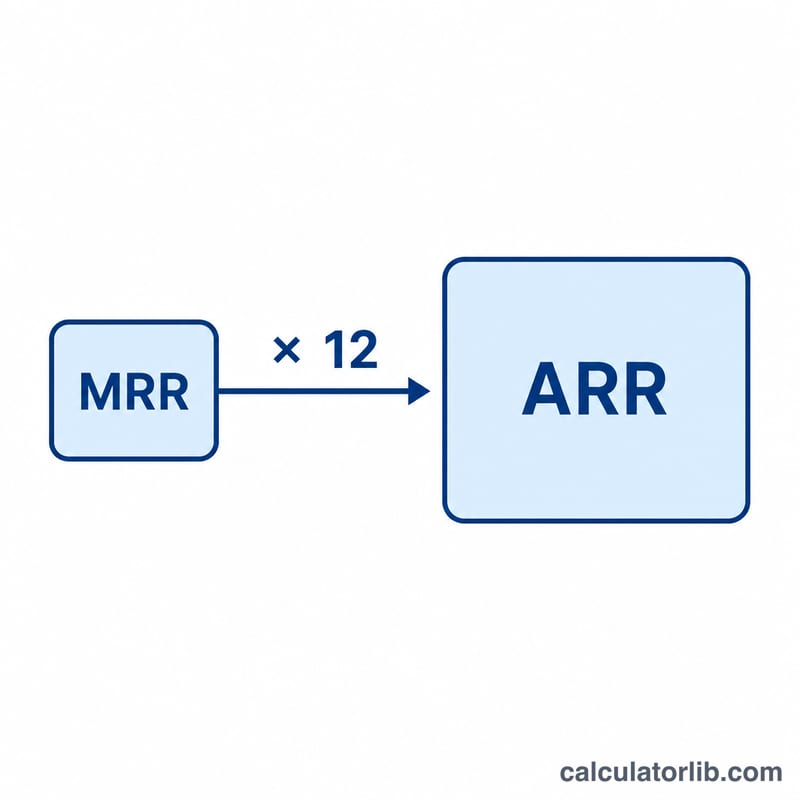
Enter your Monthly Recurring Revenue (MRR) — the total predictable subscription revenue you collect in a single month. The calculator multiplies it by 12 to give your ARR. Use net MRR (after subtracting churn and discounts but excluding one-time fees) for the most accurate figure.
The Formula Explained
The formula is simply $$\text{ARR} = \text{MRR} \times 12$$. Because recurring subscriptions renew on a regular cycle, a stable monthly revenue figure projected across twelve months represents your annualized run-rate. Note that ARR is a snapshot run-rate, not a forecast — it assumes your current MRR holds steady for the year.
Worked Example
Suppose your SaaS company earns $10,000 in MRR. Then $$\text{ARR} = \$10{,}000 \times 12 = \$120{,}000.$$ If you add a new customer paying $500/month, your MRR rises to $10,500 and your ARR becomes $126,000.
ARR Across Different MRR Scenarios
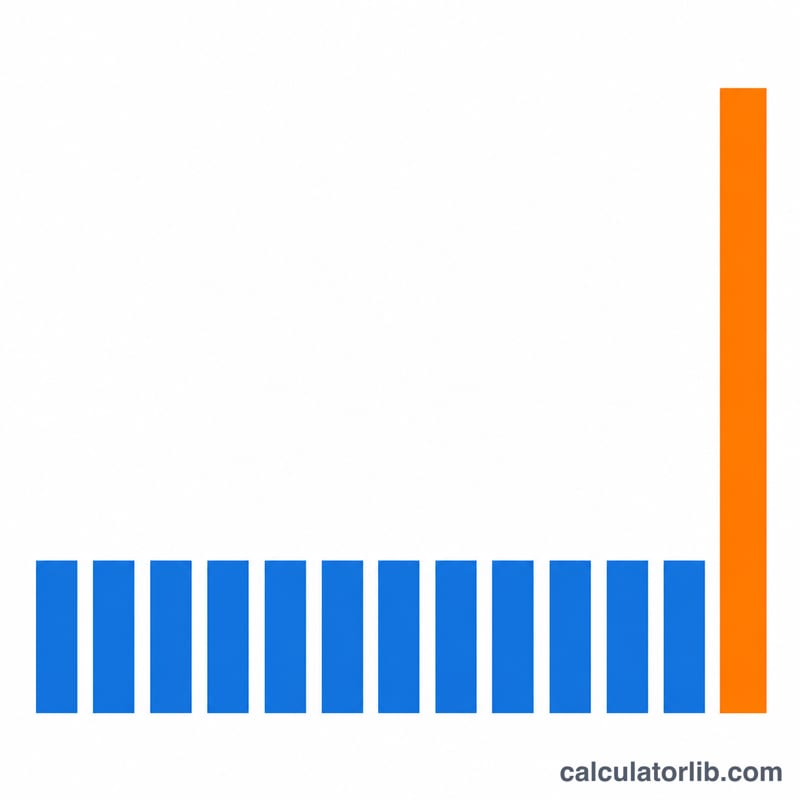
Annual Recurring Revenue is derived from Monthly Recurring Revenue with a single multiplication: \(\text{ARR} = \text{MRR} \times 12\). The table below shows how ARR scales as MRR grows. Because ARR is a normalized run-rate, each row simply projects the current monthly figure across a full year.
| Monthly Recurring Revenue (MRR) | Annual Recurring Revenue (ARR) |
|---|---|
| $1,000 | $12,000 |
| $5,000 | $60,000 |
| $10,000 | $120,000 |
| $25,000 | $300,000 |
| $50,000 | $600,000 |
| $100,000 | $1,200,000 |
Note that the relationship is strictly linear: doubling MRR doubles ARR. The figures represent a run-rate snapshot of the current subscription base, not a forecast of revenue that accounts for future growth, churn, or seasonality.
Key Terms & Definitions
- ARR (Annual Recurring Revenue)
- The normalized value of all recurring subscription revenue projected over a 12-month period, calculated as \(\text{MRR} \times 12\). It includes only predictable, contracted recurring revenue.
- MRR (Monthly Recurring Revenue)
- The total predictable subscription revenue a business expects to receive each month from active customers. ARR is built directly on top of MRR.
- Recurring Revenue
- Revenue earned on a repeating, subscription basis (monthly or annually). It excludes one-time fees such as setup charges, professional services, or hardware sales.
- Gross MRR vs. Net MRR
- Gross MRR (or new/total MRR) is recurring revenue before subtracting losses. Net MRR accounts for the combined effect of new, expansion, contraction, and churned revenue, reflecting the actual change in the recurring base.
- Churn
- The loss of recurring revenue or customers over a period. Revenue churn measures lost MRR from cancellations and downgrades; customer churn measures the count of lost accounts.
- Expansion Revenue
- Additional recurring revenue from existing customers through upgrades, add-ons, or seat increases. It can offset churn and drive net revenue retention above 100%.
- Contraction Revenue
- The reduction in recurring revenue from existing customers who downgrade plans or remove seats without fully cancelling.
- Run-Rate
- An annualized projection of current performance, assuming present conditions continue unchanged. ARR is a run-rate metric — it extrapolates one month's MRR across a year.
Interpreting Your ARR
ARR is best understood as a normalized run-rate snapshot rather than a forecast. It answers the question “If our current recurring revenue held steady for twelve months, how much would we book?” Because it is derived as \(\text{MRR} \times 12\), it captures the state of the subscription base at a single point in time and projects it forward without modeling future growth, churn, or seasonal swings.
What it signals. For investors and operators, ARR is a standard yardstick of the scale and momentum of a subscription business. Tracking how ARR changes period over period reveals whether the recurring base is expanding (through new customers and upsells) or eroding (through churn and downgrades). It is widely used to size a company, benchmark growth, and frame valuation discussions.
Why it assumes steady MRR. The ×12 multiplier implicitly treats the latest MRR as representative of the whole year. This makes ARR a clean, comparable metric, but it also means a single unusually high or low month can distort the figure. Companies with strong growth will under-state their year-end position with a current-month run-rate, while those with rising churn will over-state it.
How it differs from booked or total revenue. ARR counts only recurring subscription revenue. It excludes one-time payments such as implementation fees, professional services, and usage overages that are not contractually recurring. As a result, ARR is typically lower than total recognized (GAAP) revenue or total bookings, which include those non-recurring items. ARR is also distinct from cash collected, since annual contracts may be invoiced upfront while ARR spreads the value evenly.
This section is general educational information about a financial metric and is not financial, investment, or accounting advice.
FAQ
Does ARR include one-time fees? No. ARR should only include recurring subscription revenue. Exclude setup fees, onboarding charges, and non-recurring services.
What's the difference between ARR and revenue? Total revenue includes one-time and variable income; ARR isolates only the predictable, recurring portion annualized.
Should I use gross or net MRR? Use net MRR (after churn, downgrades, and discounts) so your ARR reflects realistic, retained revenue.