

What Is the Times-Revenue Method?
The times-revenue method (also called the revenue multiple method) is a quick way to estimate the value of a business by multiplying its annual revenue by a multiple. The multiple reflects how the market prices companies in a given industry — high-growth software firms may trade at 5–10x revenue, while service businesses may sit closer to 0.5–2x. It is a fast, top-line valuation that is especially useful for early-stage or fast-growing companies where profits are thin or negative.
How to Use This Calculator
Enter the company's annual revenue and the revenue multiple appropriate for its industry and growth profile. The calculator instantly returns the estimated business value. Try several multiples to see a realistic valuation range rather than a single point estimate.
The Formula Explained
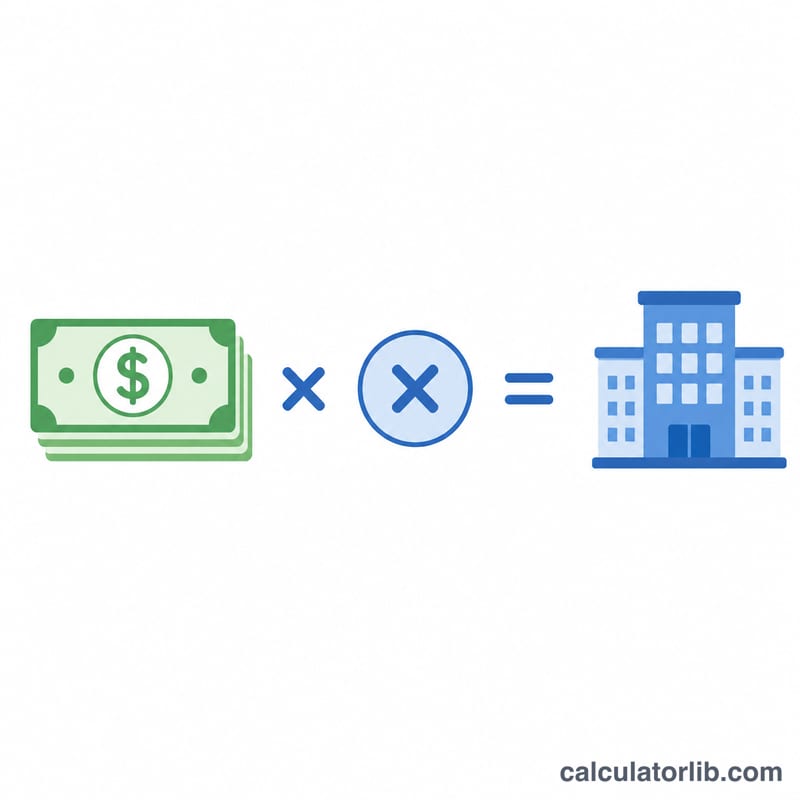
The math is simple: $$\text{Business Value} = \text{Annual Revenue} \times \text{Revenue Multiple}$$. Revenue is the total top-line sales over the past 12 months. The multiple is derived from comparable transactions or publicly traded peers in the same sector.
Worked Example
Suppose a SaaS company generates $2,000,000 in annual revenue and similar businesses sell for 4x revenue. The estimated value is $$\$2{,}000{,}000 \times 4 = \textbf{\$8{,}000{,}000}$$ If a more conservative 2.5x multiple applies, the value would be $5,000,000 — showing how sensitive the result is to the chosen multiple.

FAQ
What multiple should I use? Look at recent sales of comparable companies or industry benchmark reports. Multiples vary widely by sector, growth rate, and margins.
Is times-revenue better than times-earnings? Revenue multiples are useful when earnings are low or volatile. For mature, profitable firms an earnings-based method (like EBITDA multiples) is often more accurate.
Is this a precise valuation? No. It is a quick estimate. A formal valuation also considers profitability, debt, assets, market conditions, and discounted cash flows.