

What Is Cost Per Install (CPI)?
Cost Per Install (CPI) is a key mobile marketing metric that measures how much you pay, on average, to get one user to install your app through a paid advertising campaign. It is one of the most important KPIs for user acquisition teams because it directly links your ad budget to real installs and helps you judge whether a channel, creative, or campaign is efficient.
How to Use This Calculator
Enter your Total Ad Spend (the full amount you invested in a campaign) and your Total App Installs (the number of installs that campaign generated). The calculator divides spend by installs and returns your average CPI in dollars. Compare this figure against your target — ideally your CPI should be well below the lifetime value (LTV) of an installed user.
The Formula Explained
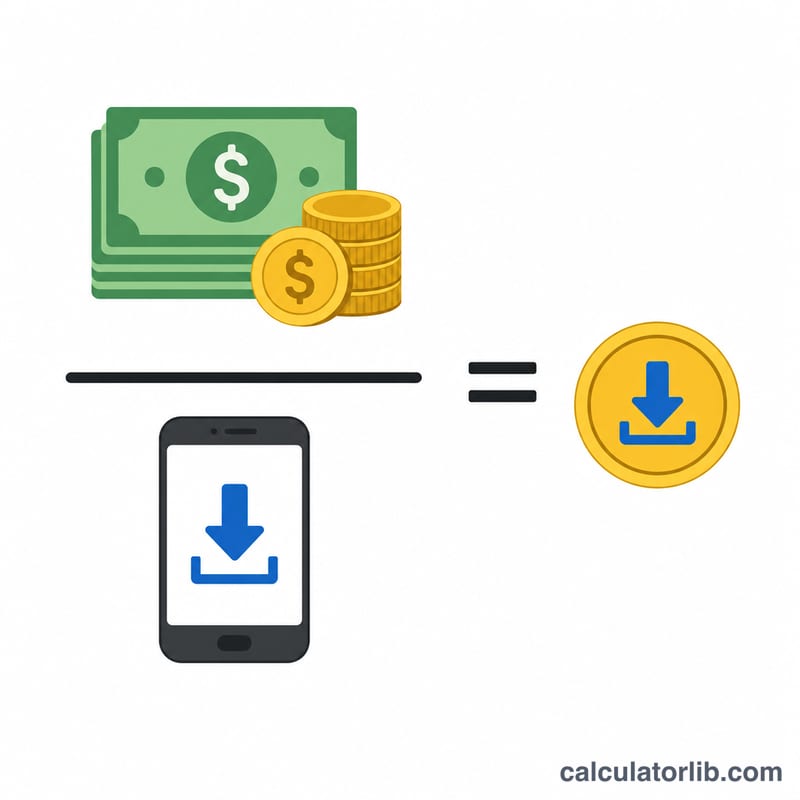
The math is simple division: $$\text{CPI} = \frac{\text{Total Ad Spend (\$)}}{\text{Total App Installs}}$$ If you spent $5,000 and earned 2,000 installs, your CPI is \($5{,}000 \div 2{,}000 = \$2.50\). A lower CPI means you are acquiring users more cheaply, but always weigh it against install quality and retention — cheap installs that never engage are not a bargain.
Worked Example
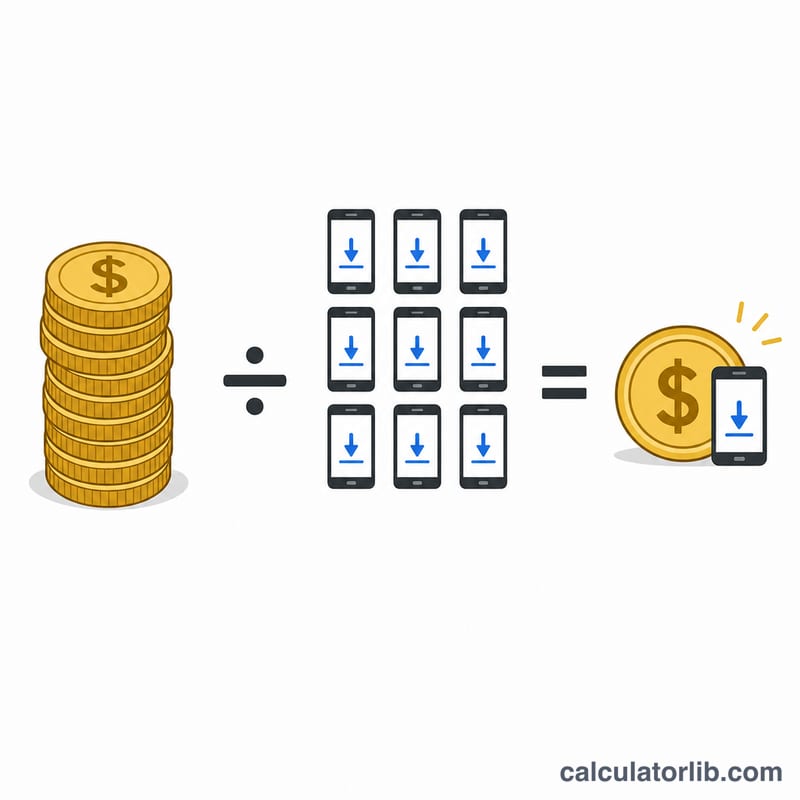
Suppose a campaign spends $3,200 across a week and drives 1,280 installs. $$\text{CPI} = 3{,}200 \div 1{,}280 = \$2.50 \text{ per install}$$ If your average revenue per user is $4.00, the campaign is profitable on a per-install basis before factoring in organic uplift.
FAQ
What is a good CPI? It varies widely by platform, region, and app category — anywhere from under $1 to over $5. The key is that CPI stays below your user lifetime value (LTV).
Does CPI include organic installs? No. CPI measures paid installs only. Organic installs from app store search or word of mouth are not part of your ad spend.
How is CPI different from CPA? CPI counts installs as the conversion event, while Cost Per Acquisition (CPA) measures a deeper action such as a purchase or registration.