
What Is the Cost of Capital (WACC)?
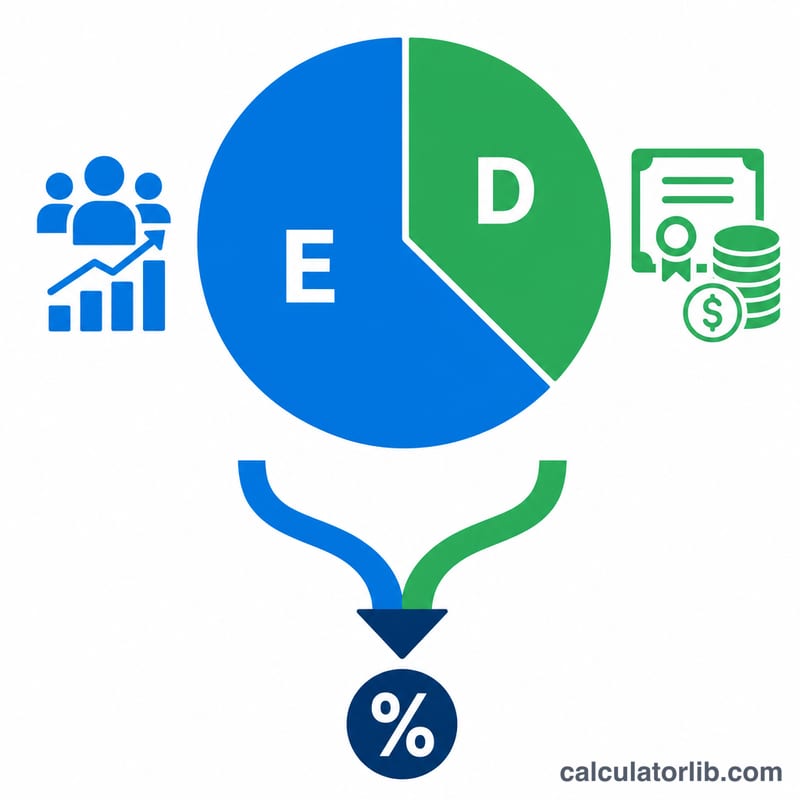
The Weighted Average Cost of Capital (WACC) is the average rate a company expects to pay to finance its assets, blending the cost of equity and the after-tax cost of debt according to how much of each it uses. WACC is a cornerstone of corporate finance — it is the discount rate used in DCF valuation, the hurdle rate for capital budgeting, and a key signal of how risky investors and lenders perceive a firm to be.
How to Use This Calculator
Enter the market value of equity (E), the market value of debt (D), the cost of equity (Re, often from CAPM), the pre-tax cost of debt (Rd), and the corporate tax rate. The calculator computes the equity and debt weights, applies the tax shield to debt, and returns your blended WACC as a percentage.
The Formula Explained
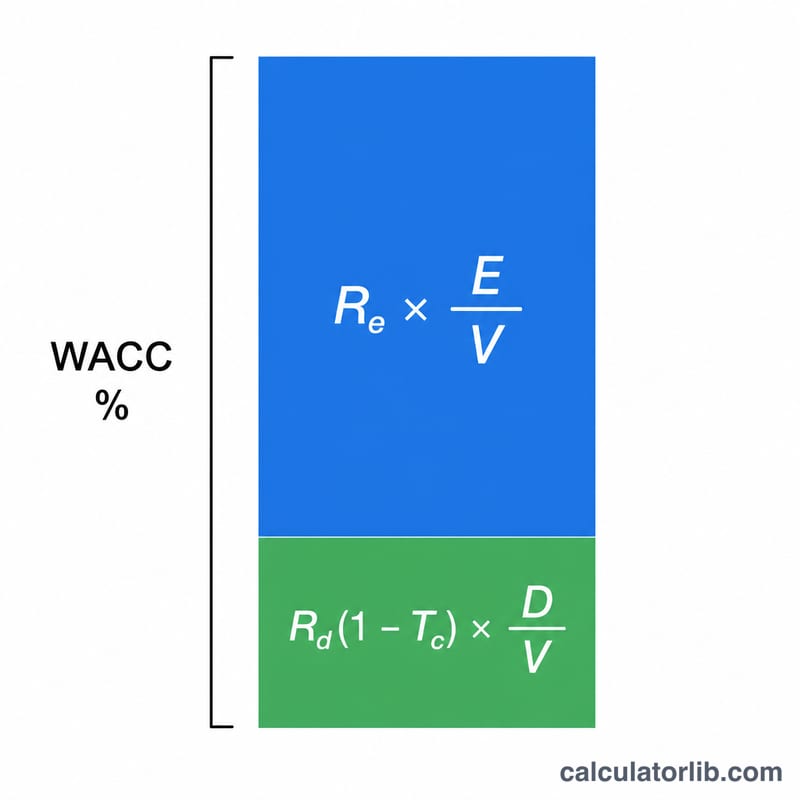
$$\text{WACC} = \frac{E}{V}\cdot R_e + \frac{D}{V}\cdot R_d\cdot(1 - \text{Tax})$$ where \(V = E + D\). The term \((1 - \text{Tax})\) reflects the tax deductibility of interest payments, which lowers the effective cost of debt. Equity carries no such shield because dividends are not tax-deductible.
Worked Example
Suppose \(E = 600{,}000\), \(D = 400{,}000\), \(R_e = 10\%\), \(R_d = 6\%\), \(\text{Tax} = 25\%\). Total \(V = 1{,}000{,}000\), so \(E/V = 0.6\) and \(D/V = 0.4\). After-tax debt \(= 6\% \times (1 - 0.25) = 4.5\%\). $$\text{WACC} = 0.6 \times 10\% + 0.4 \times 4.5\% = 6\% + 1.8\% = \mathbf{7.8\%}$$
FAQ
Should I use book or market values? Market values of equity and debt are preferred because WACC is a forward-looking rate reflecting current financing costs.
Why apply the tax rate only to debt? Interest expense is tax-deductible in most jurisdictions, creating a tax shield that reduces the real cost of borrowing. Equity returns are paid from after-tax profit.
What is a typical WACC? It varies by industry and risk, but many mature companies fall in the 6%–12% range. A lower WACC generally means cheaper financing and higher valuations.