

What Is a Mileage Reimbursement Calculator?
A mileage reimbursement calculator works out how much you should be paid for driving your personal vehicle for work, charity, medical, or other deductible purposes. You simply multiply the number of miles driven by an agreed rate per mile. Many employers and tax authorities publish a standard cents-per-mile rate (for example, the US IRS standard mileage rate), but this tool accepts any rate you enter, so it works in any country or currency.
How to Use It
Enter the total miles driven for the trip or period, then enter your rate per mile (for example 0.67 for 67 cents per mile). The calculator instantly returns the total reimbursement amount along with a breakdown of your inputs.
The Formula Explained
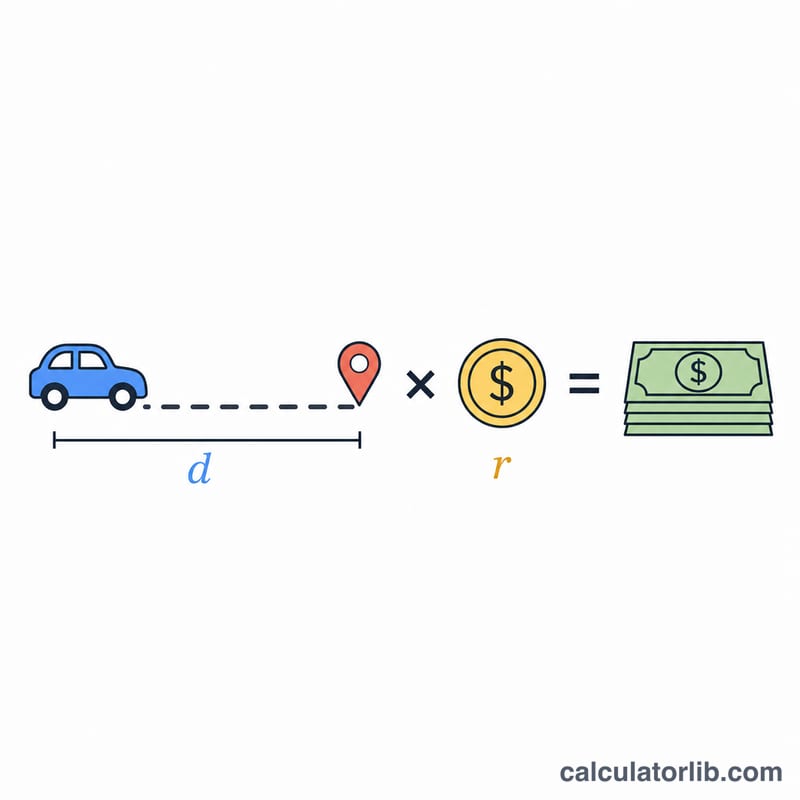
The math is straightforward:
$$\text{Reimbursement} = \text{Miles Driven} \times \text{Rate per Mile (\$)}$$
If you drove 250 miles at a rate of $0.67 per mile, the reimbursement is $$250 \times 0.67 = \$167.50$$. Because it is a simple product, doubling the miles doubles the payment, and changing the rate scales the total proportionally.
Worked Example
Suppose a sales rep logged 1,200 business miles in a month and the company reimburses at $0.655 per mile. The reimbursement is $$1{,}200 \times 0.655 = \$786.00$$. Entering 1200 and 0.655 returns this figure immediately.
FAQ
What rate should I use? Use the rate set by your employer or the official standard rate for your country and purpose (business, medical, charity). When unsure, confirm the current published figure.
Does it include tolls or parking? No. The standard mileage rate covers fuel, maintenance, insurance, and depreciation. Tolls and parking are usually reimbursed separately.
Can I use it for kilometers? Yes — just enter distance in kilometers and a per-kilometer rate; the multiplication is identical.