
What this calculator does
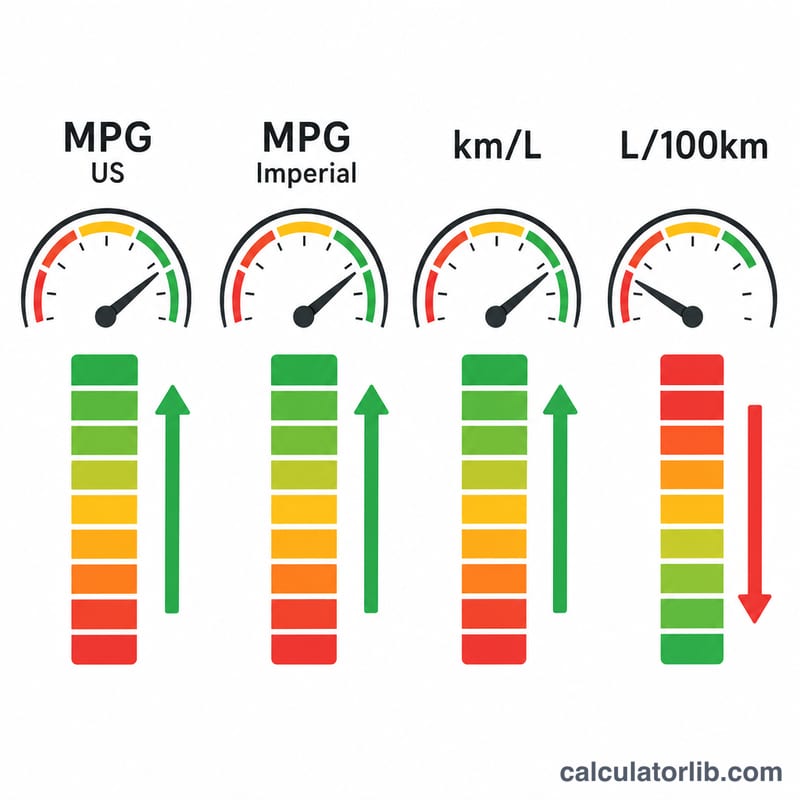
This gas mileage (fuel economy) calculator works out how efficiently your vehicle uses fuel from two simple numbers: the distance you traveled and the amount of fuel you consumed. It is a pure unit-conversion and arithmetic tool, so it applies anywhere in the world. It reports your result in four common formats at once: MPG (US), MPG (Imperial), kilometers per liter (km/L) and liters per 100 km (L/100km). "Gas" or "gasoline" here means petrol.
How to use it
Choose how you want to enter distance. With Trip Distance you type a single distance value; with Odometer Readings you enter the start and end odometer values and distance is computed as end minus start. Pick the distance unit (miles or km) and enter the fuel used along with its unit (US gallons, Imperial gallons or liters). Optionally add a fuel price (per gallon or liter) to get the total trip cost and cost per mile/km, or a per-distance price for a mileage-reimbursement style total.
The formula explained
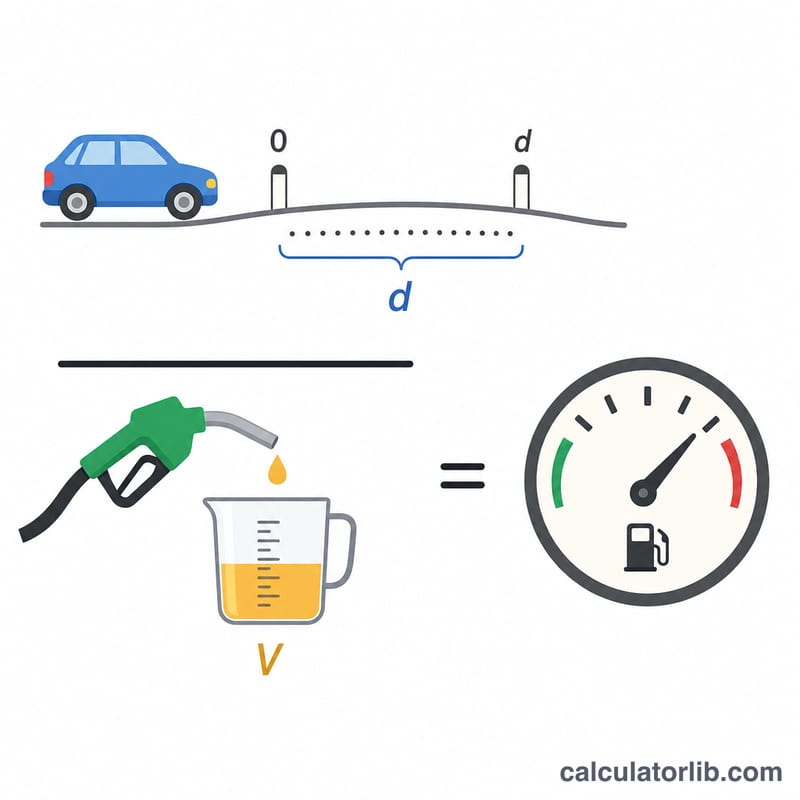
Distance and fuel are first normalized to a canonical set of units. Then $$\text{MPG (US)} = \dfrac{\text{miles}}{\text{US gallons}}$$ $$\text{MPG (Imperial)} = \dfrac{\text{miles}}{\text{Imperial gallons}}$$ $$\text{km/L} = \dfrac{\text{km}}{\text{liters}}$$ and $$\text{L/100km} = \dfrac{\text{liters}}{\text{km}} \times 100$$ Note that a US gallon (\(3.785411784\ \text{L}\)) is smaller than an Imperial gallon (\(4.54609\ \text{L}\)), so the same fuel gives a higher MPG figure in Imperial units. L/100km is inverse: lower is better.
Worked example
Drive 250 miles on 12 US gallons. $$\text{MPG (US)} = \frac{250}{12} = 20.83$$ Converting, \(12\ \text{US gal} = 45.42\ \text{L} = 9.99\ \text{Imp gal}\) and \(250\ \text{mi} = 402.34\ \text{km}\), so MPG (Imp) = 25.02, km/L = 8.86 and L/100km = 11.29. At $3.50 per US gallon the trip costs $$3.50 \times 12 = \$42.00$$ or about $0.168 per mile.
FAQ
Why are US and Imperial MPG different? Because the gallons differ in size. An Imperial gallon is about 20% larger, so Imperial MPG figures are about 20% higher for the same real economy.
Is lower L/100km better? Yes. L/100km measures fuel used per fixed distance, so a smaller number means a more efficient vehicle.
Can I use odometer readings? Yes. Switch to Odometer Readings and enter the start and end values; the distance is the difference, which must be positive.