
What Is a Prorated Salary?
A prorated salary is the portion of an annual (or period) salary that corresponds to the time an employee actually worked, rather than the full term. Proration is common when someone starts or leaves mid-period, takes unpaid leave, switches to part-time, or when a raise takes effect partway through a pay cycle. Instead of paying the full amount, the employer pays a proportional share.
How to Use This Calculator
Enter three values: the full annual salary, the number of days worked in the period, and the total work days the period would normally contain. The calculator divides days worked by total work days to find the proportion, then multiplies it by the salary. "Total work days" can be calendar days, business days, or scheduled shifts — just be consistent so the days-worked figure uses the same basis.
The Formula Explained
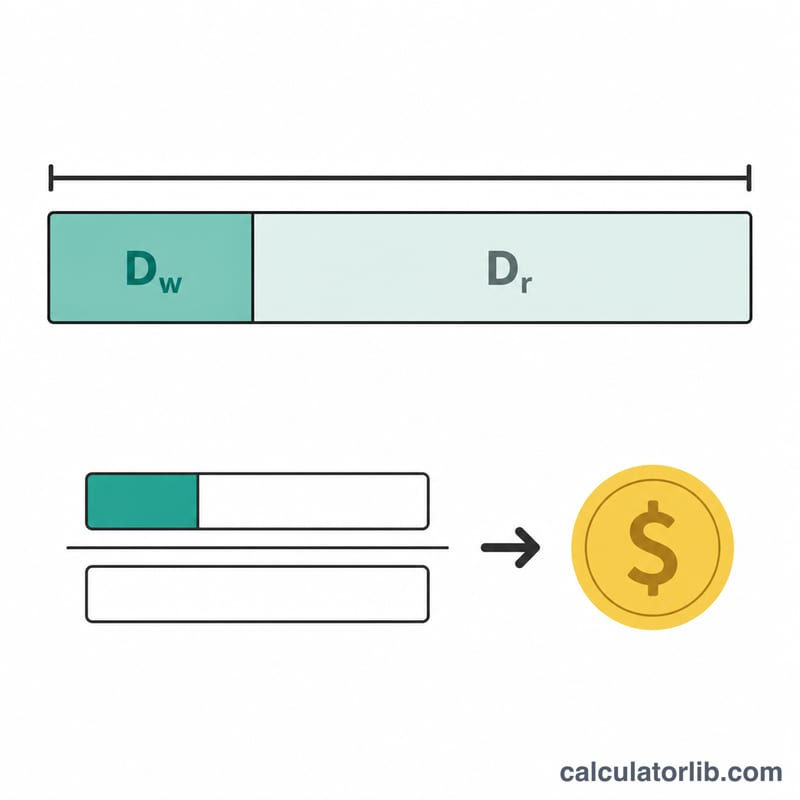
The core equation is simply:
$$\text{Prorated Salary} = \text{Annual Salary} \times \frac{\text{Days Worked}}{\text{Total Work Days}}$$
The fraction (days worked ÷ total work days) represents how much of the period was completed. Multiplying it by the salary gives the earned amount. The same logic applies to monthly or weekly pay — replace "annual salary" with the relevant period pay.
Worked Example
Suppose an employee earns $60,000 per year and worked 120 of the 260 standard business days. The proportion is \(120 \div 260 = 0.4615\), or about 46.15%. The prorated salary is $$\$60{,}000 \times 0.4615 = \$27{,}692.31$$
FAQ
What should I use for total work days? Use the number of working days in the period on the same basis as your days-worked count — typically 260 business days in a year, or the scheduled days in a month.
Does this include taxes? No. This gives gross prorated pay before any tax, deductions, or benefits.
Can I use it for monthly pay? Yes — enter the monthly salary as the "annual salary" field and use the month's working days.