
What Is Prorated Rent?
Prorated rent is the partial rent owed when a tenant moves in or out part-way through a month, rather than on the first or last day. Instead of paying for a full month, the tenant pays only for the days they actually occupy the unit. This calculator works out that fair, partial amount in seconds.
How to Use This Calculator
Enter the full monthly rent, the number of days in the month (28, 29, 30, or 31 depending on the calendar month), and the number of days occupied during that month. The calculator returns the prorated rent due, along with the daily rate.
The Formula Explained
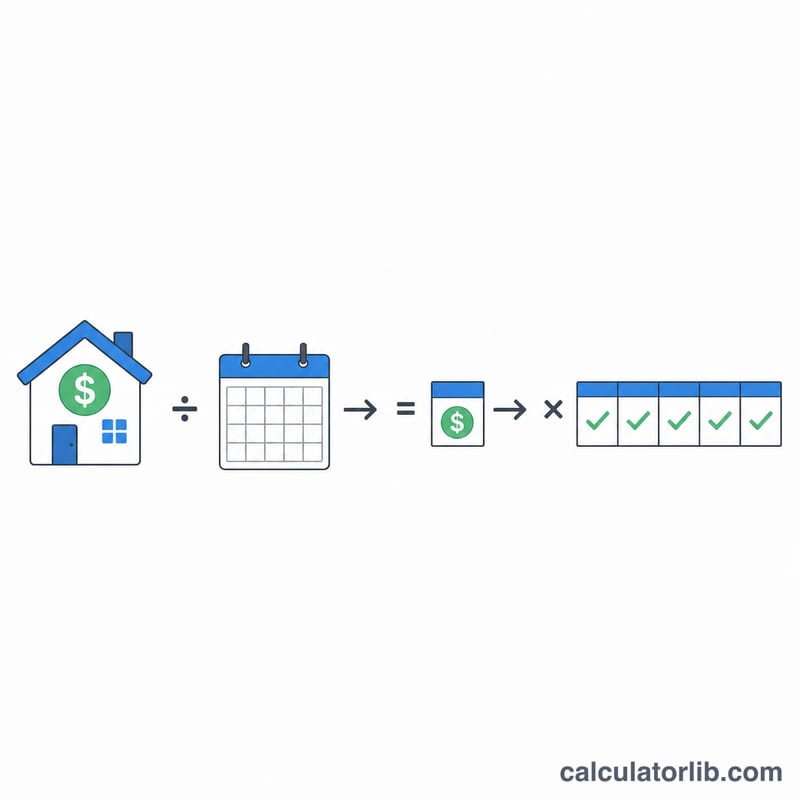
The most common proration method uses the actual number of days in the specific month:
$$\text{Prorated Rent} = \frac{\text{Monthly Rent}}{\text{Days in Month}} \times \text{Days Occupied}$$First, the monthly rent is divided by the number of days in the month to find the daily rate. That daily rate is then multiplied by how many days the tenant occupies the property.
Worked Example
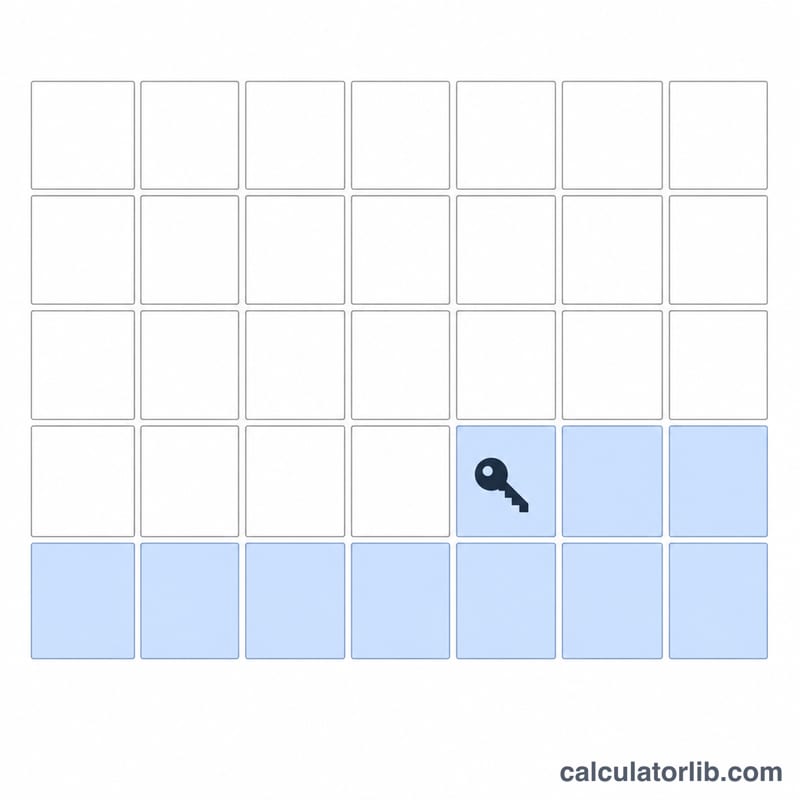
Suppose the monthly rent is $1,500, the month has 30 days, and the tenant moves in with 10 days remaining. The daily rate is \(\$1{,}500 \div 30 = \$50\). The prorated rent is $$\$50 \times 10 = \$500.$$
More Prorated Rent Examples
Both examples use the daily-rate method: divide the monthly rent by the number of days in that specific month, then multiply by the days occupied. For the most accurate result, multiply by the unrounded daily rate and round only the final amount to the nearest cent.
Example 1: Move-out in a 31-day month
A tenant pays $2,000 per month and moves out after occupying the unit for 12 days of a 31-day month.
- Daily rate: \(\frac{\$2000}{31} \approx \$64.52\) per day
- Prorated rent: \(\frac{\$2000}{31} \times 12 = \frac{\$24000}{31} \approx \$774.19\)
Prorated rent owed: $774.19
Note: multiplying the rounded daily rate ($64.52 × 12) gives $774.24, a few cents off. That is why the daily rate is kept unrounded until the final step.
Example 2: Move-in during a 28-day February
A tenant with $1,200 monthly rent moves in and occupies the unit for 14 days of a 28-day February.
- Daily rate: \(\frac{\$1200}{28} \approx \$42.86\) per day
- Prorated rent: \(\frac{\$1200}{28} \times 14 = \$600.00\)
Prorated rent owed: $600.00
Since 14 days is exactly half of a 28-day month, the result is exactly half of the monthly rent.
Some leases specify a different proration method, such as a flat 30-day month or a 365-day year, so check your lease terms. Rules on how rent is prorated and when it is due vary by lease and by local law.
FAQ
Which "days in month" should I use? Most leases use the actual days in the calendar month (e.g., 31 for July, 28 for a non-leap-year February). Some landlords use a flat 30-day "banker's month" — check your lease.
Do I count the move-in day? Typically yes — count every day the tenant has the right to occupy the unit, including the move-in date.
Is prorated rent the same for move-out? Yes. Whether moving in or out mid-month, you charge for the number of days occupied during that month.