What Is the Liters to Cubic Meters Calculator?
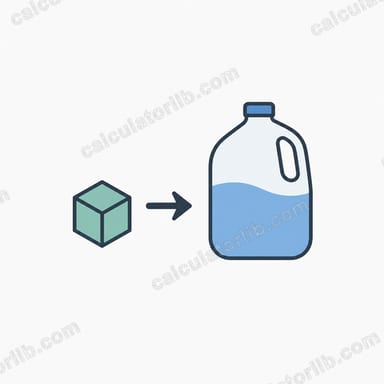
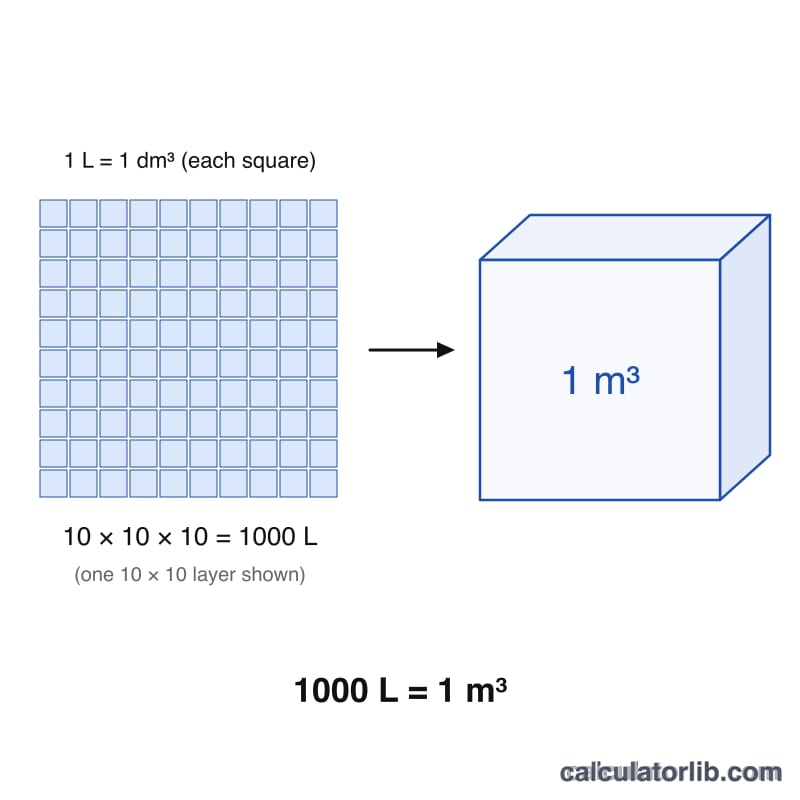
This calculator converts a volume measured in liters (L) into cubic meters (m³). Both are units of volume in the metric system, and the relationship between them is fixed and exact: one cubic meter holds exactly 1,000 liters. This tool is universal — it applies the same everywhere, since the metric definitions of the liter and cubic meter are international standards.
How to Use It
Enter the number of liters you want to convert and the calculator instantly returns the equivalent volume in cubic meters. You can use whole numbers or decimals (for example, 2,500 L or 37.5 L). The result is useful for water tanks, fuel storage, pool volumes, concrete and aggregate quantities, and any engineering or science task that mixes the two units.
The Formula Explained
The conversion uses a single division:
$$\text{m}^3 = \frac{\text{Volume (L)}}{1000}$$
Because 1 cubic meter is defined as a cube measuring \(1\,\text{m} \times 1\,\text{m} \times 1\,\text{m} = 1{,}000{,}000\,\text{cm}^3\), and 1 liter equals 1,000 cm³, dividing the liter figure by 1,000 gives the cubic meter equivalent. To go the other way, multiply cubic meters by 1,000 to get liters.
Worked Example
Suppose a storage tank holds 4,500 liters. Divide by 1,000: $$4{,}500 \div 1{,}000 = 4.5$$ So the tank holds 4.5 cubic meters of liquid.
Common Real-World Volumes in Liters and Cubic Meters
Since 1 m³ = 1,000 L, every conversion is \(\text{m}^3 = \text{L} \div 1000\). The table below shows familiar containers and water bodies. Values marked "typical" are approximate and vary by model, region and design.
| Item | Volume (L) | Volume (m³) | Note |
|---|---|---|---|
| Car fuel tank | ≈ 50 L | ≈ 0.05 m³ | Typical for a passenger car; small and large vehicles differ |
| Standard bathtub | ≈ 150–300 L | ≈ 0.15–0.3 m³ | Typical filled volume; depends on tub size and water level |
| Household water heater | ≈ 150–300 L | ≈ 0.15–0.3 m³ | Typical tank size; many homes use smaller or larger units |
| IBC tote | 1,000 L (nominal) | 1 m³ | Nominal 1,000 L size; other IBC sizes exist |
| Small backyard pool | ≈ 10,000–30,000 L | ≈ 10–30 m³ | Typical range; varies widely with pool dimensions |
| Olympic swimming pool | 2,500,000 L | 2500 m³ | Minimum standard volume (50 m × 25 m × 2 m); actual pools may be larger |
Example: \(2{,}500{,}000 \text{ L} \div 1000 = 2{,}500 \text{ m}^3\).
FAQ
How many liters are in a cubic meter? Exactly 1,000 liters make up one cubic meter.
Is this conversion exact? Yes. The relationship \(1\,\text{m}^3 = 1{,}000\,\text{L}\) is exact by definition, so there is no rounding in the conversion itself.
How do I convert cubic meters back to liters? Multiply the cubic meter value by 1,000. For example, \(3\,\text{m}^3 \times 1{,}000 = 3{,}000\,\text{L}\).