What This Calculator Does
Applies to the United States (tax years 2026, 2025 and 2024). This W-4 tax withholding calculator estimates how much federal income tax is withheld from each paycheck based on your gross pay, pay frequency, filing status and the dependent credits claimed in Step 3 of Form W-4. You choose the tax year: 2026 (the default) uses the standard deduction and brackets of IRS Rev. Proc. 2025-32, 2025 uses the amounts as amended by the One Big Beautiful Bill Act (OBBBA), and 2024 uses Rev. Proc. 2023-34.
How to Use It
Pick the tax year, enter your gross pay per pay period, choose how often you are paid, select your filing status and enter the number of dependents. Each one is multiplied by the child tax credit of that year ($2,200 for 2026 and 2025, $2,000 for 2024), the Step 3 amount for a qualifying child under 17. Other dependents are worth only $500 each, so count qualifying children here. Add any extra per-period withholding from W-4 Step 4(c). The result shows the estimated federal withholding per paycheck plus your annualized wages, taxable income and estimated annual federal tax.
The Formula
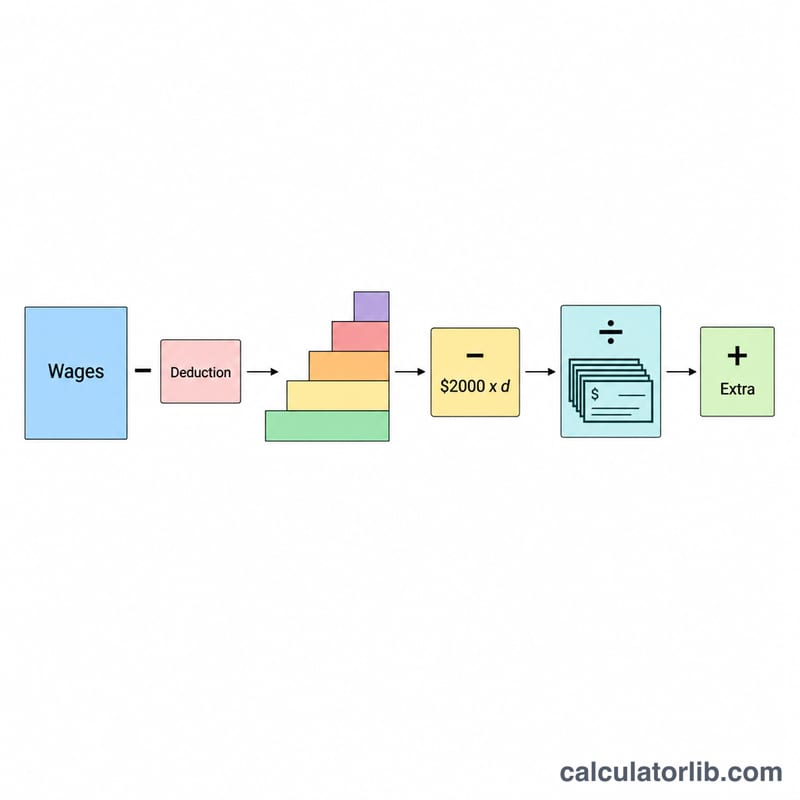
Annualized wages = gross pay × pay periods. Taxable income = annualized wages − standard deduction (2026: $16,100 single, $32,200 married filing jointly; 2025: $15,750 / $31,500; 2024: $14,600 / $29,200), never below zero. Annual tax comes from the bracket schedule of the chosen year (2026 single: 10% up to $12,400, 12% up to $50,400, 22% up to $105,700; married filing jointly: 10% up to $24,800, 12% up to $100,800, 22% up to $211,400), minus dependents × credit, and never below $0. Per-period withholding = annual tax ÷ pay periods + extra withholding.
$$W = \dfrac{\max\{0,\ T(A - D_{std}) - C \cdot \text{Dependents}\}}{\text{Periods}} + \text{Extra}$$
$$\text{where}\quad \left\{ \begin{aligned} A &= \text{Gross Pay} \times \text{Periods} \\ D_{std} &= 16{,}100\ (\text{Single}),\ 32{,}200\ (\text{Married}) \\ C &= 2{,}200 \\ T(\cdot) &= \text{2026 brackets} \end{aligned} \right.$$
Worked Example
Default case: single, paid $2,000 every two weeks (26 periods), no dependents, tax year 2026. Annualized wages = \(2{,}000 \times 26 = \$52{,}000\). Taxable = \(52{,}000 - 16{,}100 = \$35{,}900\). Tax = \(12{,}400 \times 10\% + (35{,}900 - 12{,}400) \times 12\% = 1{,}240 + 2{,}820 = \$4{,}060\). Per paycheck = \(4{,}060 \div 26 \approx \$156.15\).
With children: married filing jointly, paid $10,000 a month (12 periods), 2 qualifying children, $50 extra per paycheck, 2026. Annualized wages = $120,000. Taxable = \(120{,}000 - 32{,}200 = \$87{,}800\). Tax = \(24{,}800 \times 10\% + (87{,}800 - 24{,}800) \times 12\% = 2{,}480 + 7{,}560 = \$10{,}040\). Credit = \(2 \times 2{,}200 = \$4{,}400\), so annual tax = \(10{,}040 - 4{,}400 = \$5{,}640\). Per month = \(5{,}640 \div 12 + 50 = 470 + 50 = \$520\).
FAQ
Can the annual tax be negative? No. When the dependent credits exceed the computed tax, the annual tax is set to $0 and only any extra withholding remains. The refundable part of the child tax credit is claimed on your tax return, not through paycheck withholding.
Which tax year should I pick? Use 2026 for paychecks paid in 2026. 2025 and 2024 are kept for comparing or checking past paychecks; the standard deduction, brackets and credit change with the year you select.
Is this exact? No. It is an estimate that annualizes your pay and applies the yearly brackets, not the IRS percentage-method tables of Publication 15-T. Use it for planning only.
Does it include Social Security or state tax? No, only federal income tax withholding.