What is the Salary Needed for Rent Calculator?
This calculator tells you how much gross income you need to qualify for an apartment. Most landlords and property managers use the 3x rent rule: your gross (pre-tax) annual income should be at least three times the annual rent, which is the same as saying rent should be no more than 30% of your gross monthly income. Enter the monthly rent and choose an affordability ratio to see the salary you'll need.
How to use it
Type in the monthly rent for the apartment you want. Then pick the rule landlords in your area use — 30% is the standard (the classic 3x rule), 25% is conservative, and 33–40% is common in expensive cities. The calculator returns the required gross annual salary and the matching monthly income.
The formula explained
The 3x rule says required annual income = monthly rent × 3 × 12. Dividing both sides shows the equivalent ratio test: rent ÷ gross monthly income ≤ 30%. For a general ratio, required monthly income = rent ÷ ratio, and the annual figure is that monthly amount × 12. A higher ratio (e.g. 40%) lowers the income you need to qualify but leaves less of your paycheck for everything else.
$$\text{Required Annual Salary} = \frac{\text{Monthly Rent}}{\dfrac{\text{Income Rule \%}}{100}} \times 12$$
Worked example
Suppose rent is $1,500/month using the 30% rule. Required monthly income = \(1{,}500 \div 0.30 = \$5{,}000\). Required annual income = \(5{,}000 \times 12 = \$60{,}000\). That matches the 3x rule: \(1{,}500 \times 3 \times 12 = \$54{,}000\)... note the 3x rule and 30% rule differ slightly — 3x means rent is one-third (33%) of income, while 30% is stricter. This tool uses the percentage you select for precision.
Required Salary at Different Rents and Income Rules
Each cell shows the minimum gross (pre-tax) annual income needed: monthly rent ÷ ratio × 12. The 3x rule is the same as a 33.3% rent-to-income ratio. These rules of thumb are common in US rental screening; individual landlords and other countries may use different thresholds.
| Monthly rent | 25% rule (rent × 48) | 30% rule (rent × 40) | 33.3% / 3x rule (rent × 36) | 40% rule (rent × 30) |
|---|---|---|---|---|
| $1,000 | $48,000 | $40,000 | $36,000 | $30,000 |
| $1,500 | $72,000 | $60,000 | $54,000 | $45,000 |
| $2,000 | $96,000 | $80,000 | $72,000 | $60,000 |
| $2,500 | $120,000 | $100,000 | $90,000 | $75,000 |
| $3,000 | $144,000 | $120,000 | $108,000 | $90,000 |
Note: the calculator's 33% option uses exactly 0.33, which gives a slightly higher figure (rent ÷ 0.33 × 12, about rent × 36.36) than the exact 3x rule (rent × 36). The table above uses the exact 1/3 ratio for the 3x column.
Key Terms: Gross Income, Rent-to-Income Ratio and More
- Gross income: Your total earnings before taxes and deductions. Landlords usually apply income rules to gross income, not take-home pay.
- Net (take-home) income: What you receive after taxes, insurance and retirement contributions. It is lower than gross income, so rent at 30% of gross can be a larger share of net pay.
- Rent-to-income ratio: Monthly rent divided by monthly gross income, shown as a percentage. A lower ratio means rent is more affordable.
- 3x rule vs 30% rule: The 3x rule requires monthly gross income of at least three times the rent (a 33.3% ratio, or rent × 36 per year). The 30% rule requires rent to be no more than 30% of gross income (income of at least 3.33 times rent, or rent × 40 per year). The 30% rule is slightly stricter.
- Guarantor / co-signer: A person who agrees to pay the rent if the tenant does not. Landlords often accept one when a tenant's income falls short, and may require the guarantor to earn a higher multiple, such as 80x monthly rent in some markets, or whatever the landlord specifies.
- Household / combined income: The total gross income of all adult tenants on the lease. Many landlords add these together when applying the income rule, but policies vary.
How to Calculate the Required Salary by Hand
- Take the monthly rent. Example: $1,800 per month.
- Convert the ratio to a decimal. 30% = 0.30; 25% = 0.25; 40% = 0.40; the 3x rule = 1/3 ≈ 0.3333.
- Divide rent by the ratio to get the required monthly gross income: \(\frac{1800}{0.30} = 6000\) per month.
- Multiply by 12 for the annual figure: \(6000 \times 12 = 72000\). So the required annual gross salary at the 30% rule is $72,000.
- Optional: convert to an hourly wage by dividing by 2,080 hours (40 hours × 52 weeks): \(\frac{72000}{2080} \approx 34.62\) dollars per hour.
Shortcuts: the 3x rule (a 33.3% ratio) gives annual income = rent × 36, since \(\frac{12}{1/3} = 36\). The 30% rule gives annual income = rent × 40, since \(\frac{12}{0.30} = 40\). For the $1,800 example, the 3x rule needs 1,800 × 36 = $64,800, while the 30% rule needs 1,800 × 40 = $72,000.
FAQ
Is it 30% or 3x? They're close but not identical. The strict "3x rent" means rent is 33.3% of income; the popular "30% rule" is a bit more conservative. Choose whichever your landlord applies.
Should I use gross or net income? Landlords almost always check gross (pre-tax) income, which is what this calculator computes.
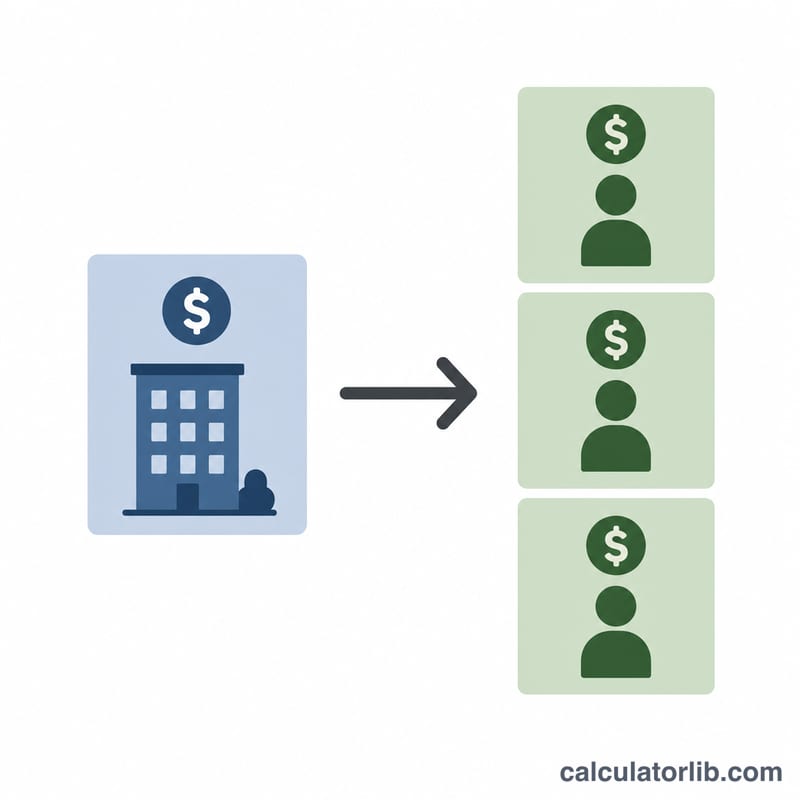
What if I have a roommate? Combined household income usually counts, so split the required salary across applicants.