

What is a Net to Gross Salary Calculator?
This calculator works backwards from your take-home (net) pay to find the gross salary you would need to earn. It is useful when negotiating a job offer, comparing contract rates, or budgeting toward a specific after-tax income. The tool is jurisdiction-neutral: instead of modeling a particular country's tax brackets, you supply a single effective tax and deduction rate, so it works anywhere as long as you know (or estimate) that overall percentage.
How to use it
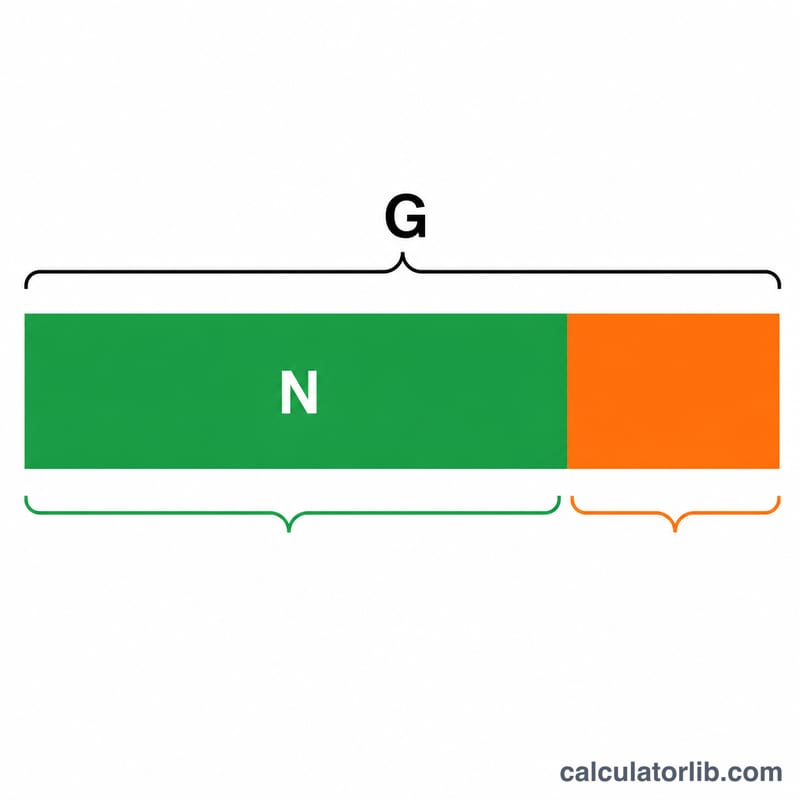
Enter the net amount you want to keep (annual, monthly, or per paycheck — the result will be in the same period). Then enter your effective rate as a percentage. The effective rate is the total share of gross pay lost to income tax, social contributions, and other deductions combined. The calculator returns the gross figure and how much goes to deductions.
The formula explained
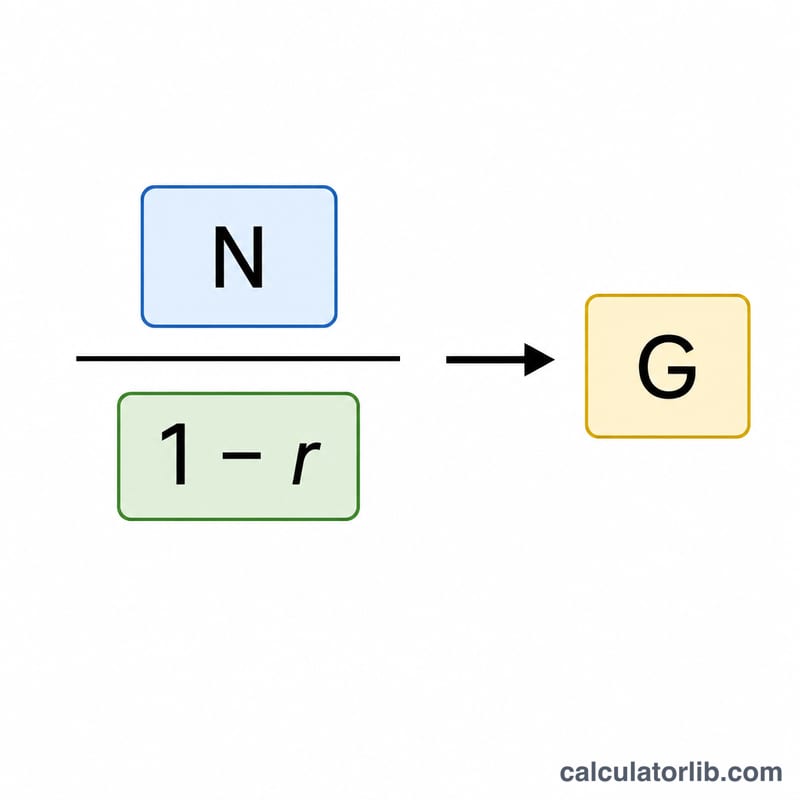
If r is the effective rate written as a decimal, your net pay is gross multiplied by \((1 - r)\). Rearranging gives the following:
$$\text{Gross} = \frac{\text{Net}}{1 - r}$$Because we divide rather than simply adding the percentage back, the result correctly accounts for the fact that the tax applies to the larger gross figure, not the smaller net one.
Worked example
Suppose you want to take home $40,000 and your effective rate is 20%. Then \(r = 0.20\) and \(1 - r = 0.80\).
$$\text{Gross} = 40{,}000 \div 0.80 = \$50{,}000$$Deductions = \(50{,}000 - 40{,}000 = \$10{,}000\), which is exactly 20% of the $50,000 gross — confirming the math.
FAQ
Why not just add 20% to my net pay? Adding 20% of net ($8,000) gives $48,000, which is wrong: 20% tax on $48,000 is $9,600, leaving only $38,400. Dividing by \((1 - r)\) avoids this error.
What rate should I enter? Use your effective rate (total deductions ÷ gross), not your top marginal bracket. Check a recent payslip: deductions divided by gross gives the percentage to enter.
Does it handle a 0% rate? Yes — at 0% the gross equals the net. Rates of 100% or more are not valid because no finite gross can produce a positive net.