
What Is a Net to Gross Salary Calculator?
A net to gross salary calculator works backwards from the money you actually take home to find the gross (pre-deduction) salary that produces it. While most pay tools start from gross and subtract tax, this one is useful when you have a target take-home figure in mind — for example, negotiating an offer, budgeting a freelance rate, or grossing up a bonus.
How to Use It
Enter your desired net salary (the amount that lands in your account after deductions) and the total deduction rate as a percentage. The deduction rate should combine income tax, social/payroll contributions, and any other percentage withholdings that apply to you. The calculator returns the gross salary required, plus the total deductions implied.
The Formula Explained
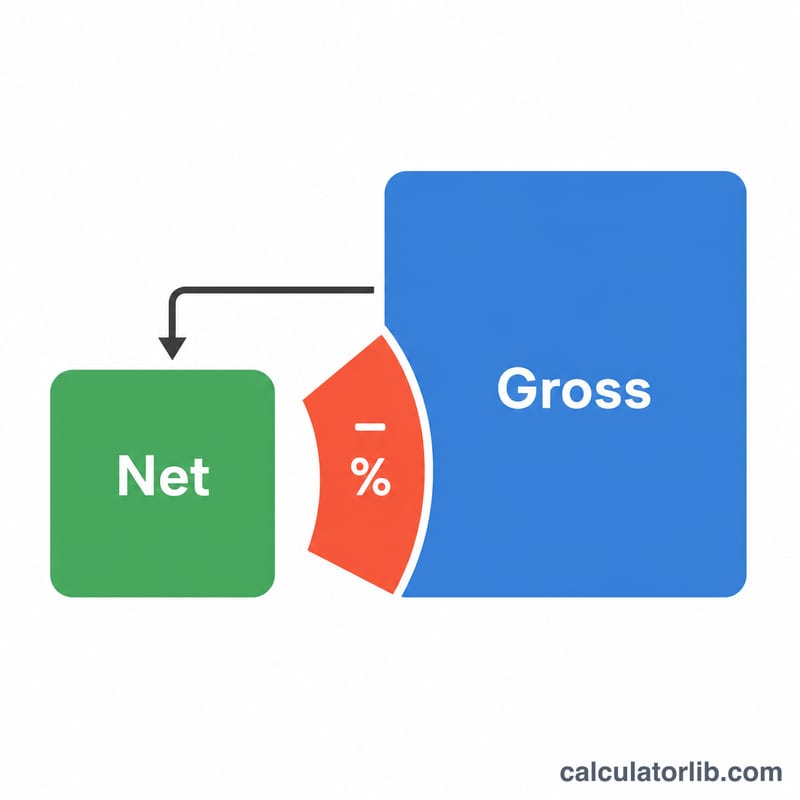
The math is a simple rearrangement. If deductions take a fraction r/100 of gross pay, then net = gross × (1 − r/100). Solving for gross gives:
$$\text{Gross} = \frac{\text{Net Salary}}{1 - \dfrac{\text{Deduction Rate (\%)}}{100}}$$
Because deductions are modelled as a flat percentage of gross, this is an approximation — real tax systems use progressive brackets and allowances, so treat the result as a close estimate rather than an exact payroll figure.
Worked Example
Suppose you want to take home $40,000 and your combined deduction rate is 20%. Then $$\text{Gross} = \frac{40{,}000}{1 - 0.20} = \frac{40{,}000}{0.80} = \$50{,}000$$ Total deductions are \(50{,}000 - 40{,}000 = \$10{,}000\), which is exactly 20% of the gross.
Key Terms: Gross, Net, and Deduction Rate
- Gross salary
- The total pay agreed with an employer before any tax, social contributions or other deductions are taken out.
- Net (take-home) salary
- The amount actually paid into your account after all deductions. It equals gross pay minus deductions.
- Effective deduction rate
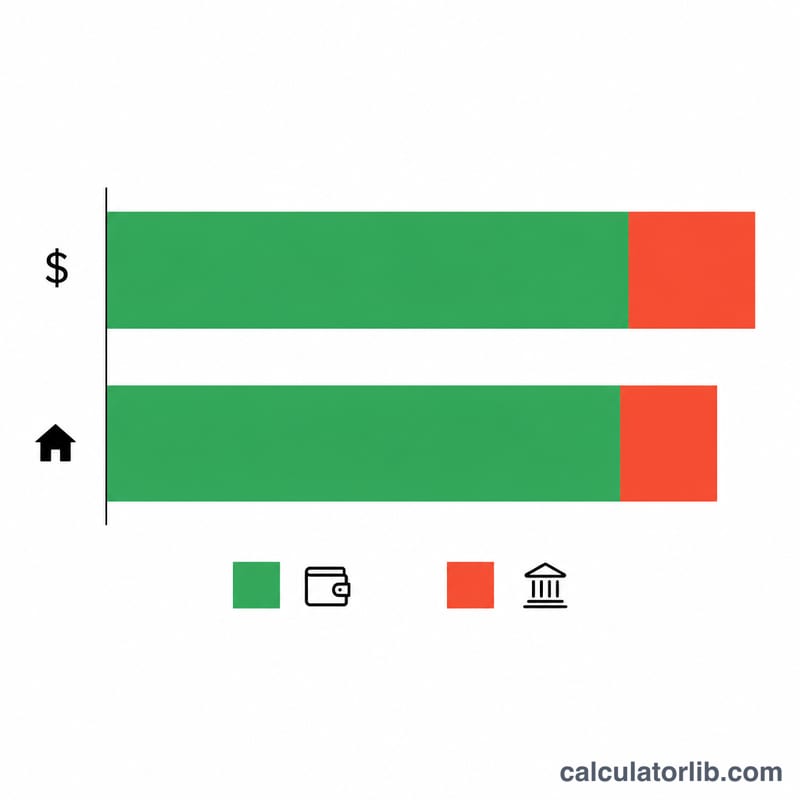
- Total deductions divided by gross pay, expressed as a percentage. In this calculator the rate is applied to the gross figure, not to the net figure. If you pay $2,000 in total deductions on $10,000 gross, the rate is 20%. Pre-tax items such as pension contributions, health insurance or union dues can be included in the rate if you want the result to cover everything between gross and take-home pay.
- Marginal tax rate
- The tax rate applied to the next unit of income. In a progressive system it is usually higher than the effective rate, so it should not be entered here unless all of your income is taxed at that one rate.
- Payroll / social contributions
- Mandatory charges withheld from pay, such as social security, pension or health insurance contributions. Their names, rates and caps vary by country.
- Gross-up
- Working backwards from a desired net amount to the gross amount needed to deliver it after deductions. The formula is:
\(\text{Gross} = \dfrac{\text{Net}}{1 - r}\), where \(r\) is the deduction rate as a decimal (for example, 25% gives \(r = 0.25\)).
Interpreting Your Result
The gross figure is the pre-deduction pay that would leave your chosen net amount if one flat deduction rate applied to everything. The total deductions implied are simply:
$$\text{Deductions} = \text{Gross} - \text{Net}$$
Example: a net of 3,000 at a 20% rate gives a gross of \(3000 \div 0.80 = 3750\), so deductions are 750, which is 20% of 3,750. At 40%, the same net needs \(3000 \div 0.60 = 5000\) gross, so deductions are 2,000.
The gross-to-net multiplier is \(\dfrac{1}{1 - r}\). It grows faster as the rate rises:
| Deduction rate | Multiplier (Gross ÷ Net) |
|---|---|
| 10% | ≈ 1.11× |
| 20% | 1.25× |
| 30% | ≈ 1.43× |
| 40% | ≈ 1.67× |
| 50% | 2.00× |
So moving from 20% to 40% does not double the required gross; it raises it by about a third (from 1.25× to 1.67× net). Each extra percentage point of deductions costs more than the one before.
Limits of the result: Real payroll calculations usually involve progressive tax brackets, tax-free allowances, contribution caps and thresholds, and benefits taxed differently from salary. A single flat rate is an approximation, so an actual payslip can differ. Use this figure for rough planning, such as comparing offers or setting a salary target, and confirm the exact numbers with your employer, payroll provider or a qualified tax professional. This is general information, not tax or financial advice.
Income and jobs: United States
Average income and unemployment in United States compared with the world, from the World Bank: a benchmark for the figures you enter above.
- GNI per capita 2025
- 88,810 USD
- GDP per capita, PPP 2025
- 90,027 intl. $
- World: 25,704
- Unemployment 2025
- 4.2%
- World: 4.8%
Latest change Up +7.1% 2025: 88,810 USD, against 82,910 USD in 2024. CalculatorLib computes this change from the two published figures.
In 2025, gross national income per person in United States was 88,810 US dollars a year, about 7,401 US dollars a month. World: 14,244 USD
| Year | GNI per capita (USD) | GDP per capita, PPP (intl. $) | Unemployment |
|---|---|---|---|
| 2025 | 88,810 | 90,027 | 4.2% |
| 2024 | 82,910 | 86,170 | 4.0% |
| 2023 | 79,950 | 82,587 | 3.6% |
| 2022 | 77,230 | 78,009 | 3.7% |
| 2021 | 71,510 | 71,441 | 5.3% |
| 2020 | 64,630 | 64,465 | 8.1% |
| 2019 | 65,840 | 65,228 | 3.7% |
| 2018 | 63,040 | 62,876 | 3.9% |
| 2017 | 58,860 | 60,048 | 4.4% |
| 2016 | 56,830 | 57,977 | 4.9% |
GNI per capita (Atlas method) is the average of all income in the economy, not a typical salary; PPP dollars adjust for local prices.
Income tax and social security: United States
- Top income tax rate 2025
- 43.65%
- from 8.7 × the average wage
- Employee social security 2025
- 7.65% · 1.45%
In 2025, the top statutory personal income tax rate in United States (central and local government combined) was 43.65%. It applies from 8.7 times the average wage of 73,520 USD, that is from about 642,101 USD a year.
Employee social security contribution rates for successive earnings bands, lowest band first; the band limits are not shown.
Top income tax rates in OECD countries
| Country | Top rate | Applies from (× average wage) | Year |
|---|---|---|---|
| Japan | 55.95% | 7.7 | 2025 |
| France | 55.37% | 12.9 | 2025 |
| South Korea | 49.5% | 19.0 | 2025 |
| Germany | 47.48% | 4.4 | 2025 |
| United Kingdom | 45% | 2.2 | 2025 |
| United States | 43.65% | 8.7 | 2025 |
| Türkiye | 40.76% | 5.6 | 2025 |
| Mexico | 35% | 20.6 | 2025 |
The top rate is the statutory rate on the highest earnings, not the rate most workers pay. OECD figures cover OECD member countries only.
United States and other countries
GNI per capita in current US dollars (Atlas method) — each country’s latest published year.
- United States 88,810 USD (2025)
- France 48,630 USD (2025)
- Japan 38,340 USD (2025)
- South Korea 37,880 USD (2025)
- Saudi Arabia 36,070 USD (2025)
- Türkiye 16,300 USD (2025)
- Russia 15,960 USD (2025)
- World 14,244 USD (2025)
- China 14,230 USD (2025)
- Mexico 13,730 USD (2025)
- Vietnam 4,970 USD (2025)
- India 2,760 USD (2025)
No published figure yet for Taiwan.
Years can differ between rows: each figure is shown with its own year. The same World Bank indicator for every country.
Latest figure: 2025 Data last updated 2026-10-18 · current
Source: The World Bank Group CC BY 4.0; OECD, Tax Database CC BY 4.0
Monthly figures are computed by CalculatorLib from these data. The top-rate threshold in national currency (multiple × average wage) is computed by CalculatorLib from these data.
Source details and methodology
- The World Bank Group — World Development Indicators (NY.GNP.PCAP.CD, NY.GDP.PCAP.PP.CD, SL.UEM.TOTL.ZS)
- OECD, Tax Database — Top statutory personal income tax rate; employee social security contribution rates
FAQ
Why is the gross more than my net divided by the tax rate? Because deductions apply to the gross, not the net. You must divide by \((1 - \text{rate})\), not multiply, to recover the larger pre-tax amount.
What rate should I enter? Use your effective overall deduction rate — total deductions divided by gross — not your top marginal tax bracket.
Is this country-specific? No. It is a universal percentage-based calculation, so it works for any currency or jurisdiction as long as your deduction rate is realistic.