

What Is a Gross-Up Calculator?
This tool applies to US payroll situations. A "gross-up" works backward: instead of starting with gross pay and subtracting taxes, you start with the exact net (take-home) amount you want an employee to receive and calculate the larger gross figure required so that, after withholding, the desired net remains. Employers commonly gross-up bonuses, relocation reimbursements, gift cards, and severance so the recipient is not left short after taxes.
How to Use It
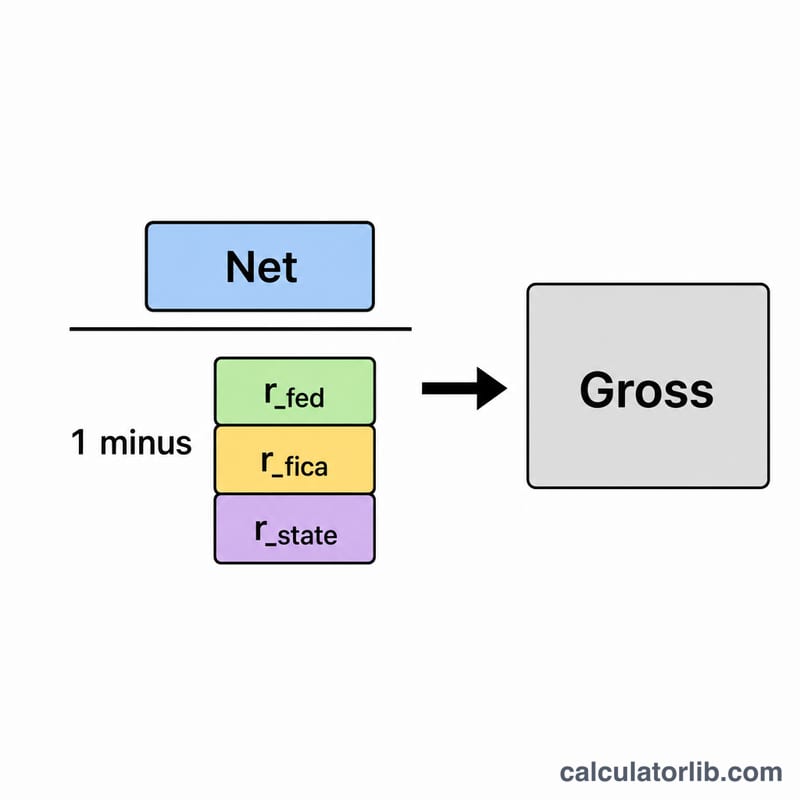
Enter the desired net pay, then the three withholding components as percentages: federal income tax (use the supplemental flat rate of 22% if unsure), FICA (Social Security + Medicare = 7.65%), and your state income tax rate. The calculator adds the rates together, subtracts them from 100%, and divides your target net by that fraction to produce the gross amount.
The Formula Explained
$$\text{Gross} = \frac{\text{Net Pay}}{1 - \left(\dfrac{\text{Federal \%} + \text{FICA \%} + \text{State \%}}{100}\right)}$$ If the combined withholding rate is 34.65%, then only 65.35% of each gross dollar reaches the employee, so you must pay \(1 / 0.6535 \approx 1.530\) dollars gross for every dollar of net. The combined rate must be below 100% or the formula has no valid solution.
Worked Example
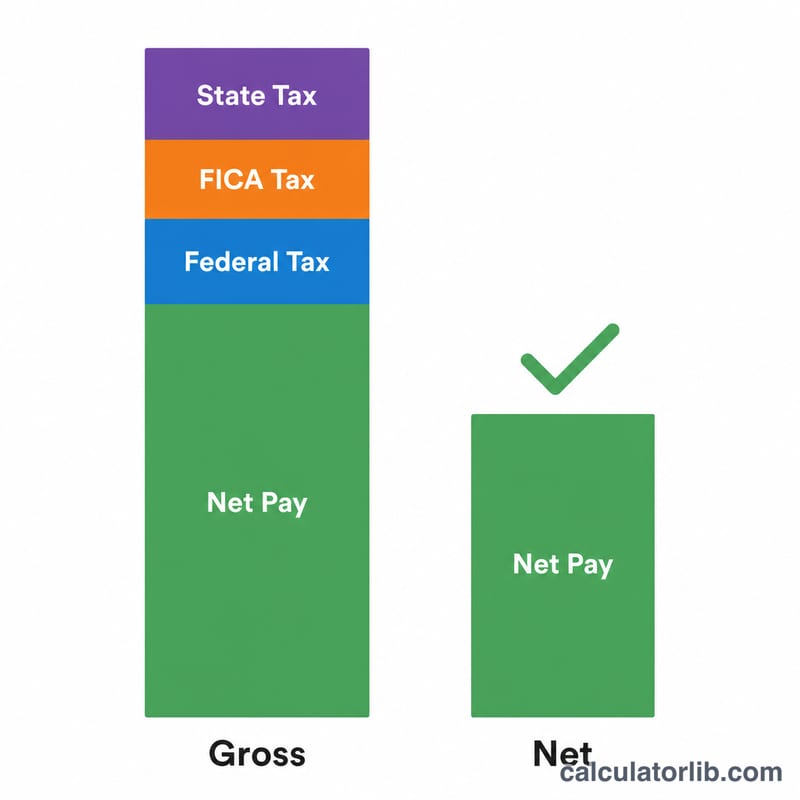
You want an employee to net $1,000 from a bonus. Federal = 22%, FICA = 7.65%, State = 5%, so the combined rate is 34.65%. $$\text{Gross} = 1000 / (1 - 0.3465) = 1000 / 0.6535 = \$1{,}530.22$$ Total withholding is $530.22, leaving the desired $1,000 net.
FAQ
Is this exact for real paychecks? It's a close estimate. Real payroll uses tax brackets, wage bases (Social Security caps), and pre-tax deductions, so use it as a planning guide.
What federal rate should I use for a bonus? The IRS supplemental wage flat rate is 22% (37% on amounts over $1 million).
Why can't the combined rate be 100%? Dividing by zero (or a negative) is undefined — no gross amount could ever produce a positive net.