What Is the 40x Rent Rule?
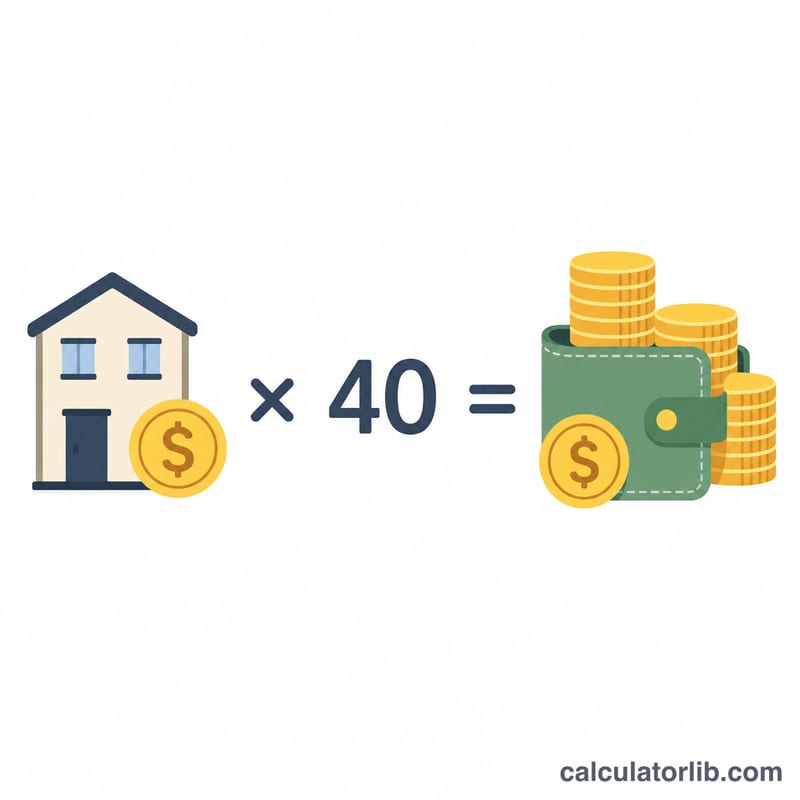
The 40x rent rule is a common income requirement used by landlords and property managers, especially in the United States and particularly in cities like New York. It states that to qualify for an apartment, your gross annual income should be at least 40 times the monthly rent. This calculator instantly converts any monthly rent figure into the gross annual salary you would typically need to be approved.
How to Use This Calculator
Enter the monthly rent for the apartment or home you're considering. The calculator multiplies it by 40 to give the required gross annual salary, and also shows the equivalent required gross monthly income so you can compare it to your paycheck before taxes.
The Formula Explained
The math is simple: $$\text{Required Annual Salary} = \text{Monthly Rent} \times 40$$ The "40x" is functionally equivalent to keeping rent at about 30% of gross income — since 12 monthly rent payments divided by (rent × 40) is roughly 30%. Landlords use it as a quick affordability screen.
Worked Example
Suppose the monthly rent is $2,000. Multiply by 40: $$2{,}000 \times 40 = \$80{,}000$$ required gross annual salary. Divided by 12, that's about $6,667 in required gross monthly income.
Required Salary at Different Rent Levels
The 40x rule, common among landlords in US rental markets (especially large cities such as New York), says your gross annual income should be at least 40 times the monthly rent. The formula is \(\text{Required Annual Salary} = \text{Monthly Rent} \times 40\). Dividing by 12 gives the gross monthly income equivalent.
| Monthly Rent | Required Gross Annual Salary (40x) | Required Gross Monthly Income |
|---|---|---|
| $1,000 | $40,000 | $3,333.33 |
| $1,500 | $60,000 | $5,000.00 |
| $2,000 | $80,000 | $6,666.67 |
| $2,500 | $100,000 | $8,333.33 |
| $3,000 | $120,000 | $10,000.00 |
| $4,000 | $160,000 | $13,333.33 |
Example: for $2,000 rent, \(\$2{,}000 \times 40 = \$80{,}000\) per year, and \(\$80{,}000 \div 12 \approx \$6{,}666.67\) per month. These figures are gross (before taxes).
Common Landlord Income Multipliers Compared
Landlords express income requirements differently. A multiplier of \(m\) on monthly rent means rent may be at most \(12/m\) of gross income. The 40x rule is exactly the same as requiring rent to be no more than 30% of gross income. The table uses a sample rent of $2,000 per month.
| Multiplier | Required Annual Salary at $2,000 Rent | Implied Rent-to-Gross-Income |
|---|---|---|
| 36x | $72,000 | \(12/36 = 33.3\%\) |
| 40x (same as the 30% rule) | $80,000 | \(12/40 = 30\%\) |
| 45x | $90,000 | \(12/45 \approx 26.7\%\) |
| 50x | $100,000 | \(12/50 = 24\%\) |
Requirements vary by landlord, building, city, and sometimes by applicant type. Some landlords accept a guarantor, a larger security deposit, or proof of savings in place of meeting the multiplier. Always check the specific listing's criteria. This is general information, not financial advice.
FAQ
Is the 40x rule a law? No. It's a guideline many landlords adopt, but requirements vary — some use 36x, 45x, or a 30% rent-to-income ratio instead.
Does this use gross or net income? The 40x rule is based on gross (pre-tax) annual income.
What if I don't meet the requirement? Options include a guarantor, a co-signer, paying several months upfront, or showing additional savings.