

What This Calculator Does
The Minimum Wage Annual Income Calculator converts an hourly wage into an estimated gross yearly income. It is useful for budgeting, comparing job offers, checking whether a minimum-wage role meets your living needs, or projecting earnings at any hourly rate. The default rate of $7.25 reflects the long-standing US federal minimum wage, but you can enter any rate and currency value to suit your own country or state.
How to Use It
Enter three numbers: your hourly wage rate, the number of hours you work each week, and the number of weeks you work each year. A full-time year is usually 52 weeks; reduce this if you take unpaid time off. The calculator returns your gross annual income along with the equivalent weekly pay and an average monthly figure. All results are before taxes and deductions.
The Formula Explained
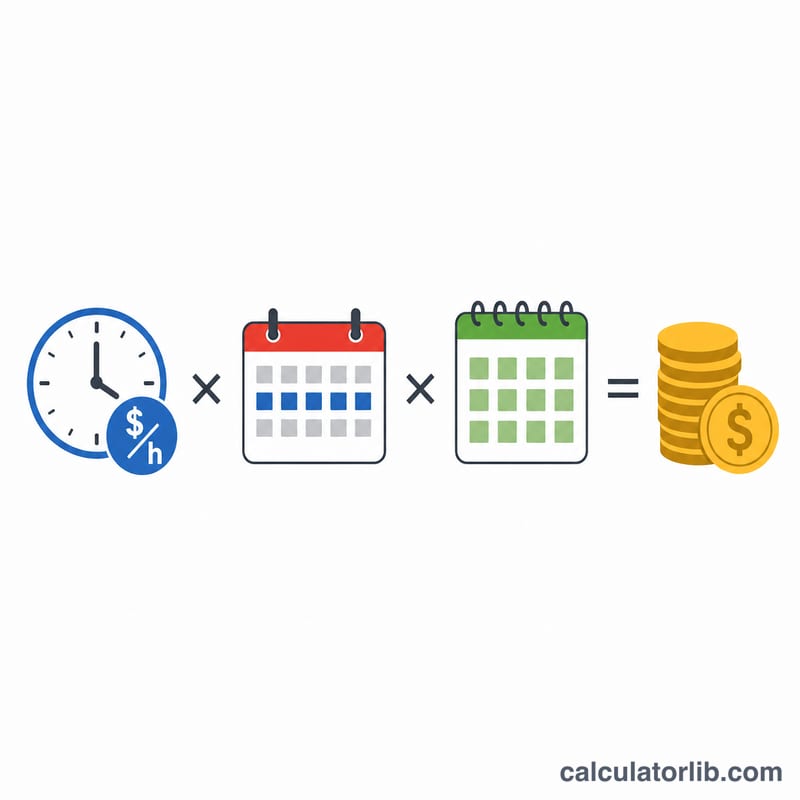
The core calculation is simple:
$$\text{Annual} = \text{Rate} \times \text{Hours per Week} \times \text{Weeks per Year}$$Weekly pay is just \(\text{Rate} \times \text{Hours}\), and the average monthly figure divides the annual total by 12. Because months vary in length, the monthly number is a smoothed average rather than an exact paycheck amount.
Worked Example
Suppose you earn $7.25 per hour, work 40 hours per week, and work all 52 weeks of the year. Annual income =
$$7.25 \times 40 \times 52 = \$15{,}080$$Your weekly pay is \(7.25 \times 40 = \$290\), and your average monthly pay is \(15{,}080 \div 12 \approx \$1{,}256.67\).
FAQ
Is this take-home pay? No. These are gross figures before income tax, payroll taxes, and other deductions. Actual take-home pay will be lower.
What if I work part-time? Just enter your real hours per week. For example, 20 hours at $7.25 for 52 weeks gives $7,540 per year.
Why allow fewer than 52 weeks? Many workers take unpaid leave or seasonal breaks. Lowering the weeks-per-year value gives a more realistic estimate of actual earnings.