

What is the Blended Overtime Rate?
When an employee works at two or more different pay rates in a single workweek, overtime cannot simply be based on the highest or most recent rate. Instead, the overtime rate is built from a blended rate — also called the weighted-average or "regular rate" — which spreads all earnings evenly across every hour worked. This is the method required under the US Fair Labor Standards Act (FLSA) for non-exempt employees, and it is widely used elsewhere as a fair-pay standard. This calculator works for any currency; the dollar sign is just for display.
How to Use This Calculator
Enter each pay rate and the number of hours worked at that rate (up to three rates). Then enter the overtime hours and the overtime multiplier (1.5 for time-and-a-half, 2 for double time). The calculator adds up the total straight-time pay and hours, divides to find the blended rate, and applies the multiplier to give your overtime rate and overtime pay.
The Formula Explained
First, total straight-time pay = (rate×hours) summed across all jobs. Total hours = the sum of all hours. The blended rate is total pay divided by total hours. Multiply that blended rate by your multiplier (e.g. 1.5) to get the overtime rate, then multiply by overtime hours for the overtime dollars.
$$\text{OT Rate} = \frac{\sum (r_i \cdot h_i)}{\sum h_i} \times \text{OT Multiplier}$$ $$\text{where}\quad \left\{ \begin{aligned} \sum (r_i \cdot h_i) &= \text{Rate 1}\cdot\text{Hrs 1} + \text{Rate 2}\cdot\text{Hrs 2} + \text{Rate 3}\cdot\text{Hrs 3} \\ \sum h_i &= \text{Hrs 1} + \text{Hrs 2} + \text{Hrs 3} \end{aligned} \right.$$ $$\text{OT Pay} = \left(\frac{\sum (r_i \cdot h_i)}{\sum h_i} \times \text{OT Multiplier}\right) \times \text{OT Hours}$$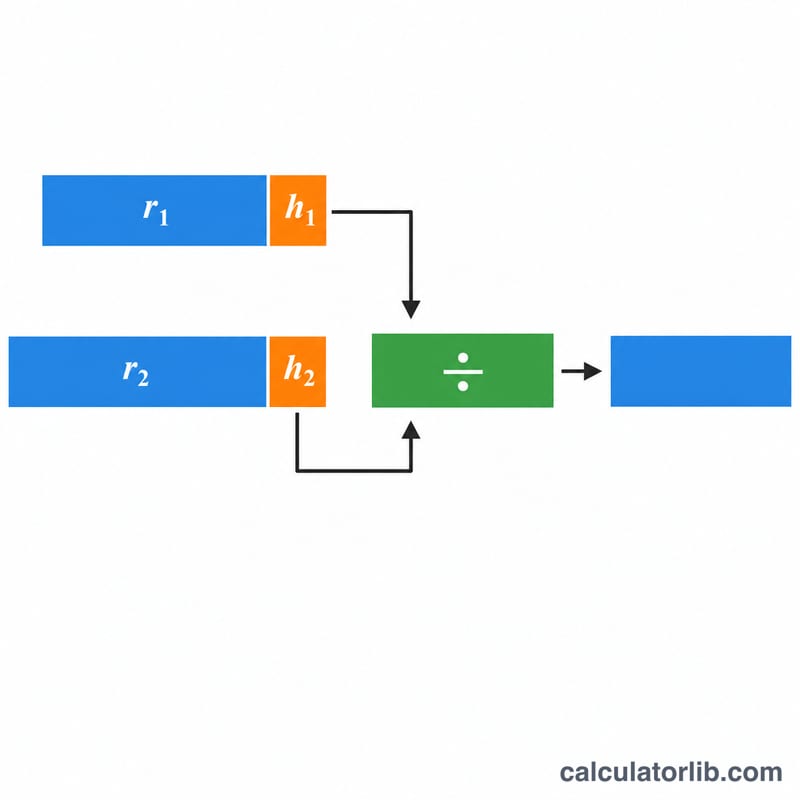
Worked Example
Suppose someone works 20 hours at $15/hr ($300) and 20 hours at $20/hr ($400). Total straight pay = $700 over 40 hours, so the blended rate is $17.50/hr. At a 1.5 multiplier the overtime rate is $26.25/hr. For 5 overtime hours, overtime pay = $131.25.
$$\text{Blended Rate} = \frac{(15 \cdot 20) + (20 \cdot 20)}{20 + 20} = \frac{300 + 400}{40} = \frac{700}{40} = 17.50$$ $$\text{OT Rate} = 17.50 \times 1.5 = 26.25$$ $$\text{OT Pay} = 26.25 \times 5 = 131.25$$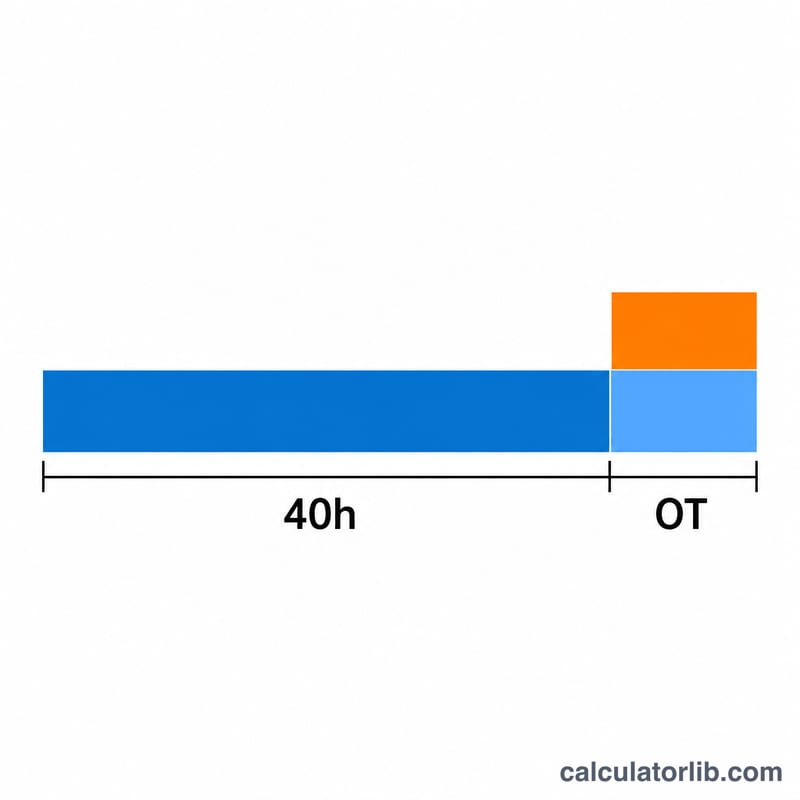
Blended Rate Across Common Scenarios
When a non-exempt employee works at more than one pay rate in a single workweek, the FLSA regular rate is the weighted average of all rates worked. The overtime (OT) rate is that blended regular rate multiplied by the overtime multiplier (typically 1.5). The table below shows realistic combinations, with the blended rate, the OT rate at 1.5×, and the OT pay for 5 overtime hours.
| Scenario | Rates & hours | Total straight-time | Total hours | Blended rate | OT rate (1.5×) | OT pay (5 hrs) |
|---|---|---|---|---|---|---|
| Two rates, unequal hours | $15 × 30 hrs $20 × 15 hrs |
$750.00 | 45 | $16.67 | $25.00 | $125.00 |
| Two rates, equal hours | $15 × 20 hrs $20 × 20 hrs |
$700.00 | 40 | $17.50 | $26.25 | $131.25 |
| Three rates, unequal hours | $12 × 20 hrs $18 × 15 hrs $25 × 10 hrs |
$760.00 | 45 | $16.89 | $25.33 | $126.67 |
| Three rates, equal hours | $12 × 15 hrs $18 × 15 hrs $25 × 15 hrs |
$825.00 | 45 | $18.33 | $27.50 | $137.50 |
Note that the blended rate always lands between the lowest and highest rate worked, weighted toward whichever rate accounts for more hours.
Interpreting Your Blended Overtime Rate
The blended rate this calculator produces is what the Fair Labor Standards Act (FLSA) calls the regular rate of pay. For a non-exempt employee who works at two or more rates in the same workweek, the regular rate is not the highest rate, nor the most recent rate — it is the weighted average of every rate, found by dividing total straight-time earnings by total hours worked.
Why it can be lower than your highest rate. Because the regular rate is a weighted average, hours paid at a lower rate pull the average down. For example, working mostly at \(\$15\) and only a few hours at \(\$25\) yields a blended rate much closer to \(\$15\) than to \(\$25\). This is expected and correct under the FLSA — overtime is owed on the average, not on the peak rate.
Only the 0.5× premium is the extra OT obligation. In many payroll systems the employee has already been paid straight-time (1.0×) for all hours, including the overtime hours, at their various rates. In that case the remaining overtime obligation is just the half-time premium — the blended regular rate × 0.5 × overtime hours. The 1.5× OT rate shown here represents the full value of an overtime hour; subtract the straight-time already paid to find the additional amount owed.
These figures apply to FLSA non-exempt employees. Some states (for example, California) require daily overtime or double-time and use their own rate rules, which can differ from the federal weekly standard. This tool provides general, informational estimates only and is not legal, tax, or payroll advice; confirm specific obligations with your payroll department or a qualified professional.
Key Terms & Definitions
- Blended (weighted-average) rate
- The single hourly rate found by dividing total straight-time earnings across all jobs or pay rates by the total hours worked in the workweek. It is the basis for calculating overtime when more than one rate applies.
- FLSA regular rate
- The hourly rate, as defined by the Fair Labor Standards Act, on which overtime must be computed. It includes most forms of compensation (such as multiple hourly rates and certain bonuses) and, for multi-rate work, equals the blended rate.
- Non-exempt employee
- A worker who is covered by the FLSA's minimum-wage and overtime protections and is therefore entitled to overtime pay for hours over 40 in a workweek. Contrast with exempt employees, who are not owed overtime.
- Straight-time pay
- Earnings for hours worked at the basic (1.0×) rate, before any overtime premium is added. For multi-rate workers it is the sum of each rate multiplied by its hours.
- Overtime multiplier (1.5× / 2×)
- The factor applied to the regular rate for overtime hours. Federal law requires at least 1.5× ("time and a half"); some employers or state laws apply 2× ("double time") in certain situations.
- Workweek
- A fixed, recurring period of 168 hours — seven consecutive 24-hour days — that an employer designates for measuring overtime. Overtime under the FLSA is calculated per workweek, not by pay period or day.
FAQ
Do I include overtime hours in the blended-rate hours? The straight-time hours used to compute the blended rate are your regular worked hours at each rate. Many employers compute the blended rate from all worked hours and add a \(0.5\times\) premium; this tool uses the straightforward full-rate × multiplier method.
What multiplier should I use? 1.5 (time-and-a-half) is the common legal minimum in the US; some agreements use 2.0 for holidays or double time.
Is this legal advice? No. It is an estimate tool. Always confirm with your payroll department or applicable labor regulations.