
What Is the Cutoff Frequency?
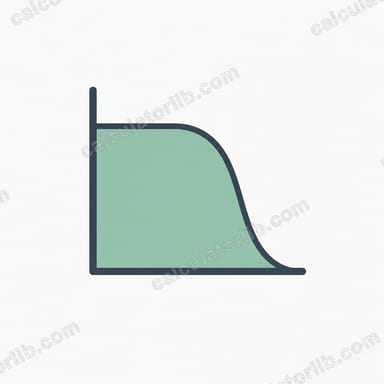
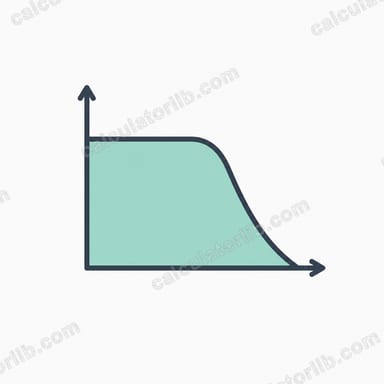
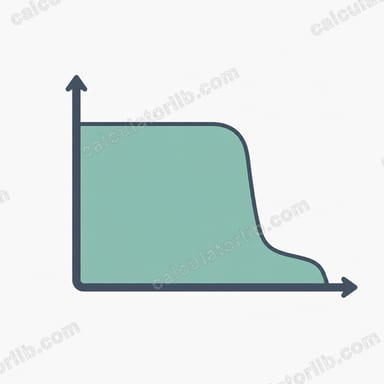
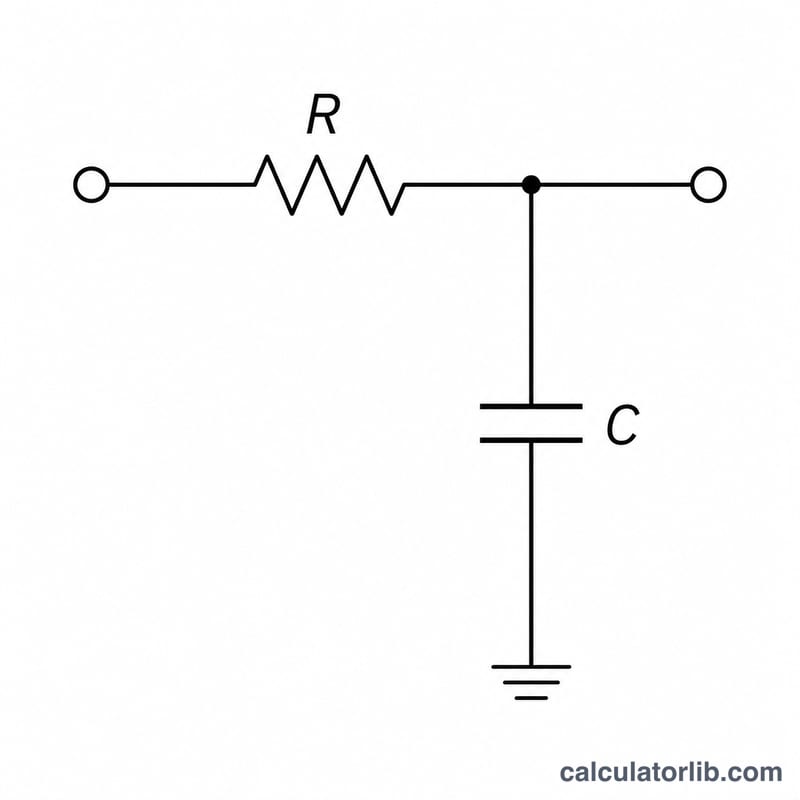
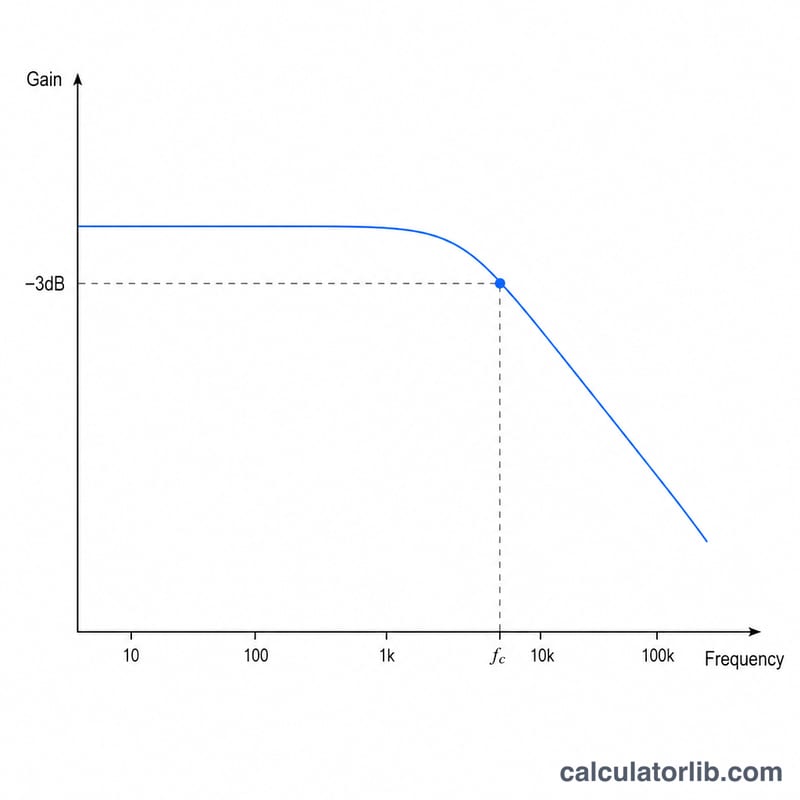
The cutoff frequency (also called the corner or -3dB frequency) of a first-order RC filter is the point at which the output signal power drops to half of the input power — equivalent to a voltage drop of about 70.7%. Below this frequency a low-pass filter passes signals freely; above it, signals are increasingly attenuated. This calculator works for both RC low-pass and high-pass configurations, since both share the same cutoff formula.
How to Use It
Enter the resistance R in ohms and the capacitance C in farads. The calculator returns the cutoff frequency in hertz along with the RC time constant. Remember to convert prefixes: 1 kΩ = 1000 Ω, 1 µF = 0.000001 F, 1 nF = 0.000000001 F.
The Formula Explained
The cutoff frequency is given by $$f_c = \frac{1}{2\pi \, \text{R }(\Omega) \cdot \text{C (F)}}$$ The factor \(2\pi\) converts the angular cutoff frequency (\(\omega_c = 1/RC\), in radians per second) into ordinary frequency in hertz. The product \(RC\) is the time constant \(\tau\), so the formula can also be written \(f_c = \frac{1}{2\pi\tau}\).
Worked Example
Suppose \(R = 1000 \ \Omega\) and \(C = 1 \ \mu\text{F}\) (\(0.000001 \ \text{F}\)). Then \(RC = 0.001 \ \text{s}\), and \(2\pi RC \approx 0.0062832\). So $$f_c = \frac{1}{0.0062832} \approx 159.15 \ \text{Hz}.$$ This is a very common audio filter value.
FAQ
Does this work for high-pass filters too? Yes — a simple first-order RC high-pass filter has the same cutoff frequency formula as the low-pass version.
What units should I use? Ohms for resistance and farads for capacitance. Convert microfarads and nanofarads to farads first.
What is the time constant? \(\tau = RC\) is the time (in seconds) for the circuit to charge or discharge to about 63.2% of its final value.