
What is the Cyclotron Frequency?
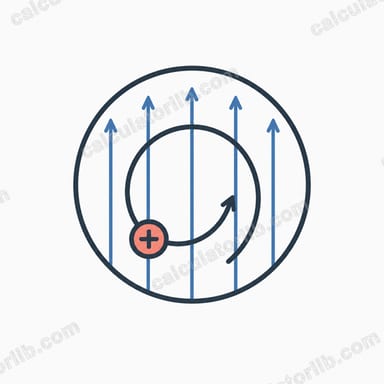
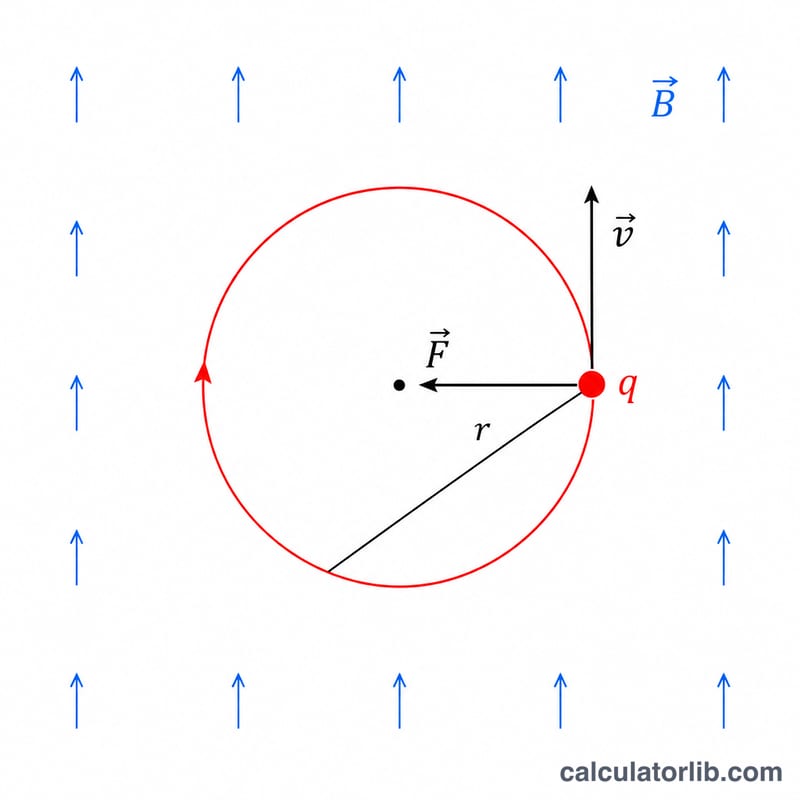
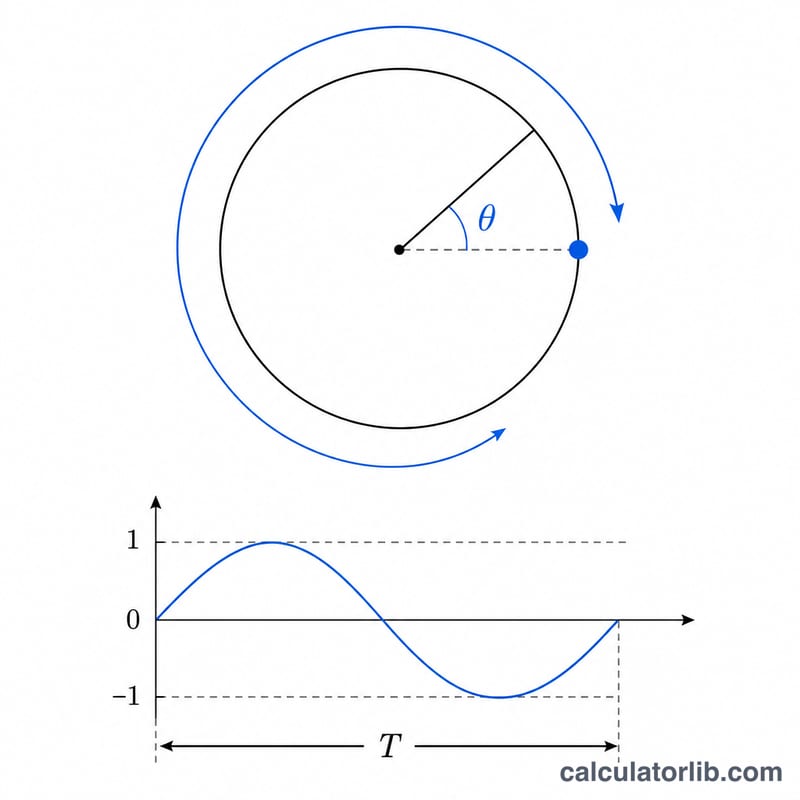
The cyclotron frequency is the rate at which a charged particle circles around magnetic field lines in a uniform magnetic field. When a particle of charge q and mass m moves through a magnetic field B, the magnetic force provides the centripetal force, causing it to travel in a circle. Remarkably, this frequency does not depend on the particle's speed or radius — only on its charge-to-mass ratio and the field strength.
How to Use This Calculator
Enter the particle's charge q in Coulombs, the magnetic field strength B in Tesla, and the particle's mass m in kilograms. The calculator returns the cyclotron frequency f in Hertz, the angular frequency ω in radians per second, and the orbital period T in seconds. The defaults are set to the electron (\(q = 1.602176634 \times 10^{-19}\ \text{C}\), \(m = 9.109 \times 10^{-31}\ \text{kg}\)).
The Formula Explained
The cyclotron frequency is given by $$f = \dfrac{\text{Charge }q \cdot \text{Field }B}{2\pi \cdot \text{Mass }m}$$ The angular form is \(\omega = qB/m\), and since \(f = \omega/(2\pi)\), the two are simply related. The period is \(T = 1/f\). Because the frequency is independent of velocity, all particles of the same type orbit at the same frequency regardless of energy — the principle that makes cyclotron particle accelerators work.
Worked Example
For an electron (\(q = 1.602176634 \times 10^{-19}\ \text{C}\), \(m = 9.10938 \times 10^{-31}\ \text{kg}\)) in a \(B = 0.5\ \text{T}\) field: $$f = \frac{1.602176634 \times 10^{-19} \times 0.5}{2\pi \times 9.10938 \times 10^{-31}} \approx 1.399 \times 10^{10}\ \text{Hz}$$ or about 14 GHz.
FAQ
Does the frequency depend on the particle's speed? No. For non-relativistic motion the cyclotron frequency is independent of speed and orbit radius — a key feature exploited in cyclotrons.
What is angular frequency vs. frequency? Angular frequency \(\omega\) is in radians per second, while frequency \(f\) is in cycles per second (Hz). They satisfy \(\omega = 2\pi f\).
Why might my result differ slightly? Small differences arise from the exact values used for fundamental constants like the electron mass.