
What is the RLC Impedance Calculator?
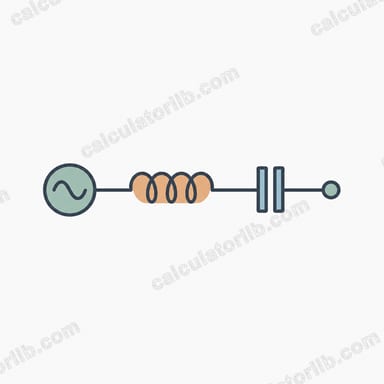
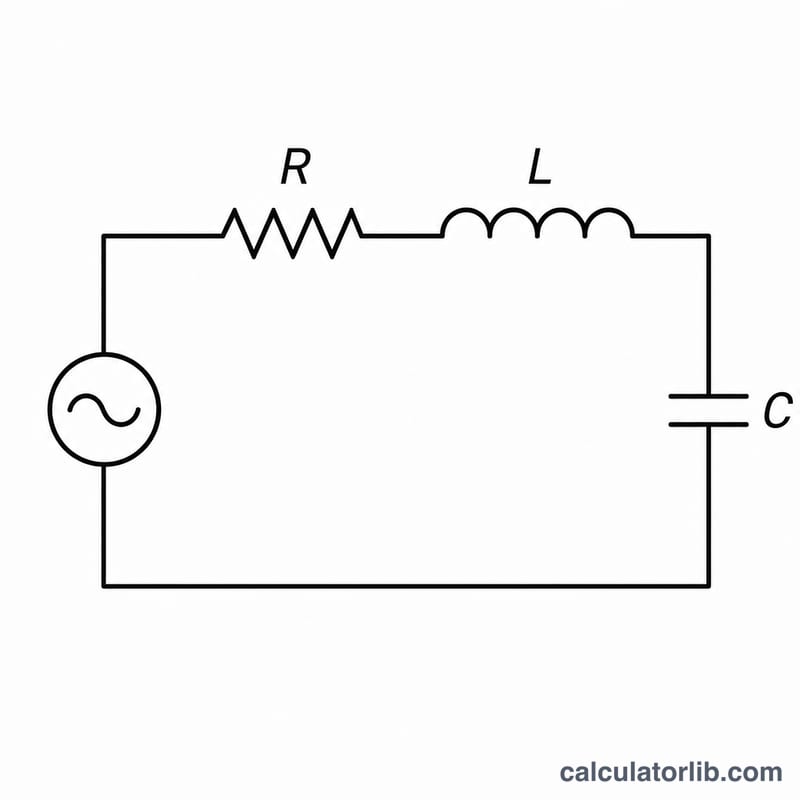
This tool computes the total impedance (Z) of a series RLC circuit — a circuit containing a resistor (R), an inductor (L) and a capacitor (C) driven at a frequency f. Impedance is the AC equivalent of resistance: it tells you how much the circuit opposes alternating current, measured in ohms (Ω). The calculator also returns the inductive and capacitive reactances and the phase angle between voltage and current.
How to use it
Enter the resistance in ohms (Ω), the inductance in henries (H), the capacitance in farads (F), and the source frequency in hertz (Hz). Click calculate to see the total impedance along with XL, XC, the net reactance and the phase angle. Use SI base units — for example, 1 µF = 0.000001 F and 1 mH = 0.001 H.
The formula explained
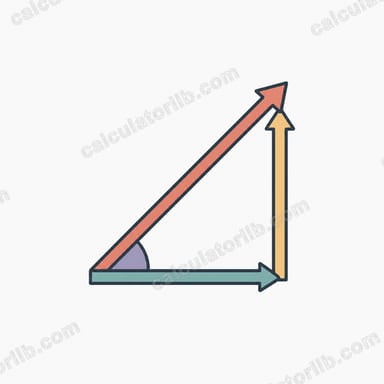
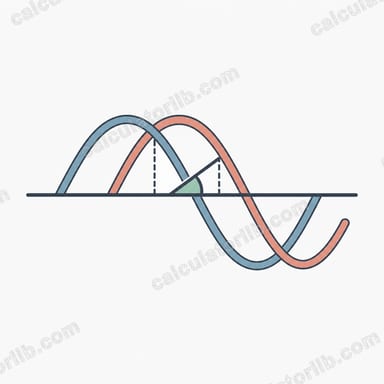
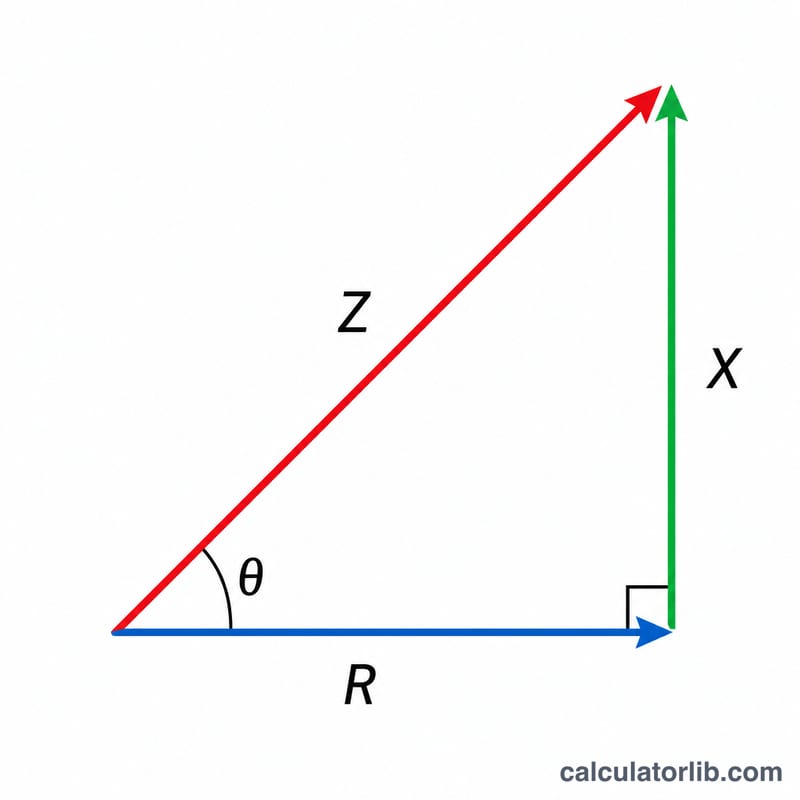
The inductive reactance is \(X_L = 2\pi f L\) and the capacitive reactance is \(X_C = \frac{1}{2\pi f C}\). Because the inductor and capacitor push current in opposite phase, their net reactance is \(X = X_L - X_C\). Combining with resistance using the Pythagorean theorem gives $$Z = \sqrt{R^2 + X^2}$$ The phase angle is \(\varphi = \arctan(X / R)\): positive means inductive (current lags), negative means capacitive (current leads). When \(X_L = X_C\) the circuit is at resonance and \(Z = R\), its minimum value.
Worked example
For R = 10 Ω, L = 0.001 H, C = 0.000001 F and f = 1000 Hz: \(\omega = 2\pi \cdot 1000 \approx 6283.19\). \(X_L = 6283.19 \cdot 0.001 \approx 6.2832\ \Omega\); \(X_C = \frac{1}{6283.19 \cdot 0.000001} \approx 159.155\ \Omega\). Net reactance \(\approx -152.872\ \Omega\), so $$Z = \sqrt{10^2 + 152.872^2} \approx 153.2\ \Omega$$ and \(\varphi \approx -86.26^\circ\) (strongly capacitive).
FAQ
Is this for series or parallel circuits? This calculator models a series RLC circuit, where R, L and C carry the same current.
What units should I use? Ohms, henries, farads and hertz. Convert µF and mH to base units first.
What happens at resonance? When \(X_L = X_C\), the reactances cancel, impedance equals R and the phase angle is zero.