
What this calculator does
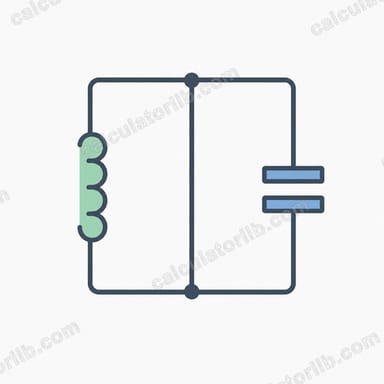
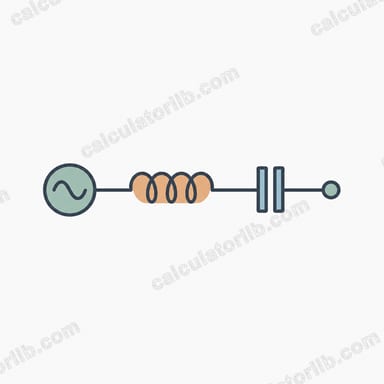
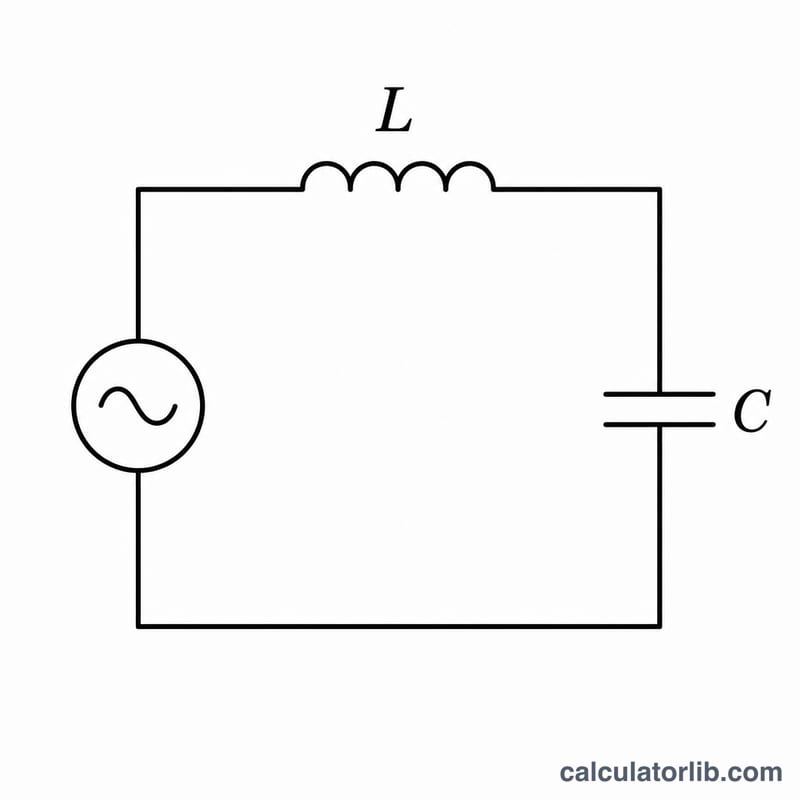
This tool computes the impedance magnitude |Z| and phase angle of an ideal inductor (L) and capacitor (C) connected in series and driven by a sinusoidal source at frequency \(f\). Because an ideal series LC circuit has no resistance, the impedance is purely reactive: the result is the difference between the inductive reactance and the capacitive reactance.
How to use it
Enter the inductance, capacitance and frequency, picking the matching unit from each dropdown (henries with mH/uH/nH, farads with mF/uF/nF/pF/fF, hertz with kHz/MHz/GHz). The calculator converts every value to SI base units, then returns |Z| in ohms and the phase in degrees.
The formula explained
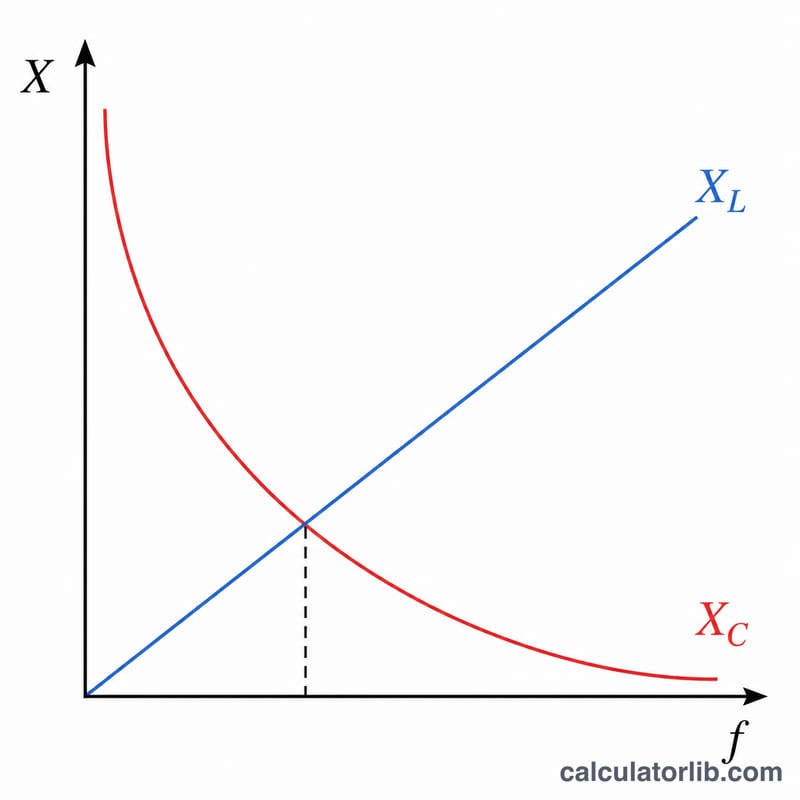
The angular frequency is \(\omega = 2\pi f\). The inductive reactance is \(X_L = \omega L\) and the capacitive reactance is \(X_C = \frac{1}{\omega C}\). The series impedance is purely imaginary, \(Z = j\left(\omega L - \frac{1}{\omega C}\right)\), so its magnitude is $$|Z| = \left| \omega L - \frac{1}{\omega C} \right|$$ The phase is +90 deg when the inductor dominates, -90 deg when the capacitor dominates, and 0 deg at series resonance where \(\omega L = \frac{1}{\omega C}\).
Worked example
With \(L = 10\ \text{mH} = 0.01\ \text{H}\), \(C = 1\ \mu\text{F} = 1\times 10^{-6}\ \text{F}\) and \(f = 5\ \text{kHz}\): $$\omega = 2\pi \cdot 5000 = 31415.93\ \text{rad/s}$$ $$X_L = 314.159\ \Omega \quad\text{and}\quad X_C = 31.831\ \Omega$$ $$|Z| = |314.159 - 31.831| = 282.328\ \Omega$$ Since \(X_L > X_C\) the circuit is net inductive, so the phase is +90 deg.
FAQ
Why is the phase always +/-90 degrees? An ideal LC circuit has zero resistance, so its impedance is purely reactive and the phase can only be +90, -90, or 0 at resonance.
What happens at resonance? When \(\omega L\) equals \(\frac{1}{\omega C}\), the reactances cancel and |Z| drops to zero, the ideal series-resonance short.
Why does |Z| go to infinity at DC? At zero frequency the capacitor blocks current completely (open circuit), so the impedance is infinite.